How to Check Lexus GX Weight Easily for Towing, Performance
Most people who buy a Lexus GX already know it is a substantial vehicle. You feel it when you climb in. You hear it when a door closes with that particular solid thud that body-on-frame SUVs have and crossovers spend fortunes trying to imitate.
What most GX owners do not fully understand, at least not right away, is exactly what the Lexus GX weight figures mean in practical terms and how those numbers connect to everything from towing a boat to braking safely on a wet highway.
Lexus GX weight is not a single number. It is a set of numbers, each telling you something different about how the vehicle behaves, what it can safely carry, and where its limits sit.
Curb weight, gross vehicle weight rating, payload capacity, gross combined weight rating, tongue weight — each of these measurements has a specific meaning, and confusing them with each other is how people end up towing more than their hitch can handle or overloading a vehicle they thought had plenty of capacity.
Also Read: How to Find the Best Lexus GX Inventory Near You in 2026
Short Answer About Lexus GX Weight
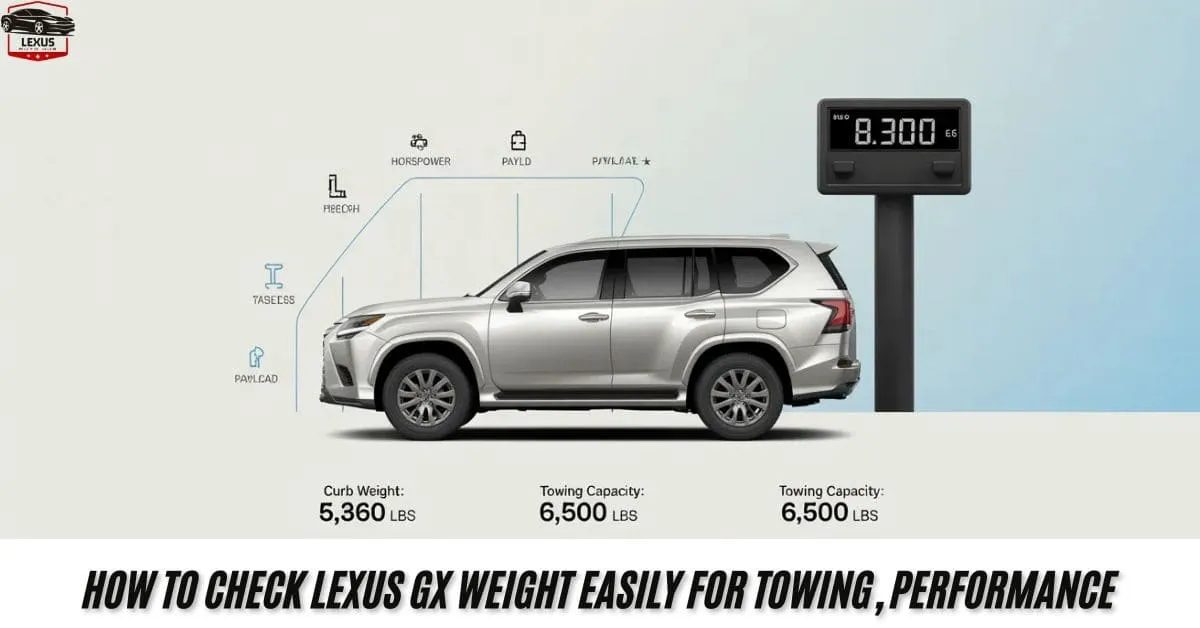
The Lexus GX 460 has a curb weight of approximately 5,100–5,300 lbs (2,313–2,404 kg), depending on the model and trim. This weight affects towing capacity, fuel efficiency, and overall handling.
If you want, I can also give a one-line super-short version perfect for FAQs or quick reference. Do you want me to do that?
Why Lexus GX Weight Matters More Than Most Owners Realize

There is a tendency among SUV buyers to treat weight as a passive characteristic — something the manufacturer figured out and stamped on a door jamb that you never need to think about again. That thinking works fine right up until the moment it does not. And when it stops working, the consequences can be serious.
Lexus GX weight plays a direct role in three areas that every owner should care about: towing safety, braking performance, and tire load management.
When you exceed the towing capacity that the GX’s weight ratings support, you are not just bending a rule. You are asking the transmission, the brakes, the frame, and the cooling system to handle loads they were not designed for. Over time, that causes premature wear. In a single event, it can cause loss of vehicle control.
The same principle applies to payload. The Lexus GX is a genuinely capable hauler for a luxury SUV, but it has real limits. Loading it with passengers, luggage, a roof rack full of gear, and a full tank of fuel adds up faster than most people expect. Understanding Lexus GX weight means understanding where those limits are before you approach them, not after you have already exceeded them.
Performance is affected too. A GX that is loaded to or near its gross vehicle weight rating handles differently than one running lightly. Suspension response changes.
Braking distances increase. The way the vehicle sits and steers shifts in ways that can catch an unprepared driver off guard. Knowing your Lexus GX weight situation at any given moment is part of driving it well.
Also Read: 2023 Lexus RX 350 Horsepower: Impressive Performance
Lexus GX Weight Figures: What Each Number Actually Means
Before getting into how to find and check the Lexus GX weight specifications on your specific vehicle, it helps to understand what each weight category represents.
These are not interchangeable terms, and using the wrong number when making towing or loading decisions is a common and potentially dangerous mistake.
Curb Weight
Curb weight is the weight of the Lexus GX with a full tank of fuel, all standard fluids topped off, and no passengers or cargo. It is the baseline weight of the vehicle as it leaves the factory and drives off the lot. For the current generation GX, curb weight runs between approximately 4,740 pounds and 5,100 pounds depending on the trim level and whether the three-row seating configuration is fitted.
Curb weight matters because it tells you how heavy the vehicle already is before you add anything to it. It is the foundation from which payload capacity is calculated, and it is the number most directly connected to fuel economy, braking performance, and tire wear under normal daily driving conditions.
Also Read: How to Maintain the Best 2023 Lexus RX 350 Executive Package
Gross Vehicle Weight Rating

The gross vehicle weight rating, abbreviated as GVWR, is the maximum total weight the Lexus GX is engineered to handle safely. This includes the curb weight plus every person, every item of luggage, every accessory, and every drop of fluid inside the vehicle. It does not include the weight of a trailer. The GVWR for the current GX is approximately 6,200 pounds depending on configuration.
The difference between the GVWR and the curb weight gives you the payload capacity. On most GX configurations, payload capacity works out to somewhere between 1,100 and 1,400 pounds.
That sounds generous until you start accounting for five adult passengers at an average weight of 175 pounds each — that alone is 875 pounds before a single bag goes in the cargo area.
Also Read: Copper Crest RX350: Your Ultimate Guide to This Luxury SUV
Gross Combined Weight Rating
The gross combined weight rating, or GCWR, is the maximum combined weight of the GX and whatever trailer it is towing, fully loaded. This number caps the total system weight that the drivetrain, brakes, and frame can safely manage.
Exceeding the GCWR is not just a capacity violation. It means the braking system is being asked to stop more mass than it was designed for, which is a genuine safety concern, particularly on downhill grades.
Tongue Weight and Hitch Rating

Tongue weight is the downward force that the front of the trailer exerts on the tow hitch. It is typically expressed as a percentage of total trailer weight, with the ideal range sitting between 10 and 15 percent of the loaded trailer weight.
Proper tongue weight keeps the trailer stable during towing and prevents the rear of the GX from squatting excessively under load. The factory-equipped tow hitch on the Lexus GX has its own rating that caps the tongue weight it can accept, which is separate from the overall towing capacity.
Also Read: Lexus RX Gas Tank Size: Everything You Need to Know
Reference weight specifications for key Lexus GX configurations:
| Specification | Value |
| Curb Weight — 3rd Gen (2014–2023) | ~4,740 – 5,000 lbs |
| Curb Weight — 4th Gen (2024–2026) | ~4,960 – 5,100 lbs |
| GVWR — 3rd Gen | ~6,100 lbs |
| GVWR — 4th Gen | ~6,200 lbs |
| Max Towing Capacity — 3rd Gen | 6,500 lbs (with tow pkg) |
| Max Towing Capacity — 4th Gen | 6,000 lbs (with tow pkg) |
| Payload Capacity (approx.) | 1,100 – 1,400 lbs |
| Max Tongue Weight | ~660 lbs |
How to Find Lexus GX Weight on Your Specific Vehicle
The weight specifications for your specific GX are not just available online or in a brochure. They are physically stamped or printed on the vehicle itself in locations that are specifically designed to survive the life of the car and remain readable for as long as the vehicle is on the road.
The Door Jamb Sticker
The most important and most accessible location for Lexus GX weight information is the certification label on the driver’s side door jamb. Open the driver’s door and look at the edge of the door or the door frame itself.
You will find a sticker that lists the GVWR, the gross axle weight rating for both the front and rear axles, the vehicle identification number, and the tire and rim specifications including recommended inflation pressures.
This label is the definitive source for your specific vehicle’s weight ratings. It reflects the exact configuration your GX was built to — not a general estimate from a spec sheet. If there is ever any discrepancy between what you find here and what a brochure or website says, the door jamb label takes precedence. It was applied specifically to your vehicle by the factory.
Also Read: Lexus RX 450h Towing Capacity: What You Need to Know
The Owner’s Manual
The owner’s manual that came with your Lexus GX contains a dedicated section on weight specifications and towing guidelines.
For many owners, this is the most complete source of information because it includes not just the raw Lexus GX weight numbers but also the guidelines for how to use those numbers correctly when loading the vehicle or connecting a trailer.
If you purchased your GX used and the original owner’s manual is missing, Lexus makes digital versions available through their owner portal using your vehicle’s VIN number. The manual is worth reading in full at least once, particularly the towing and loading sections. Most owners skip this and later find themselves looking up information urgently in a parking lot before hitching up a trailer for the first time.
The Tow Hitch Label

If your Lexus GX is equipped with the factory tow hitch, there will be a label on or near the hitch receiver that identifies the maximum trailer weight and tongue weight the hitch is rated for. This is a separate rating from the vehicle’s overall towing capacity, and you must observe whichever limit is lower. A hitch rated for 500 pounds of tongue weight on a vehicle whose overall system allows 660 pounds means 500 pounds is your real ceiling.
Aftermarket hitches installed on a GX will have their own labels with potentially different ratings. If you are unsure whether the hitch on your GX is factory or aftermarket, a dealer can confirm this from the VIN, or a quick look at the hitch head usually tells the story in terms of fit quality and label formatting.
Using Lexus Owner Tools and the Dealer
The official Lexus owner website allows you to enter your VIN and access a vehicle-specific specification sheet that includes the full range of Lexus GX weight figures. This is a useful cross-reference if you want to confirm what the door jamb label shows or if the label itself has become difficult to read over the years.
Your Lexus dealer can pull the same information and in some cases provide additional context about options or equipment that might affect weight ratings — particularly if your vehicle has aftermarket accessories or a dealer-installed equipment package that adds meaningful mass to the standard curb weight.
How Lexus GX Weight Affects Towing Capability
Towing is one of the most common reasons GX owners start paying serious attention to the weight specifications on their vehicle. The GX’s body-on-frame construction and available tow package make it a genuinely capable towing platform by luxury SUV standards, but that capability comes with specific requirements that the weight numbers define.
Also Read: Lexus RX 350 Gas Tank Size: Everything You Need To Know
Matching Trailer Weight to Lexus GX Weight Ratings
The maximum towing capacity of the third-generation Lexus GX with the tow package is 6,500 pounds. The fourth-generation model, with its newer powertrain architecture, is rated at 6,000 pounds. These figures represent the maximum, not the target.
Towing at or near maximum capacity is a fundamentally different experience from towing at 60 to 70 percent of capacity, and for anyone new to towing with a GX, starting well below the maximum limit while you learn how the vehicle behaves under load is smart practice.
When calculating whether a trailer is within the Lexus GX weight-based towing limit, use the loaded trailer weight, not the dry trailer weight.
A boat trailer rated at 4,500 pounds dry but carrying a 1,800-pound boat plus gear and water weight in the hull can easily approach 7,000 pounds in real-world conditions. That exceeds what the current GX is rated to tow, regardless of how it looks on paper when you compare dry weights.
The Weight Distribution Problem
Even when total trailer weight is within the Lexus GX towing limits, improper weight distribution inside the trailer can create handling problems that feel like the GX is at fault. A trailer that is loaded too heavily at the rear will push down on the trailer coupler and lift the GX’s rear wheels slightly, reducing front axle traction and making steering feel vague and disconnected.
The fix is to load trailers so that approximately 60 percent of the cargo weight sits ahead of the trailer’s axle centerline. This naturally produces proper tongue weight in the 10 to 15 percent range and keeps the Lexus GX sitting level under load. A GX that appears to squat noticeably at the rear when hooked to a trailer is telling you the tongue weight is too high and the trailer load distribution needs adjustment.
Trailer Brakes and the GCWR
Trailers above 1,500 pounds should have their own braking system, and most states legally require trailer brakes above 3,000 pounds of loaded trailer weight. When you are operating near the upper range of the Lexus GX towing capacity, the trailer brake system is not optional from a safety standpoint regardless of what local regulations say.
The GX’s own braking system was calibrated around a specific maximum gross combined weight. Relying on it alone to stop the full GCWR in an emergency stop at highway speed is asking more than it was designed to deliver.
Tire Load Ratings and Lexus GX Weight
The tires on your Lexus GX carry a load rating that is calibrated to the vehicle’s weight specifications. Each tire has a maximum load it can safely support, and the combined rating of all four tires must exceed the GVWR. When you replace tires on a Lexus GX, using tires with a lower load rating than the originals creates a safety deficit that is invisible until something goes wrong.
Always replace Lexus GX tires with units that match or exceed the original load index. Your dealer or a qualified tire shop can confirm the correct load rating from your door jamb label. Do not make tire decisions based solely on size compatibility. A tire can physically fit the wheel and still have an insufficient load rating for the Lexus GX weight requirements.
How Lexus GX Weight Influences Off-Road and Daily Performance
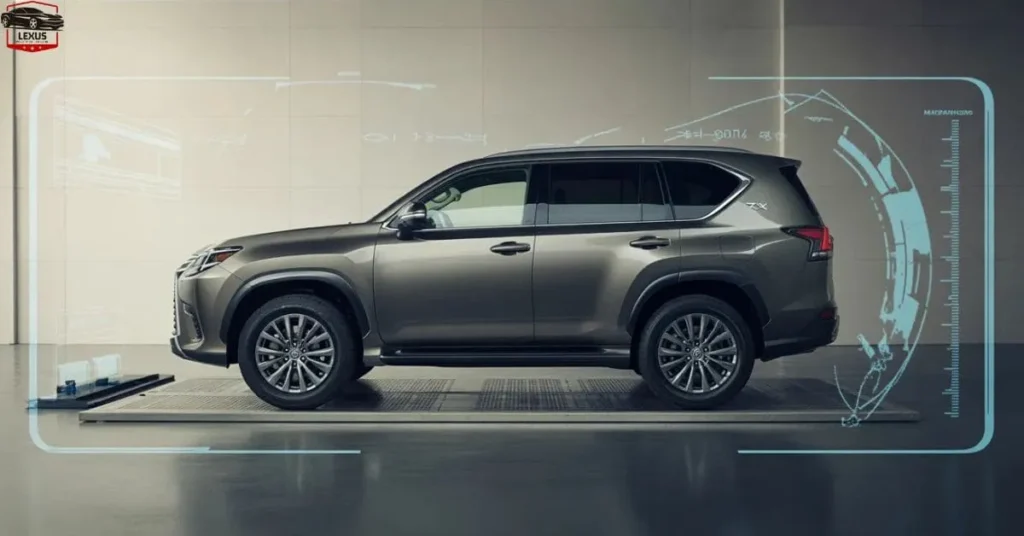
The Lexus GX was designed from the beginning to carry its weight well. The body-on-frame construction, the long-travel suspension, and the relatively high ground clearance all contribute to a vehicle that manages its substantial mass with more composure than many lighter crossovers. But that does not mean weight is irrelevant to performance. It simply means the GX was engineered to handle its own weight in a specific way.
Off-Road Performance and Weight Management
Off-road, Lexus GX weight becomes a more complex factor than it is on pavement. On one hand, the vehicle’s substantial mass works in its favor on rough terrain by keeping it planted and stable. A lighter vehicle bounces and pitches more aggressively over uneven surfaces. The GX’s weight, combined with its long suspension travel, produces a ride on rough terrain that feels controlled rather than chaotic.
On the other hand, weight matters enormously when you are trying to extract a stuck vehicle or manage traction on loose surfaces. A heavier vehicle sinks deeper into soft ground, requires more torque to pull free, and puts more load on recovery equipment.
If you use your GX for serious off-road driving, being mindful of how much extra gear you are carrying is part of responsible trail preparation. Every unnecessary pound in the cargo area when you are driving on sand or mud is working against you.
Fuel Economy and the Weight Relationship
Lexus GX weight and fuel economy exist in a direct and unavoidable relationship. The GX is not positioned as a fuel-efficient vehicle, and no one buys it expecting crossover-level consumption figures. But within the GX’s own performance range, weight management affects fuel consumption noticeably. A fully loaded GX driven with a trailer will use considerably more fuel per mile than the same vehicle driven empty on the same route.
Understanding this relationship helps with real-world trip planning. If you are driving a heavily loaded GX on a long towing trip, building in extra fuel stops is simply good planning. The official fuel economy figures for the GX were measured at curb weight with no trailer. Every modification to that baseline — passengers, cargo, a trailer — moves the real-world figure in one direction only.
Practical Steps to Check and Manage Lexus GX Weight Before Any Trip
Understanding Lexus GX weight in theory is useful. Applying it before a specific trip is what actually keeps you safe and legal. Here is a practical routine for checking and managing your GX weight situation before any trip that involves significant loading or towing.
- Step one: Check the door jamb label before any heavy load trip. Confirm the GVWR and both axle weight ratings. These numbers do not change, but having them fresh in your mind before you start loading helps you make real-time decisions.
- Step two: Estimate your passenger weight. Count everyone riding and use a conservative average. Five adults plus children adds up quickly against a payload budget of around 1,200 pounds.
- Step three: Weigh your loaded cargo separately if possible. Use a bathroom scale for bags before they go in. For heavier items, a shipping or hardware store scale works well. The goal is to avoid guessing.
- Step four: Use a certified scale if you are towing anything significant. Many truck stops and agricultural supply locations have certified drive-on scales that give you total vehicle weight for a small fee. Getting an actual scale weight of your loaded GX with trailer attached is the only way to know for certain that you are within the GCWR.
- Step five: Check tire pressure after loading. Lexus GX weight pushes into the tires differently when the vehicle is fully loaded versus empty. Some owners increase tire pressure slightly toward the maximum doorjamb recommendation when carrying heavy loads. Always check the doorjamb label for your vehicle’s specific guidance rather than using a general rule.
- Step six: Verify the trailer tongue weight. A simple tongue weight scale available at most trailer supply retailers lets you measure the actual downward force on your hitch before pulling out. This takes two minutes and confirms you are in the 10 to 15 percent range.
Lexus Towing Capacity and SUV Weight Guide
Lexus SUVs are known for combining luxury with strong performance, and weight plays a major role in towing ability and road stability. Many buyers want to understand how heavy these vehicles are and how that affects their towing capacity and overall performance.
Lexus GX Weight and Curb Weight Details
The Lexus GX is one of the heavier models in the Lexus lineup due to its body-on-frame construction. This design improves durability and off-road capability but also increases overall weight.
The curb weight of the GX varies depending on the model year and trim. For example, older GX 460 models typically weigh over 5,000 pounds, while newer GX 550 versions are slightly heavier due to updated features and stronger build quality. When converted to kilograms, this weight is generally above 2,200 kg.
Lexus GX Gross Vehicle Weight and Payload
In addition to curb weight, the GX also has a gross vehicle weight rating, which includes passengers, cargo, and fuel. This rating helps determine how much load the vehicle can safely carry. Payload capacity is another important factor, as it shows how much additional weight can be added inside the vehicle without affecting safety.
The GX 550 also includes a gross combined weight rating, which represents the total weight of the vehicle plus any trailer being towed. This is especially important for drivers who plan to use the SUV for towing heavy loads.
Lexus SUV Weight Across the Range
Lexus SUVs vary in weight depending on size and purpose. Compact models are lighter and designed for efficiency, while larger models like the GX and LX are heavier and built for power and durability. Understanding these differences helps buyers choose the right model for their needs.
Lexus Towing Capacity and Performance
Towing capacity is closely linked to vehicle weight and engine performance. Heavier SUVs like the GX are capable of towing significant loads, making them suitable for trailers, boats, and outdoor equipment. The strong frame and powerful engine contribute to stable towing performance even on rough terrain.
Lexus GX 460 and GX 550 Weight Comparison
The GX 460 is a well-known model with a solid reputation for reliability and off-road strength. Its weight supports good towing performance and road stability. The newer GX 550 builds on this foundation with updated technology and slightly increased weight, offering improved capability and comfort.
How Much a Lexus SUV Weighs Overall
The total weight of a Lexus vehicle depends on the model, trim level, and features. Smaller SUVs weigh less and are easier to handle in city driving, while larger SUVs are heavier and better suited for towing and off-road use. Understanding weight helps drivers make better decisions about performance, fuel efficiency, and usage.
Lexus Weight and Driving Experience
Vehicle weight directly affects handling, fuel economy, and ride comfort. Heavier Lexus models provide a more stable and smooth ride, especially on highways and uneven roads. At the same time, advanced engineering ensures that even heavier SUVs maintain a refined and comfortable driving experience.
MY Final Thoughts:
Every Lexus GX weight specification exists for a reason, and none of them are arbitrary. They represent the outcome of engineering analysis, real-world testing, and regulatory requirements that collectively define what this vehicle can do safely and well. Treating those numbers as restrictions misses the point. They are actually the framework within which the GX performs at its best.
When you stay within the Lexus GX weight limits for payload and towing, the vehicle does exactly what it was designed to do. The brakes stop you confidently.
The suspension manages road inputs without drama. The transmission shifts smoothly and the drivetrain stays cool. The tires wear evenly and maintain their rated grip. Everything works together the way it was intended.
When you push beyond those limits, you are changing the engineering equation. Sometimes nothing bad happens immediately. But the margin that was built into the design to protect you in a sudden emergency situation is narrower, and in some cases it is gone entirely.
That is not a risk worth taking when the alternative is simply knowing your numbers and planning your load accordingly.
The Lexus GX is one of the most capable and durable luxury SUVs available. Respecting the Lexus GX weight limits is not a compromise on that capability. It is the condition under which that capability is fully available to you, every time you need it.
FAQs
What is the 80% rule when towing?
When it comes to towing, following the 80% rule is essential for safe towing. This guideline recommends pulling no more than 80% of your vehicle’s rated capacity to protect your engine and brakes. Exceeding your vehicle towing limits can lead to excessive engine strain and brake strain, increasing the risk of accidents. Understanding your towing capacity helps ensure towing safety and prolongs vehicle life.
Is the Lexus GX good for towing?
You may not get the impression from this SUV’s elegant good looks that it is built to do a lot of towing, but you couldn’t be more wrong. Here are just some of the highlights of the Lexus GX which enhances its trailering capabilities: Body-on-frame construction.
What are the common problems with Lexus GX?
2016 LEXUS GX GX 460 Sport Utility 4D PRE OWNED. $31,398.2011 LEXUS GX GX 460 Sport Utility 4D USED. $23,895. What Are Common Lexus GX Problems? Low-speed transmission jerk / hesitation. Low-frequency vibration / “washboard” jitter at low–high speeds.
What is the 60/40 rule in trailering?
INFINITI QX80: The supremely spacious INFINITI QX80 is one of the best large SUVs for towing. The 2023 model can haul 8,500 pounds. Lincoln Navigator: Another top luxury SUV for towing is the Lincoln Navigator. A perennial favorite year after year, the 2023 Navigator tows up to 8,700 pounds
What SUVs offer the best towing?
INFINITI QX80: The supremely spacious INFINITI QX80 is one of the best large SUVs for towing. The 2023 model can haul 8,500 pounds. Lincoln Navigator: Another top luxury SUV for towing is the Lincoln Navigator. A perennial favorite year after year, the 2023 Navigator tows up to 8,700 pounds.

I’m Fiza Ansari, a Lexus specialist with 2+ years of experience helping drivers find their perfect luxury vehicle. From the sporty RC F to the elegant ES sedan and family-friendly RX—I know each model thoroughly. My expertise covers performance features, ownership costs, leasing options, and certified pre-owned benefits. Whether you’re a first-time luxury buyer or upgrading to an F Sport model, I provide honest guidance to help you make the right choice for your lifestyle and budget.