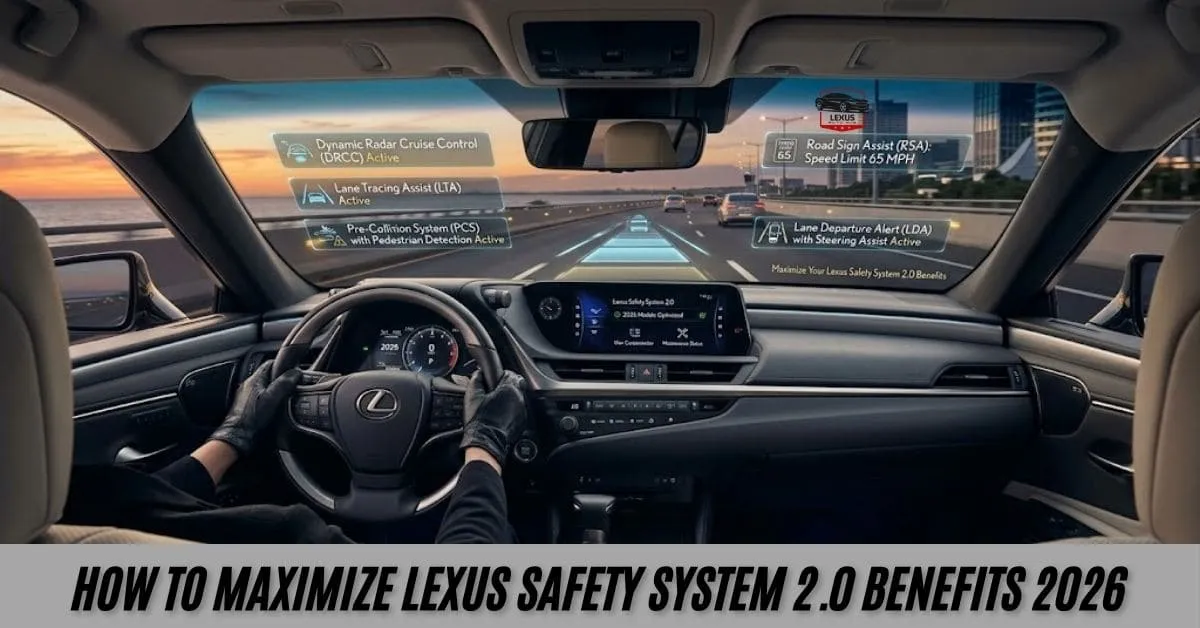
How to Maximize Lexus Safety System 2.0 Benefits 2026
Before you can maximize anything, you need to understand what you are working with. Lexus Safety System 2.0 is not a single feature — it is an integrated suite of camera-based, radar-based, and sensor-fusion technologies working together in real time.
Think of it as a second set of eyes that never gets tired, never gets distracted, and operates faster than human reflexes allow.
The platform represents a significant evolution from earlier generations. Where older systems struggled with complex lighting conditions, rain, and sudden pedestrian movement, the 2.0 generation handles these edge cases with noticeably more confidence.
Lexus engineers spent years refining the millimeter-wave radar calibration and the monocular camera algorithms to reduce false-positive warnings — one of the most common complaints with first-generation systems across all brands.
In 2026, the vehicles equipped with Lexus Safety System 2.0 also benefit from over-the-air software improvements that Lexus has pushed out periodically.
If you have not checked whether your vehicle received its latest update, that is literally the first thing you should do before anything else in this guide. An unupdated system is a system running below its designed capability.
Also Read: How to Get Best Lexus Electric SUV Price Near You 2026
Short Answer About Lexus Safety System 2.0
The Lexus Safety System 2.0 is an advanced suite of safety technologies designed to enhance driver and passenger protection.
It includes features such as pre-collision alerts, lane departure alerts, adaptive cruise control, and pedestrian detection, all aimed at preventing accidents and improving on-road safety.
This system helps drivers maintain lane discipline, monitor traffic conditions, and respond quickly to potential hazards. By combining proactive alerts with automated assistance, Lexus Safety System 2.0 ensures a safer, more confident driving experience.
It reflects Lexus’s commitment to innovation and positions the brand as a leader in modern automotive safety technology.
Getting the Most from the Lexus Safety System 2.0 Pre-Collision System
The Pre-Collision System, or PCS, is the centerpiece of Lexus Safety System 2.0. It uses both a forward-facing camera and a millimeter-wave radar unit mounted near the front grille.
The dual-sensor approach is intentional — camera detects visual features like pedestrian shapes and lane markings, while radar measures actual distance and closing speed without caring about lighting conditions.
Set Your Sensitivity Correctly for Your Driving Environment
One of the biggest mistakes drivers make is leaving PCS sensitivity at its factory default setting regardless of where they drive. The system gives you sensitivity options — typically Early, Standard, and Late in most 2026 Lexus model configurations.
If you primarily drive in busy urban areas with lots of stop-and-go traffic and jaywalking pedestrians, setting sensitivity to Early means the system alerts you sooner and brakes more conservatively.
This feels slightly more intrusive, but in a city environment, that conservative behavior can be the difference between a close call and a genuine collision.
Conversely, if you spend most of your time on open rural highways where traffic density is low, a Standard sensitivity setting prevents unnecessary alerts from distant vehicles that you would have handled yourself anyway.
The goal is to tune the system so alerts feel relevant rather than annoying — because drivers who find alerts annoying start switching systems off, and that defeats the entire purpose.
Never Ignore the Audible and Visual Warnings
This sounds obvious, but it bears saying explicitly. When the Lexus Safety System 2.0 Pre-Collision System triggers a warning,
it does so because its sensor fusion has calculated a genuine risk threshold. The instinct of many drivers — especially experienced ones — is to mentally override the alert and trust their own judgment. Sometimes that judgment is correct.
Also Read: Lexus Hours Today 2026: How to Find Accurate
But the system processes information faster than conscious thought, and during the fraction of a second it takes you to consciously register a warning, the physics of braking distance are already working against you.
At 70 mph, your vehicle travels roughly 103 feet per second. The Pre-Collision System in Lexus Safety System 2.0 begins calculating risk well before the gap closes — your job is to stay alert enough to work with it, not around it.
The practical habit here is simple: when PCS alerts, take your foot off the accelerator immediately. You do not have to panic-brake.
Just removing throttle input while the system evaluates the situation gives it the reaction window it was designed around. Fighting the system by accelerating through an alert is the one thing guaranteed to reduce its effectiveness.
Also Read: How to Compare Lexus Paint Colors Step by Step 2026
Lane Keeping and Steering Assist Using Lexus Safety System 2.0 as a True Co-Pilot
Lane Departure Alert with Steering Assist is where Lexus Safety System 2.0 transitions from a warning system into an active driving partner.
The camera reads lane markings continuously and, if it detects your vehicle drifting without a corresponding turn signal, it produces both a vibration-type alert through the steering wheel and a gentle corrective steering input.
Understand the Difference Between Alert and Assist

Lane Departure Alert tells you that you are drifting. Lane Keep Assist actually nudges you back. These are related but separate functions, and knowing which one is active on your specific 2026 Lexus model helps you set correct expectations.
Some trim levels include both by default; others require manual activation through the driver settings menu. Spend five minutes in your parked vehicle navigating the multi-information display settings to confirm both are enabled before assuming they are.
When Lane Keep Assist is active and working correctly, you will notice the steering wheel offering gentle resistance if you start drifting toward a lane boundary without signaling. The system does not jerk the wheel — it applies a soft, progressive torque.
This means it works best as a fatigue-management tool on long highway drives where micro-drifts happen due to reduced attention, not as a substitute for actually steering the vehicle.
Also Read: How to Choose Perfect New Lexus Coupe Your Lifestyle 2026
Always Signal Your Intended Lane Changes
This is the single most important behavioral change that dramatically improves how Lexus Safety System 2.0 lane features function.
The system reads your turn signal as an intentional command. When you signal, it suppresses the Lane Departure Alert for that maneuver because it understands your drift is deliberate. When you do not signal, it treats any drift as an unintentional error and alerts or corrects accordingly.
Beyond safety system optimization, proper signaling is simply good driving. But in the context of Lexus Safety System 2.0, it directly unlocks smoother.
Also Read: Lexus CPO for Sale Near Me: How to Get the Best
Radar Cruise Control — Mastering the Core of Lexus Safety System 2.0 Highway Driving
Radar Cruise Control, or Dynamic Radar Cruise Control in Lexus terminology, is the feature that most dramatically changes the quality of long-distance driving when used properly.
Unlike conventional cruise control that simply holds a set speed, this system actively maintains a selected time gap between your vehicle and whatever is directly ahead of you in your lane.
Set Your Following Distance Gap Thoughtfully

Most Lexus models with the 2.0 suite offer three or four gap settings — typically represented as short, standard, and long intervals. Many drivers default to the shortest gap to maintain speed in flowing traffic. This is understandable, but it is also the setting that asks the most of the system and gives it the least margin to respond gracefully.
A medium gap setting is the sweet spot for most highway conditions in 2026. It maintains a following distance that gives the radar system enough time to process a slowing vehicle ahead, calculate the required deceleration,
and execute it smoothly without requiring the hard braking that shorter gap settings sometimes produce. You travel at nearly the same effective speed while giving the system more breathing room to do its job elegantly.
Also Read: How to Choose Lexus LC 500 for Sale Houston Easily 2026
Understand When to Resume Manual Control

Lexus Safety System 2.0 Radar Cruise Control is designed for relatively consistent highway conditions. It handles gradual slowdowns, moderate traffic fluctuations, and vehicles entering your lane with impressive composure.
However, there are specific conditions where taking back manual control is the right decision: stop-and-go city traffic below about 25 mph (unless your vehicle has the low-speed follow function), construction zones with unpredictable lane configurations, and merging situations where vehicles are cutting in from multiple angles simultaneously.
Experienced Lexus Safety System 2.0 users develop a feel for which conditions the system handles gracefully and which ones are better managed by an attentive driver. This is not a criticism of the technology — it is simply understanding the tool.
A hammer is excellent for nails and wrong for screws. Using DRCC in conditions it was designed for, and driving manually in conditions it was not, gives you the best of both capabilities.
Also Read: How to Understand the Lexus LX Towing Capacity 2026
Automatic High Beam — The Lexus Safety System 2.0 Feature Drivers Most Underuse
Automatic High Beam control is perhaps the most quietly useful component of the entire Lexus Safety System 2.0 package, and it is routinely the feature that drivers either forget exists or never bother to enable properly.
The system uses the forward camera to detect the headlights and tail lights of other vehicles and automatically switches between high and low beam operation without requiring driver input.
The practical benefit is significant. Studies on night driving consistently show that high beams dramatically increase visibility and reaction time on unlit roads,
but most drivers use them far less than they should because managing the switch manually while watching the road and other traffic is genuinely difficult. Automatic High Beam removes that cognitive burden entirely.
Also Read: How to Decide Lexus Land Cruiser in 2026
Enable It and Leave It Enabled
The most common mistake with this feature is turning it on for one drive and then forgetting to reactivate it on subsequent trips. Some drivers find the automatic switching slightly jarring at first — the beam shifts between high and low when vehicles appear or disappear from range.
Within a week of regular night driving with it enabled, this becomes entirely natural and you stop consciously noticing it. The result is that you are running high beams far more of the time on dark roads than you would manage manually, with zero effort and zero risk of blinding oncoming traffic.
Check your instrument cluster or multi-information display on dark stretches of road to confirm the system is active. The indicator light, usually a blue high-beam symbol with an A designation for automatic, should be visible when the feature is operating correctly.
Also Read: How to Set Up Lexus LX 800 Tech & Safety Features 2026
Practical Habits That Make Lexus Safety System 2.0 Work at Peak Performance
Technology performs at its ceiling when the conditions it operates in are well-maintained. Lexus Safety System 2.0 is no exception. The following habits are not complicated, but they compound over time into a meaningfully safer and more capable system experience.
- 1 Keep your windshield clean, inside and out. The forward-facing camera is mounted near the rearview mirror and looks through the glass.
- A smeared, dusty, or fogged windshield degrades camera performance directly. Interior film buildup — which happens gradually from off-gassing plastics and humidity — is especially problematic because drivers rarely notice it until visibility is meaningfully reduced.
- 2 Do not block or cover the front grille area. The millimeter-wave radar emitter sits behind the grille emblem area in most 2026 Lexus models.
- Aftermarket grille covers, heavy snow buildup, or mud packing directly into the grille can attenuate radar signals significantly. After winter driving, inspect this area as a regular habit.
- 3 Check for software updates at every service interval. Lexus pushes calibration improvements and detection algorithm updates periodically.
- Your dealer service visit is the reliable moment to confirm these are installed. If your vehicle supports over-the-air updates in your market, enable that feature so improvements come to you automatically.
- 4 Recalibrate the system after any windshield replacement. If your windshield is replaced for any reason, the camera mounted to it requires professional recalibration.
- A misaligned camera produces incorrect angular readings that cascade into degraded Pre-Collision and lane detection performance. This recalibration is not optional — it is essential to system accuracy.
- 5 Do not assume the system sees everything you cannot. Lexus Safety System 2.0 has genuine capability, but it has defined operational boundaries.
- Pedestrians at the very edges of the detection cone, vehicles crossing laterally at intersections, and obstacles very close to the bumper are all conditions where driver attention remains the primary safety layer. The system supplements your awareness — it does not replace it.
How Weather Affects Lexus Safety System 2.0 and What You Should Do About It
Every camera and radar-based safety system has to contend with weather, and understanding how atmospheric conditions affect Lexus Safety System 2.0 helps you drive more intelligently when conditions are imperfect.
Heavy rain presents challenges primarily for the camera component. Water on the windshield — even with wipers running — creates optical distortion that reduces the camera’s confidence in what it is detecting.
The radar unit handles rain far better than the camera does, so the system shifts more weight to radar data during precipitation.
The practical effect is that some camera-dependent features, particularly lane detection, may become temporarily limited in heavy downpour. You will see the system notify you on the instrument cluster when this happens.
Dense fog affects radar range. Fog particles scatter radio waves, and while the millimeter-wave frequencies used by Lexus’s radar system are far more penetrating than visible light, very dense fog does reduce effective detection range.
The conservative response is straightforward: when visibility is severely limited by fog, reduce your speed so that your manual stopping distance matches the reduced radar range the system can reliably work within.
Bright, direct sunlight — particularly low-angle morning and evening sun directly in the camera’s field of view — can temporarily blind the camera sensor in the same way it blinds human eyes.
During these conditions, the Pre-Collision System may indicate reduced or unavailable status. Increase following distance and heighten personal attention during these windows.
Weather limitations in Lexus Safety System 2.0 are not system failures — they are honest disclosures of operating boundaries.
A system that tells you when it is limited is safer than one that silently performs poorly and gives you false confidence.
Driving Forward with Lexus Safety System 2.0
The full value of Lexus Safety System 2.0 is not unlocked the moment you drive off the lot. It reveals itself through consistent, informed use — through calibrated settings, maintained sensors, developed habits, and a clear understanding of what the system does brilliantly and where it hands responsibility back to you.
In 2026, this technology represents some of the most mature driver-assistance engineering available at this price point.
It has earned a reputation not because it is flashy, but because it works reliably in the real conditions real drivers encounter every day.
Your role is to be the attentive, informed driver that this kind of technology was designed to work alongside — not to replace.
Final Thoughts:
The Lexus Safety System 2.0 represents a major advancement in automotive safety, combining cutting-edge technology with practical features to protect drivers and passengers.
With tools like pre-collision alerts, lane-keeping assistance, adaptive cruise control, and pedestrian detection, this system enhances overall driving confidence and reduces the risk of accidents. Lexus Safety System 2.0 demonstrates the brand’s commitment to proactive safety, ensuring both comfort and security on the road.
For drivers seeking a reliable and high-tech SUV or sedan, this suite of safety innovations provides peace of mind, making it an essential feature in modern Lexus vehicles.
FAQs
Which Lexus has the best safety features?
The 2025 Lexus NX stands out for its exceptional safety performance, earning the prestigious IIHS Top Safety Pick award. This recognition reflects its strong crash test performance and ability to meet stricter safety criteria, including advanced headlight safety requirements.
Where is Lexus sold the most?
Lexus global sales showed strong performance, with North America auto market leading as the largest region. The brand achieved significant growth in vehicle sales, with global car shipments increasing year over year.
Where do I find my 6 digit PIN?
The IRS Identity Protection PIN (IP PIN) is a six-digit code designed to enhance taxpayer security and prevent tax fraud. Individuals can request an IP PIN online through the IRS website by completing the ID.me login and identity verification process. This secure IRS account access ensures only authorized users can file tax returns.
What does (!) mean in a Lexus?
Dashboard warning lights play a crucial role in vehicle safety, and the triangle warning symbol with an exclamation mark is one of the most important indicators.
What are the disadvantages of owning a Lexus?
Lexus cars are renowned for their reliability, but owning a luxury vehicle comes with higher maintenance costs. Lexus repair expenses, including parts and labor, are typically more expensive than non-luxury brands. Routine car maintenance.

I’m Fiza Ansari, a Lexus specialist with 2+ years of experience helping drivers find their perfect luxury vehicle. From the sporty RC F to the elegant ES sedan and family-friendly RX—I know each model thoroughly. My expertise covers performance features, ownership costs, leasing options, and certified pre-owned benefits. Whether you’re a first-time luxury buyer or upgrading to an F Sport model, I provide honest guidance to help you make the right choice for your lifestyle and budget.