

Best 2013 Genesis 5.0 Hidden Features Guide 2026
The 2013 Genesis 5.0 was Hyundai’s boldest statement to the world — a rear-wheel-drive luxury sports sedan powered by a naturally aspirated 5.0-liter V8 engine that most people still underestimate to this day. More than a decade after it rolled off the line, owners are still discovering tricks, shortcuts, and buried settings inside this car that the owner’s manual barely touched.
This guide is written for the real-world driver who wants to squeeze every last bit of capability, comfort, and enjoyment out of their 2013 Genesis 5.0 in 2026 whether you’ve owned it for ten years or just picked one up.
Also Read: 2015 BMW 535i xDrive: Uncompromising Best Luxury, Handling
Short Answer About 2013 Genesis 5.0
The 2013 Genesis 5.0 is a luxury sedan that combines powerful performance with premium comfort. It features a 5.0-liter V8 engine, delivering strong acceleration and a smooth driving experience.
Known for its upscale interior, advanced features, and solid build quality, it offers great value in the used car market. While fuel economy is moderate due to the V8 engine, the performance and comfort make it a popular choice.
With proper maintenance, the 2013 Genesis 5.0 remains a reliable and affordable luxury option for buyers seeking power, style, and long-term usability in a full-size sedan.
Understanding What Makes the 2013 Genesis 5.0 Special

Before we get into the hidden tricks, it’s worth understanding exactly why the 2013 Genesis 5.0 deserves this level of attention. Hyundai equipped this car with a Tau 5.0 V8 engine producing 429 horsepower and 376 lb-ft of torque.
That’s not just competitive — it was genuinely challenging German and American competitors that cost significantly more money at the time.
The platform itself is an evolution of Hyundai’s rear-wheel-drive architecture, tuned with an electronically controlled suspension, Torsen limited-slip differential, and a sophisticated 8-speed automatic gearbox from Aisin the same company that supplies transmissions to Lexus and BMW.
What this means for today’s owner is that the mechanical foundation is deeply capable, and a lot of that capability is locked behind menus, button sequences, and driving habits that nobody told you about.
The trim level on the 2013 Genesis 5.0 also matters. The base 5.0 was already well equipped, but the 5.0 R-Spec variant added sport-tuned suspension, 19-inch wheels, summer tires, and a revised steering calibration. Throughout this guide, we’ll note where features differ between the two.
Also Read: Best Lexus for Sale Under $10,000 That Feel Like $30K Cars
| Specification | 2013 Genesis 5.0 |
|---|---|
| Engine | Tau 5.0L DOHC V8 |
| Horsepower | 429 hp @ 6,400 rpm |
| Torque | 376 lb-ft @ 5,000 rpm |
| Transmission | 8-Speed Aisin Automatic |
| Drive | Rear-Wheel Drive |
| 0–60 mph | ~5.1 seconds |
| Suspension | AGCS Electronically Controlled |
| Differential | Torsen Mechanical LSD |
| Curb Weight | ~4,200 lbs |
Infotainment and Technology Hidden Features in the 2013 Genesis 5.0
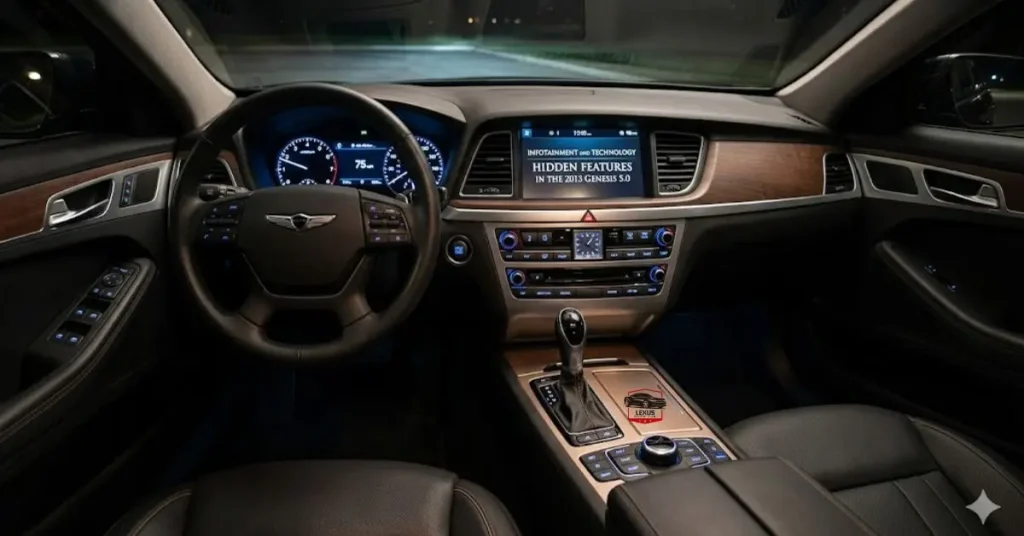
The center stack in the 2013 Genesis 5.0 looks conventional, but there are several menus and functions buried inside that most owners never find. This is partly because the interface logic isn’t intuitive, and partly because the manual explains what buttons do without explaining what they actually accomplish.
The Hidden Service Menu
This is the one people ask about most. The navigation and audio head unit in the 2013 Genesis 5.0 has a diagnostic service mode accessible through a specific button combination.
While we won’t walk through activating it here —because incorrectly changing calibration values can affect system behavior it’s worth knowing it exists if you’re dealing with screen brightness issues, speaker balance drift, or navigation GPS signal problems.
A dealership or reputable independent shop can access this menu to adjust settings that don’t appear in the standard user interface.
Also Read: Best Where to Buy a Used Car 2026: Top Places to Find Deals
Automatic Volume Compensation
The premium Lexicon audio system (on fully-equipped 5.0 trims) includes a feature called Speed-Sensitive Volume that automatically raises audio levels as driving speed increases to compensate for road and wind noise.
This is buried in the audio settings menu under “SVC” and can be set to Off, Low, Medium, or High. Most owners either leave it on a setting they don’t like or don’t know it exists. Try Medium for highway driving — it makes a genuine difference in how the system sounds at speed.
Bluetooth Audio Quality Setting
The 2013 Genesis 5.0’s Bluetooth stack supports different audio codec priorities. By default, it connects at a standard profile. If your phone supports A2DP and you’re hearing compressed, thin-sounding music through Bluetooth, delete and re-pair your phone.
During re-pairing, make sure your phone’s Bluetooth audio is set to high quality before completing the pair. The Genesis head unit will negotiate the best available codec during initial pairing — it doesn’t renegotiate mid-connection.
Rear Camera Parking Lines Adjustment
The backup camera on the 2013 Genesis 5.0 shows dynamic steering-angle lines. What owners don’t realize is that these lines can be recalibrated if the car has had wheel alignment work done or if the lines seem offset from where the car actually tracks.
The calibration procedure involves accessing the camera settings menu with the car in reverse and adjusting reference points using the steering wheel position at specific visual markers. This is documented in the body control module service guide.
Also Read: Best Used Car Checklist Before You Buy Any Car 2026
Engine and Performance Tricks for the 2013 Genesis 5.0 V8
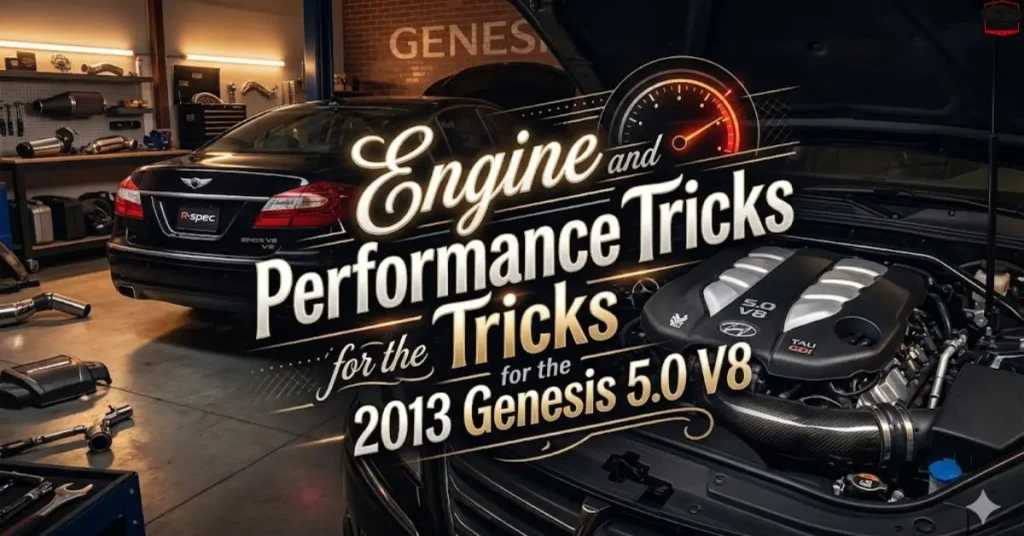
The Tau V8 in the 2013 Genesis 5.0 is a bulletproof engine when maintained correctly, but it has characteristics that reward drivers who understand its engineering. Here are the things that make a real difference.
Oil Weight and V8 Longevity
Hyundai specifies 5W-30 for the Tau V8. What the manual doesn’t emphasize is that the VVT system in this engine is particularly sensitive to oil viscosity in cold climates.
In temperatures regularly below 20°F, some owners and mechanics recommend 0W-30 full synthetic for faster VVT actuator engagement on cold starts. In hot climates like the Middle East or Southern US summers, staying with 5W-30 or even a 5W-40 provides better film strength at high operating temperatures.
- Always use full synthetic oil. The Tau V8’s tight tolerances and VVT system respond poorly to conventional or blended oils, especially after the engine accumulates mileage.
- Change oil every 5,000–6,000 miles regardless of the oil life monitor. The monitor is conservative calibrated for average driving, not performance use.
- Inspect spark plugs at 60,000 miles. Iridium plugs last longer but the Tau runs hot and plug condition affects throttle response noticeably.
- Check the serpentine belt tensioner at 80,000 miles. This is a known wear item on the 5.0 and tensioner failure can affect the power steering pump and alternator.
- Carbon clean the intake valves at 80,000–100,000 miles. Like all direct-injection V8s, the Tau accumulates carbon on intake valves that port injection would wash away. Walnut blasting is the correct solution.
Also Read: How to Find Best Used Lexus for Sale Houston Deals 2026
Comfort and Convenience Features Hidden in Plain Sight
Not every hidden feature in the 2013 Genesis 5.0 is performance-related. Several of the most useful ones are comfort and convenience functions that owners overlook simply because they’re buried in menus or activated through non-obvious button presses.
The One-Touch Window Close
All four windows on the 2013 Genesis 5.0 support one-touch auto-down from the driver’s door. What owners miss is that a long press on the close button will also one-touch close all four windows simultaneously from the driver’s panel.
This also works with the key fob holding the lock button for three seconds closes all windows and the sunroof if it’s open. Very useful if you’re walking away from the car and realize you left windows open.
Seat Memory and the Third Position
The driver’s seat memory stores two positions on the standard buttons labeled 1 and 2. What the owner’s manual doesn’t explain is that there’s effectively a third memory position: the Exit position.
When you open the driver’s door, if the Exit function is enabled in the seat settings menu, the seat automatically slides rearward to make entry and exit easier. This position can be customized. Go to the seat memory settings and find “Exit Position” — you can set how far back it moves and disable it entirely if you prefer.
The Rear Sunshade Trick
The power rear sunshade on fully-equipped 2013 Genesis 5.0 models deploys from a button on the center console. Most owners know this. What they don’t know is that the sunshade can also be set to auto-deploy whenever reverse is selected, since rear visibility with the shade up is limited enough to be a safety concern.
This setting is in the display and systems menu under “Sunshade” — it defaults to manual only, but the auto-retract on reverse setting is genuinely useful.
Climate Control Memory Across Ignition Cycles
The dual-zone climate control in the 2013 Genesis 5.0 remembers your last settings across ignition cycles, but it has a subtlety: the fan speed is always reset to a medium setting on start-up regardless of where you left it.
Temperature, mode, and zone split are all remembered. Fan speed is not. This is intentional behavior — presumably to prevent an unexpected blast of air on cold mornings but knowing it means you won’t spend time wondering if something is wrong with the system when the fan always starts at the same speed.
Also Read: Best Used 2016 BMW X3: Luxury, Comfort & Performance
Safety System Hidden Behaviors in the 2013 Genesis 5.0
The 2013 Genesis 5.0 came with a suite of active safety technologies that were ahead of their time for the price point. Understanding how these systems actually behave — rather than what the marketing materials said — helps you work with them instead of against them.
Lane Departure Warning Sensitivity
The lane departure warning system on equipped 2013 Genesis 5.0 models can be adjusted for sensitivity. The default setting is fairly aggressive and will trigger on faded lane markings, which generates false alerts on older roads.
Reducing the sensitivity by one level in the driving aids menu keeps the system functional on well-marked roads without the constant false positives that cause owners to disable it entirely. The system works through a camera behind the rearview mirror — keeping the windshield clean in that area is essential for accurate detection.
Blind Spot Monitoring Reset
The blind spot monitoring sensors on the rear bumper are sensitive to dirt, ice, and damage. If the system shows a warning light but appears to be working intermittently, cleaning the sensor areas on the rear bumper with a soft cloth often resolves the issue.
In cold weather, the sensors can ice over and give false readings. The system resets automatically when it detects consistent sensor readings above a minimum threshold — usually within a few minutes of driving with clean sensors.
Stability Control and the Sport Override
Pressing the ESC button once on the 2013 Genesis 5.0 puts the system into Sport mode — reduced intervention, not disabled. Holding the ESC button for approximately 3 seconds on R-Spec models fully disables the system.
On standard 5.0 models, full ESC disable requires accessing the setting through a longer press sequence. The system always re-enables when you restart the car. This is correct behavior — it prevents owners from forgetting the system is off.
Also Read: 10 Best Used 2014 Lexus GS Hybrid Deals 2026 Buy Now 2026
What Still Makes the 2013 Genesis 5.0 Worth Owning in 2026

In 2026, the 2013 Genesis 5.0 sits in a very interesting position in the used car market. Values have stabilized after a period of decline, and enthusiasts who know the car are beginning to appreciate.
it the way people eventually came to appreciate the E39 BMW 5-series a large, rear-wheel-drive, naturally aspirated V8 sedan with a properly sorted chassis and luxurious interior that can be purchased for a fraction of its original sticker price.
Parts availability is solid. Hyundai’s parts network still supports this generation, and the Aisin transmission components, Tau engine parts, and body components are well-stocked.
The aftermarket has matured enough to offer suspension upgrades, intake systems, and exhaust options for those who want to build on the already strong foundation.
The 2013 Genesis 5.0 also benefits from being a simpler car than its modern equivalents. It lacks over-the-air update dependencies, subscription-gated features, and complex electrified drivetrains.
When something needs fixing, a competent independent mechanic can handle it without proprietary tools or factory dealer access for the vast majority of repairs.
If you’re maintaining a 2013 Genesis 5.0 in 2026, the most important thing you can do beyond the hidden features in this guide is to join the owner communities.
The Genesis forums and enthusiast groups have accumulated more practical knowledge about this specific car — transmission quirks, coolant system vulnerabilities, HVAC common failures — than any single guide can contain.
The collective ownership experience of a decade-plus of real-world use is an invaluable resource for keeping your car running well and discovering new things it can do.
Getting the Most From Your 2013 Genesis 5.0 Starting Today

The 2013 Genesis 5.0 was built with more capability, more intelligence, and more engineering depth than most people gave it credit for when it was new. In 2026, with over a decade of ownership knowledge now available, there’s no excuse for leaving any of that capability on the table.
Start with the drive modes and use them intentionally rather than leaving the car in Normal all the time. Explore the suspension behavior by actually engaging the AGCS through an active navigation route. Recalibrate your audio settings for your actual listening habits.
Keep the Tau V8 on a proper maintenance schedule with the right oil and watch it continue performing the way it did when it left the factory.
The hidden features in this guide aren’t tricks or hacks — they’re the full capability of a well-engineered car, finally being used the way its engineers intended. The 2013 Genesis 5.0 rewards attention and understanding in a way that few cars at any price point genuinely do.
Take the time to know yours, and it will give you a driving experience that’s still genuinely impressive even by the standards of 2026.
My Final Thoughts:
The 2013 Genesis 5.0 remains one of the most underrated performance sedans ever built. Its V8 engine, rear-wheel-drive balance, and intelligent chassis technology still hold up impressively in 2026. Most owners never fully unlock what this car can do but now you can.
Whether you drive it daily or preserve it as a weekend machine, understanding these hidden features transforms the experience entirely. This isn’t just an old car. It’s a properly engineered driver’s sedan that deserves real appreciation and the more you explore it, the more it delivers.
FAQs
What engine does the 2013 Genesis 5.0 have?
The 2013 Genesis 5.0 comes with a powerful 5.0-liter V8 engine that delivers strong performance, smooth acceleration, and a premium driving experience.
Is the 2013 Genesis 5.0 reliable?
Yes, the 2013 Genesis 5.0 is considered reliable when properly maintained. It offers solid build quality, durable engine performance, and long-term usability.
What is the fuel economy of the 2013 Genesis 5.0?
The fuel economy is moderate due to its V8 engine, typically offering lower mileage compared to smaller engines but better performance.
Yes, it is a full-size luxury sedan with premium features like leather seats, advanced technology, and a comfortable interior.
Yes, it is a full-size luxury sedan with premium features like leather seats, advanced technology, and a comfortable interior.
How much does a 2013 Genesis 5.0 cost used?
The price varies depending on condition and mileage, but it is generally affordable compared to other luxury sedans in its class.

I’m Fiza Ansari, a Lexus specialist with 2+ years of experience helping drivers find their perfect luxury vehicle. From the sporty RC F to the elegant ES sedan and family-friendly RX—I know each model thoroughly. My expertise covers performance features, ownership costs, leasing options, and certified pre-owned benefits. Whether you’re a first-time luxury buyer or upgrading to an F Sport model, I provide honest guidance to help you make the right choice for your lifestyle and budget.