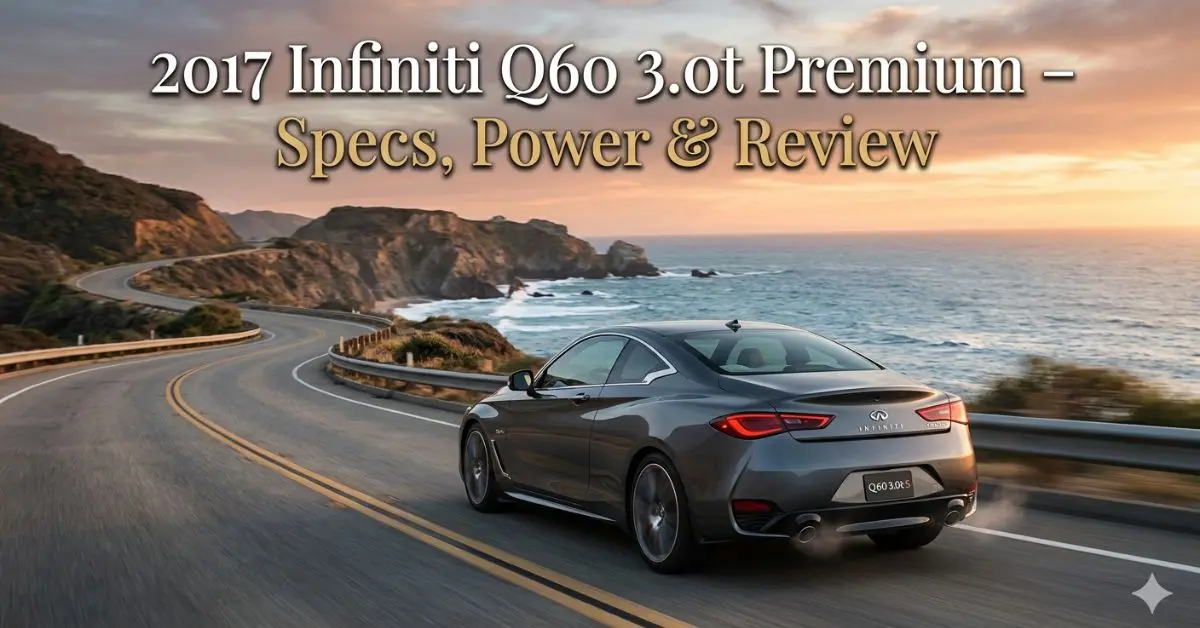
2017 Infiniti Q60 3.0t Premium: Specs, Power & Review
Some cars arrive with quiet confidence and leave a lasting impression that takes months to fully shake. The 2017 Infiniti Q60 3.0t Premium is exactly that kind of car.
When Infiniti rolled out the second-generation Q60 for the 2017 model year, it was making a statement that the brand had been building toward for years — that Japanese luxury performance does not need to borrow its identity from Stuttgart or Munich to be worth taking seriously.
The Q60 in this particular configuration, the 3.0t Premium trim, sits at the entry point of the twin-turbocharged lineup and makes a compelling case that you do not need to spend to the top of the range to get something genuinely rewarding.
This is a sports coupe in the truest sense. Not a four-door pretending to be sporty with a raked roofline. Not a crossover with a performance badge. A two-door coupe with a properly powerful engine, a chassis tuned for driver engagement, and a cabin that takes comfort seriously without abandoning the aesthetic ambition that makes sitting inside the thing a pleasure.
The 2017 model year was the first full production year of this generation, and it arrived with enough development behind it to feel complete rather than provisional.
What follows is a detailed look at what the 2017 Infiniti Q60 3.0t Premium actually delivers — across its specifications, its power characteristics, and its real-world driving experience.
Also Read: 2022 Cadillac XT6 Premium Luxury: Comfort Meets Power
Short Answer About 2017 Infiniti Q60 3.0t Premium
The 2017 Infiniti Q60 3.0t Premium is a stylish luxury coupe powered by a 3.0L twin-turbo V6 engine producing 300 horsepower. It delivers strong acceleration, smooth handling, and a premium driving experience.
The interior includes leather seating, dual touchscreen displays, and advanced technology features. Its sporty design and turbocharged performance make it popular among luxury coupe enthusiasts. Overall, the Q60 3.0t Premium offers a great balance of power, comfort, and modern styling.
Full Specifications of the 2017 Infiniti Q60 3.0t Premium
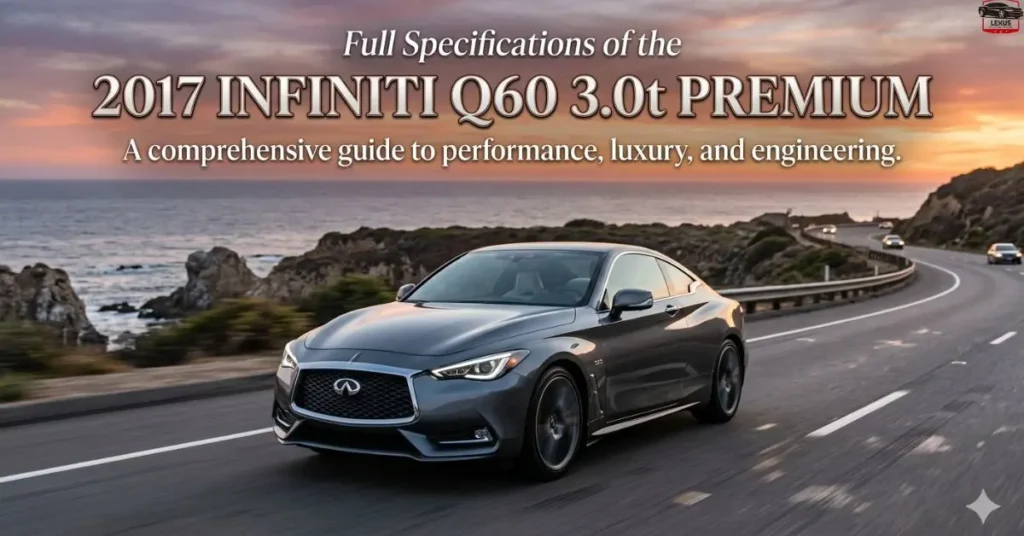
Understanding a vehicle starts with the numbers. Not because numbers tell the whole story — they never do — but because they establish the framework within which the real character of a car exists. The spec sheet of the 2017 Infiniti Q60 3.0t Premium is worth reading carefully, because several of its figures are genuinely impressive for a vehicle at this price point.
Engine: 3.0-liter twin-turbocharged V6 Output: 300 horsepower / 295 lb-ft of torque Transmission: 7-speed automatic with manual shift mode Drivetrain: Rear-wheel drive (AWD available as option) 0–60 mph: Approximately 5.1 seconds Top Speed: 155 mph (electronically limited) Fuel Economy: 19 mpg city / 26 mpg highway (RWD) Curb Weight: Approximately 3,780 lbs (RWD)
Also Read: Best GMC Acadia SLT 2023 Review, Specs & AWD Features
Dimensions:
- Overall Length: 184.6 inches
- Width: 72.8 inches
- Height: 54.8 inches
- Wheelbase: 109.3 inches
- Cargo Volume: 8.0 cubic feet
Standard Features on the Premium Trim:
- Leather-appointed seating surfaces
- Power front seats with driver memory
- Heated front seats
- Dual-zone automatic climate control
- 8-inch touch display infotainment system
- Bose audio system (9 speakers)
- Rear-view camera
- Infiniti In Touch dual display system
- Bluetooth connectivity
- Apple CarPlay / Android Auto compatibility (via later software updates)
- LED headlamps
- 19-inch aluminum alloy wheels
These specifications place the Q60 3.0t Premium in a strong position against rivals like the BMW 4 Series, Mercedes-Benz C-Class Coupe, and Audi A5. On paper it matches them in most categories and exceeds several.
The 300-horsepower output from the base twin-turbo trim is notably strong — some German competitors at comparable pricing deliver meaningfully less power and ask buyers to option their way up to similar outputs.
Also Read: 2021 Ford Bronco Sport First Edition Review & Buying Guide
The Heart of It: Power Delivery in the 2017 Infiniti Q60 3.0t Premium
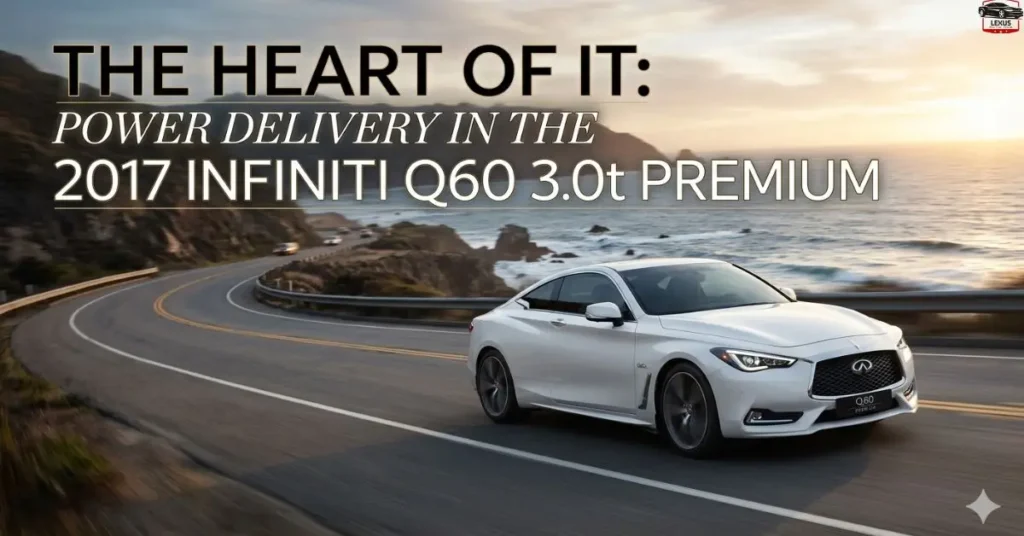
Engine character is one of those qualities that lives in the space between what a dyno sheet shows and what a driver feels. The 2017 Infiniti Q60 3.0t Premium benefits from an engine — the VR30DDTT — that was developed specifically for this application and for the Q50 sedan that shares the platform.
It is not a carryover unit from a truck or a mass-market sedan adapted for sport duty. It was designed with performance as a primary objective, and that intention is detectable from the first time you press the throttle with genuine commitment.
The twin-turbo setup builds boost pressure quickly enough that there is no meaningful lag in everyday driving. From a rolling start, the power arrives promptly and builds in a linear fashion through the mid-range that makes the engine easy to use confidently.
It does not demand high revs to feel alive — the torque plateau is accessible from relatively low in the rev range, which makes city driving and highway overtaking feel equally natural. At full throttle, the engine note changes character in a way that rewards the driver without resorting to artificial amplification.
Also Read: 2024 Ford Explorer Timberline: Best Specs, Price & Review
There is a genuine mechanical quality to the sound under hard acceleration — not theatrical, not particularly loud, but honest. The exhaust note at the top of the rev range has a slight rasp that communicates what the engine is doing without overstating it.
The 7-speed automatic transmission works well with the engine in standard operation. Gear selection under normal driving is smooth and unhurried. In Sport mode, the transmission holds gears longer, downshifts more aggressively, and responds to paddle shifter inputs with the kind of immediacy that makes the manual mode feel worth using rather than a checkbox feature.
Shifts in Sport are firm but not jarring — a good balance for a car that might be someone’s daily driver on Monday and a canyon road companion on Saturday. Rear-wheel drive, which is the base configuration for the 3.0t Premium, gives the car a balance and precision that AWD versions naturally trade away in the pursuit of broader all-condition capability.
In dry conditions, the RWD Q60 communicates more clearly through the steering and chassis, and the rear end can be encouraged to step out with appropriate throttle application in a way that feels playful rather than unpredictable.
Buyers in climates with serious winter conditions will reasonably opt for the AWD variant, but for those in temperate regions, the rear-wheel-drive car is the purer driving experience.
Also Read: Best 2021 INFINITI Q50 3.0T LUXE Review, Specs & Price
Chassis and Handling: How the 2017 Infiniti Q60 3.0t Premium Drives
Power alone does not make a sports coupe. The 2017 Infiniti Q60 3.0t Premium understands this. The chassis tuning was handled with a degree of seriousness that distinguishes it from grand tourers that prioritize isolation over involvement.
The front suspension uses a double-wishbone arrangement — a configuration that provides more precise geometry control than the MacPherson strut setups found in many competitors.
This translates into more consistent behavior through corners, better isolation of braking forces from steering inputs, and a more connected feel through the steering wheel when the road surface changes. It is the kind of engineering decision that costs more to implement and delivers returns that are felt rather than easily described in a brochure.
Also Read: Best 2023 Nissan Maxima SV Review & Specs
The rear uses a multi-link independent arrangement, which allows the rear wheels to track road irregularities independently rather than forcing compromises between ride quality and cornering stability. On smooth roads, the Q60 corners with a flatness and composure that suggests a well-damped, well-sorted chassis.
On roads with mid-corner bumps, it maintains its line without the nervous darting that affects some competitors with less sophisticated rear suspension geometry. Steering is electrically assisted and has been a point of debate among enthusiasts of this generation. At low speeds, it is light and easy to manage in parking situations.
As speed increases, it firms up progressively, which is correct behavior. The precision at the center of the steering is good — the car goes where it is pointed with fidelity. The feedback, however, is modest compared to some hydraulically assisted systems from earlier eras.
This is a common characteristic of modern electrically assisted setups, and the Q60 is not uniquely disadvantaged, but buyers coming from older sports cars will notice the filtering.
Brakes are strong, with consistent pedal feel and good thermal stability. The stopping distances are competitive for the class, and the pedal modulation allows confident threshold braking without the abruptness that some high-performance setups exhibit on the street.
Ride quality, even in Sport mode, retains enough compliance to make the car livable on imperfect roads. The suspension absorbs sharp-edged urban imperfections acceptably, and at highway speeds the body control is excellent — the car feels planted and stable without the float that affects softer luxury coupes.
Also Read: Best 2021 Chevrolet Tahoe Premier Price Guide
Interior and Comfort: Living Inside the 2017 Infiniti Q60 3.0t Premium
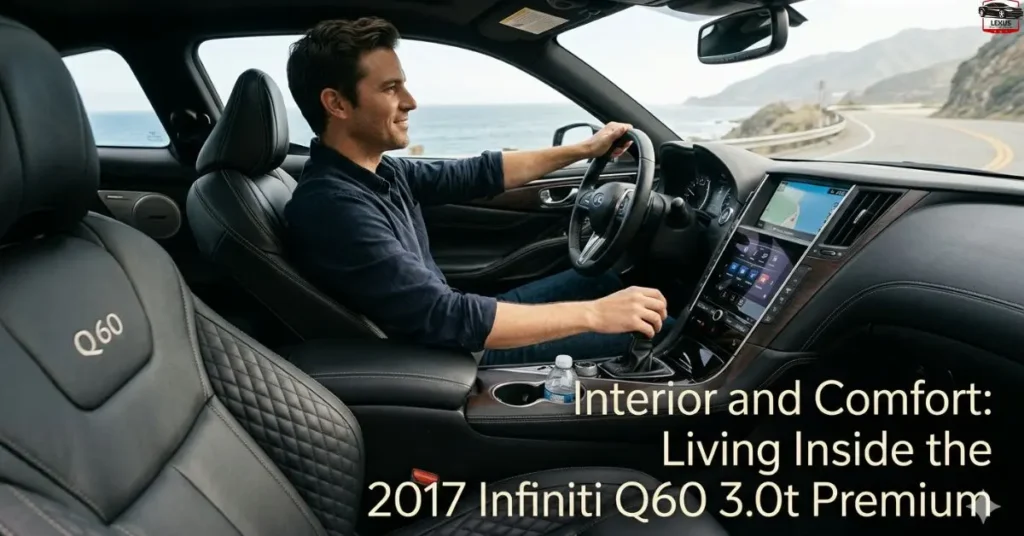
A sports coupe lives most of its life as a daily driver, and the interior experience matters as much as what happens at a corner apex for most buyers. The 2017 Infiniti Q60 3.0t Premium delivers a cabin that is genuinely well-designed, with some specific strengths and one or two areas where the execution falls short of the overall ambition.
Starting with the positives: the front seats are outstanding. Deeply bolstered, well-shaped, and covered in leather that is soft without feeling delicate, they hold the driver and passenger securely in spirited driving without creating fatigue during longer journeys.
The driving position is low and sporting without being cramped — the steering wheel, seat height, and pedal placement combine to create a cockpit feel that reinforces the car’s performance intentions every time you settle in.
The dashboard design is one of the most visually distinctive in the class. Infiniti’s design team executed a layered, flowing aesthetic that wraps around the occupants and creates a sense of enclosure that feels intentional rather than claustrophobic.
Also Read: 2019 Nissan Armada Platinum Review, Price & Specs Full Guide
The materials on the primary touch surfaces — the padded dashboard, the door panels, the center console armrest — are soft and pleasant to contact. Hard plastics are pushed to the lower sections of the cabin where hands do not naturally rest.
The dual-screen infotainment arrangement is a specific choice that Infiniti made with this generation. An upper 8-inch display handles navigation, audio, and primary functions, while a lower touchpad-based screen manages secondary controls and climate.
In practice, the division of functions requires some learning, and the interface logic is not immediately intuitive. After a period of familiarity it becomes workable, but it is not the most seamless system in the segment. The navigation mapping, in particular, feels dated compared to what contemporaries were offering.
The Bose audio system, standard on the Premium trim, is a genuine bright spot. Nine speakers, including a subwoofer integrated into the cargo area, deliver a sound quality that suits the cabin well. The soundstage is wide, the midrange is clear, and at highway speeds the system maintains balance without needing to be pushed to uncomfortable volumes to overcome road noise.
Rear seat space is the honest limitation that any two-door coupe must acknowledge. Adults can be accommodated for shorter journeys, but the combination of the low roofline and the swept coupe silhouette reduces headroom noticeably compared to a sedan.
Legroom is acceptable if front seat occupants show reasonable consideration for their positioning, but calling the Q60’s rear accommodations generous would be inaccurate. The car is, fundamentally, a two-person vehicle with emergency occasional seating in the back — and most buyers shopping for a coupe understand and accept this reality.
Cargo space at 8.0 cubic feet is adequate for the class. Gym bags, grocery runs, and weekend overnight luggage fit without drama. The trunk opening is reasonably wide, and the depth is sufficient for items of normal size.
Also Read: 2021 Toyota Tundra 1794 Edition: Power, Luxury & Review
Technology and Safety in the 2017 Infiniti Q60 3.0t Premium
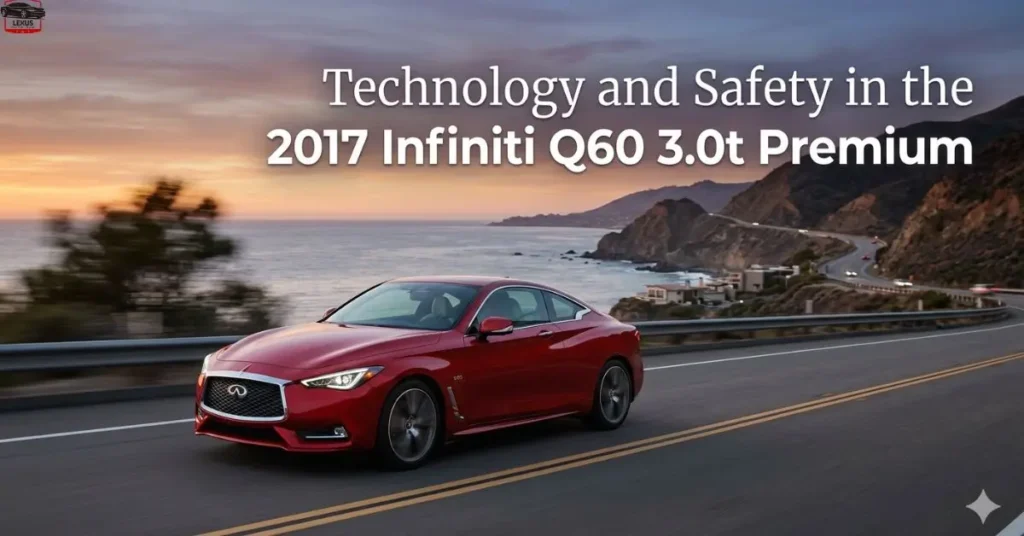
The 2017 Infiniti Q60 3.0t Premium was well-equipped for its era in terms of safety technology, with Infiniti pushing a number of driver assistance features into this segment at a time when some competitors were treating them as top-trim exclusives.
Forward Emergency Braking was available, detecting potential collisions and preparing the braking system for maximum stopping performance while alerting the driver. Blind Spot Warning with Rear Cross Traffic Alert used radar sensors in the rear bumper to monitor adjacent lanes and approaching vehicles when reversing — a practically useful system that functions reliably in everyday use.
Lane Departure Warning monitored lane markings and provided visual and haptic steering wheel feedback when unintended lane movement was detected. Adaptive cruise control with full-speed following was available as part of technology packages, providing a useful highway companion that maintained following distance automatically.
Infiniti’s InTouch system, while discussed for its interface complexity in the context of comfort and convenience, also integrated connected services that provided real-time traffic data, remote vehicle monitoring, and over-the-air software updates — features that were forward-thinking for a 2017 production vehicle.
The structural architecture of the Q60 received strong marks in crash testing, with the high-strength steel construction and strategically placed crumple zones doing the work that passive safety requires.
Ownership Experience: Running Costs and Reliability of the 2017 Infiniti Q60
For buyers considering the 2017 Infiniti Q60 3.0t Premium as a used purchase today — which represents the majority of the current market for this vehicle — the ownership experience question is particularly relevant.
A nine-year-old performance vehicle carries questions about maintenance history, common failure points, and the cost of keeping it in good condition over the next phase of its life. Infiniti’s reliability record for this generation is generally solid, though not without areas requiring attention.
The VR30DDTT engine is mechanically robust when maintained properly. Regular oil changes at the manufacturer-specified intervals are important given the twin-turbo configuration — oil quality matters more when hot exhaust-driven turbines are involved. Buyers purchasing used examples should verify service history and look for documentation of oil change frequency.
The transmission has been broadly reliable, and reports of significant transmission failures in well-maintained examples are not common. The infotainment system, as mentioned, has drawn criticism for interface complexity but is not a frequent source of mechanical failure.
Running costs are consistent with what a buyer might expect from a performance-oriented vehicle with a twin-turbo V6. Premium fuel is recommended, and tire costs on the 19-inch wheels can be meaningful depending on the rubber chosen. Insurance rates reflect the car’s performance classification and will vary by region, driver history, and coverage level.
Overall, the Q60 represents a reasonable ownership proposition for a buyer who understands performance vehicle maintenance expectations and budgets accordingly.
What the Competition Offers vs the 2017 Infiniti Q60 3.0t Premium
Placing the 2017 Infiniti Q60 3.0t Premium alongside its natural competitors — the BMW 430i, Mercedes-Benz C300 Coupe, Audi A5 2.0T — reveals where it wins and where it concedes ground.
Against the BMW 430i, the Q60 wins on horsepower outright. The base 430i of this era produced 248 horsepower to the Q60’s 300, which is a genuine advantage in straight-line performance. The BMW counters with a more refined infotainment system and a slightly more communicative steering feel, but the power gap is not easily dismissed.
Against the Mercedes C300 Coupe, the comparison is similarly favorable on power while the Mercedes responds with an interior that edges the Q60 on materials quality in certain areas and a more cohesive technology presentation.
Against the Audi A5, the Q60 again leads on power in comparable trim configurations. The Audi offers its famously serene cabin and Quattro AWD as standard, but buyers who prioritize performance output will find the Infiniti the more compelling choice.
My Final Thoughts:
After examining every dimension of what the 2017 Infiniti Q60 3.0t Premium offers, the conclusion is clear. This is a sports coupe that was underappreciated when new and remains underappreciated today, which creates an interesting opportunity for buyers who do their research.
The twin-turbo V6 delivers 300 horsepower with real urgency and genuine character. The chassis is sorted and rewarding, with a double-wishbone front suspension that delivers driver engagement at a level that takes competitors real money to match.
The exterior design, dramatic and distinctive, has aged well — it looks current and purposeful rather than dated. The interior has meaningful quality and comfort in the areas that matter most.
The weaknesses — a dual-screen infotainment system that requires patience, a rear seat that concedes to the coupe silhouette, and steering feedback that stops short of truly intimate communication — are real, but they are the weaknesses of a car that prioritizes what matters and makes honest trade-offs to get there.
For the buyer who wants a sports coupe that performs confidently, looks exceptional from every angle, and delivers a driving experience built on genuine engineering rather than marketing language, the 2017 Infiniti Q60 3.0t Premium earns serious consideration. It is, in every meaningful way, more car than its price suggests.
What engine does the 2017 Infiniti Q60 3.0t Premium have?
The 2017 Infiniti Q60 3.0t Premium features a 3.0L twin-turbo V6 engine producing 300 horsepower and 295 lb-ft of torque.
Is the 2017 Infiniti Q60 3.0t Premium fast?
Yes, the Q60 3.0t Premium offers quick acceleration, sporty handling, and strong turbocharged performance for a luxury coupe.
What are the key features of the 2017 Infiniti Q60 3.0t Premium?
Key features include leather-appointed seats, dual touchscreen infotainment, premium audio system, navigation, and advanced safety technologies.
Is the 2017 Infiniti Q60 3.0t Premium reliable?
The Q60 is generally considered reliable with proper maintenance, though buyers should check for transmission and electronic system issues.
What is the fuel economy of the 2017 Infiniti Q60 3.0t Premium?
The 2017 Q60 3.0t Premium delivers an estimated 20 MPG city and 30 MPG highway, depending on drivetrain configuration.

I’m M Ahmad Ansari, a Lexus enthusiast with 5+ years of hands-on experience across the entire lineup—from the RC F’s roaring V8 to the whisper-quiet RZ electric. I understand what separates Japanese luxury from the rest: obsessive engineering, unmatched reliability, and that refined driving feel you can’t find anywhere else. Whether it’s F Sport performance packages, hybrid technology, or choosing between new and certified models, I bring real-world knowledge and genuine passion for what makes Lexus exceptional.