Bronco Big Bend Area 51: Best Review, Specs & Buying Guide
When Ford brought the Bronco back from the dead in 2021, it came with a lineup of trims that covered everything from casual weekend warriors to hardcore rock-crawling enthusiasts. Right in the middle of that lineup sits the Big Bend trim — a sweet spot that blends comfort, capability, and affordability.
But what really catches the eye among buyers is one particular color option: the Bronco Big Bend Area 51. That distinctive, almost-greenish-blue hue has become one of the most talked-about color choices in the modern Bronco’s catalog, and for good reason.
This article is a complete deep-dive into everything you need to know about the Bronco Big Bend Area 51 — from its real-world performance and interior quality to pricing, off-road chops, and whether it’s actually worth your money. Whether you’re shopping seriously or just doing your research, this guide covers it all.
Also Read: Honda Pilot Elite 2023 Black: Specs, Features & Review
What Is the Bronco Big Bend Area 51 Trim?
The Big Bend is Ford’s second trim level in the Bronco lineup, sitting just above the base model. It was named after Big Bend National Park in Texas — rugged country that suits the Bronco’s personality well. The trim was designed for buyers who want more than the bare-bones base model but aren’t ready to stretch to the more off-road-focused Badlands or Wildtrak trims.
What makes the Big Bend interesting is that it hits a practical balance. You get meaningful off-road upgrades over the base Bronco, a reasonably well-appointed interior, and a starting price that doesn’t immediately send you into financial regret. It’s a trim built for people who actually use their SUV both on and off the road, not just folks who want the look without the functionality.
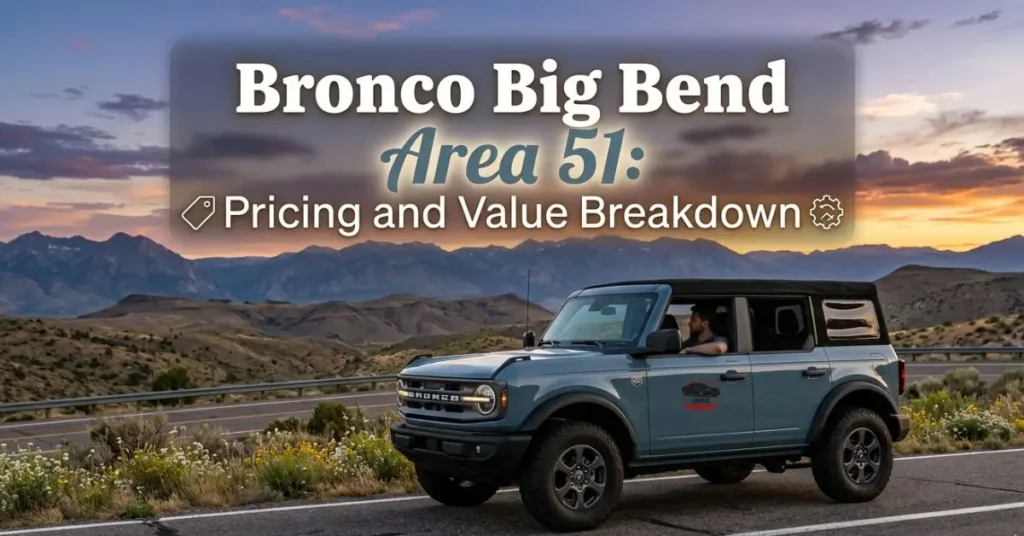
The Bronco Big Bend Area 51 pairs that already capable platform with one of the most distinct exterior colors Ford has ever offered on a modern production vehicle. Area 51 is a muted, metallic teal-blue that sits somewhere between slate gray and ocean blue depending on the light. It turns heads on the street and looks phenomenal covered in trail dust.
Also Read: Best 2019 Honda Accord Sport 2.0T: Power, Specs & Guide
Bronco Big Bend Area 51 Color: Why It Stands Out
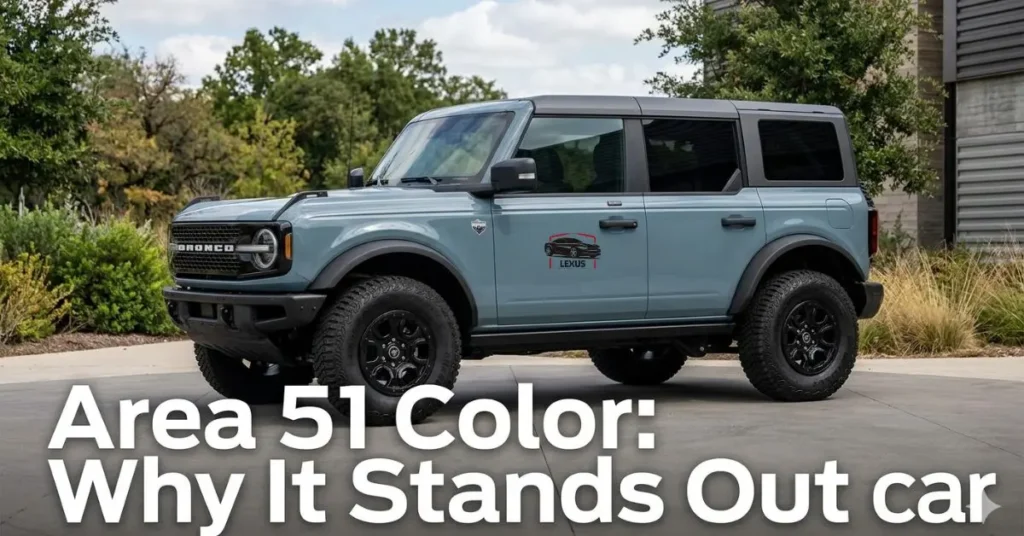
Let’s talk about the elephant in the room — or the UFO, given the name. Area 51 is not your typical color. It isn’t a flashy candy-apple red or a safe pearl white. It’s a color that rewards attention. In direct sunlight, it has a warm, almost sage-green undertone. In shade or cloudy conditions, it reads more clearly as a steel blue. At night under artificial lighting, it can look almost gray.
This chameleon-like quality is part of what makes the Bronco Big Bend Area 51 so popular. Buyers who pick this color tend to be people who want something that stands out without screaming for attention. It’s confident, mature, and oddly timeless for a color named after a conspiracy theory.
Ford offered Area 51 as a standard color option with no additional cost on most configurations, which is another reason buyers gravitated toward it. You’re getting a genuinely premium-looking exterior finish without paying a premium paint surcharge.
On the resale market, Broncos finished in Area 51 have consistently held strong value, partly because demand remains high and the color continues to appeal to a wide range of buyers.
Also Read: Best Lexus 4Runner 2023: GX 460 vs 4Runner Full Comparison
Bronco Big Bend Area 51: Key Specifications
Understanding what you’re getting under the hood and in the spec sheet is critical before any purchase. Here’s a thorough breakdown of what the Bronco Big Bend Area 51 brings to the table across key categories.
Engine Options
The Big Bend trim is available with two engine choices. The first is a 2.3-liter EcoBoost four-cylinder engine that produces 300 horsepower and 325 lb-ft of torque. It’s a punchy, responsive engine that feels more than adequate for both daily driving and moderate trail work.
The second option is the 2.7-liter EcoBoost V6, which bumps output to 330 horsepower and 415 lb-ft of torque. The V6 is the pick for serious towing or if you simply want that extra confidence on steep inclines.
Both engines are paired with either a 7-speed manual transmission — yes, a real manual with a proper crawler gear — or a 10-speed automatic. The manual is a rare and welcome option in a world where automatics have taken over almost everything. For enthusiast drivers, it adds a dimension of engagement that’s hard to find in any other modern SUV at this price point.
Drivetrain and 4×4 System
The Bronco Big Bend comes standard with Ford’s selectable four-wheel-drive system. You get 4H and 4L modes accessible via a dedicated rotary dial on the center console. The system is part-time 4WD, which is appropriate for off-road use but means you should keep it in 2WD on dry pavement to avoid drivetrain stress.
The transfer case is a proper two-speed unit, giving you that low-range gearing that makes all the difference when you’re crawling over rocky terrain or navigating steep descents. It’s not just a marketing feature — the 4L mode on the Bronco genuinely works the way off-road drivers expect it to.
Also Read: Best 2024 Toyota Limited: Luxury Specs & Full Guide
Ground Clearance and Approach Angles Bronco Big Bend Area 51
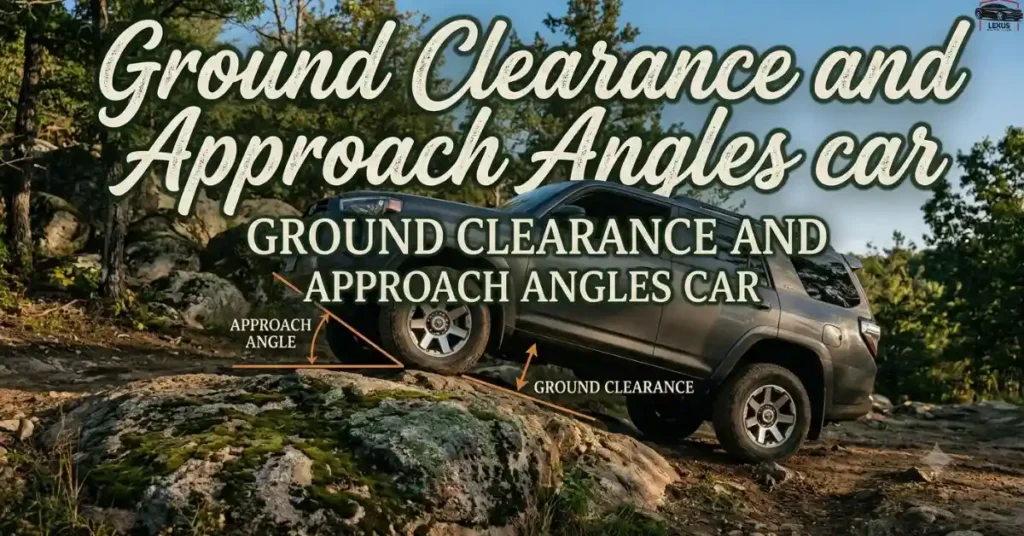
The Big Bend trim sits on 235/75R17 all-terrain tires mounted on 17-inch wheels. Ground clearance comes in at 8.4 inches for the four-door model — respectable, though not class-leading at this trim level. The approach angle is 35.5 degrees on the two-door and slightly less on the four-door, with a departure angle of 30 degrees. These numbers are solid for casual trail use, even if the higher trims push further into extreme territory.
Also Read: Best 2023 Jeep Wrangler Sahara Price: Complete Buyer’s Guide
Towing and Payload Bronco Big Bend Area 51
With the 2.3L engine, the Bronco Big Bend is rated to tow up to 3,500 pounds. Step up to the 2.7L V6 and that number climbs to 4,500 pounds. Neither figure is going to impress F-150 buyers, but for a midsize SUV that’s primarily built for off-road adventure, the towing capacity is more than enough for a small boat, a lightweight camper trailer, or a couple of dirt bikes.
Interior Quality and Features of Bronco Big Bend Area 51
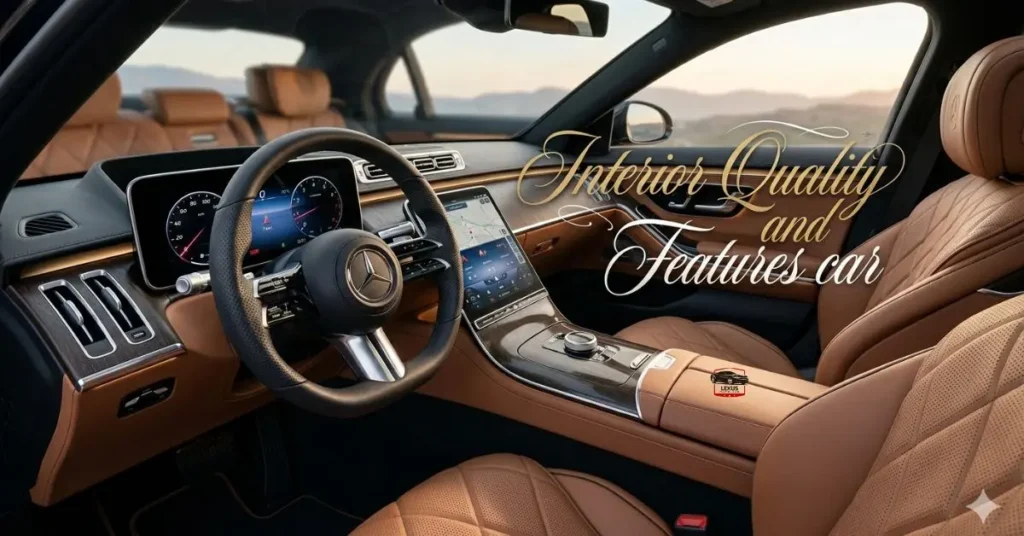
One of the genuine improvements the Big Bend brings over the base Bronco is in the interior. Ford made a deliberate effort to elevate the cabin experience without over-complicating things, and the result feels purposeful rather than plush.
You get cloth seating as standard, though upgrading to Marine Grade Vinyl — the Bronco’s answer to easy-clean upholstery — is available and honestly recommended if you plan on spending real time off-road. The seats are supportive and reasonably comfortable for long drives, though taller drivers may find the headroom a bit tight in the four-door version with the standard roof.
The dashboard design centers around a vertical 8-inch touchscreen running Ford’s SYNC 4 system. It’s genuinely intuitive, wireless Apple CarPlay and Android Auto are included, and the interface responds quickly without the lag that plagued older SYNC versions. The physical controls for climate and off-road modes are kept separate from the touchscreen, which is exactly how it should be when you’re driving over rough terrain with gloves on.
Standard features on the Big Bend include heated front seats, a leather-wrapped steering wheel, a six-speaker audio system, and the Trail Control system — Ford’s version of off-road cruise control that manages throttle and braking on rough terrain so you can focus on steering. That last feature alone justifies the step up from the base trim for anyone who takes trail driving seriously.
The removable doors and roof are signature Bronco features that carry over to the Big Bend trim. Taking the doors off is a straightforward process and genuinely changes the open-air driving experience. The modular hardtop can be configured in different ways depending on how much sky you want above you.
Also Read: Best 2022 Chevy Tahoe RST: Power, Style & Complete Guide
Off-Road Performance: Real World Results Bronco Big Bend Area 51
Numbers and spec sheets only tell part of the story. The Bronco Big Bend Area 51 in the real world is a capable machine that handles more than most buyers will ever actually throw at it.
On pavement, the Bronco drives like a proper SUV — not a car pretending to be one. The steering is a bit heavy and the ride is firmer than a crossover, but it’s composed and predictable. Wind noise is noticeable above 65 mph, particularly with the soft top or when doors are removed, but that’s a fair trade-off given the Bronco’s DNA.
On dirt roads and gravel paths, the Big Bend is in its element. The all-terrain tires provide solid bite, the suspension soaks up bumps with confidence, and the overall feel of the vehicle is sure-footed. Engage 4L on a rocky incline and the truck just handles it — no drama, no slipping, no hand-wringing.
Also Read: 2017 Jeep Grand Cherokee Overland: Ultimate Buyer’s Guide
The GOAT Modes — which stands for Goes Over Any Type of Terrain — give the driver preset configurations for different surfaces. Normal, Eco, Sport, Slippery, Sand, Mud/Ruts, and Rock Crawl modes are available on the Big Bend. Each one adjusts throttle response, traction control thresholds, and transmission behavior to match the terrain. It sounds gimmicky, but the difference between modes is genuinely noticeable when you use them correctly.
The Big Bend’s one honest limitation off-road is departure angle on the four-door body. The longer wheelbase sacrifices some of the extreme trail geometry you’d get from a two-door or a Badlands with its sway bar disconnect.
For most buyers doing forest roads, light rock trails, and river crossings, this is a complete non-issue. For those eyeing technical rock crawling, a higher trim makes more sense.
Bronco Big Bend Area 51: Pricing and Value Breakdown
Pricing on the Bronco Big Bend has seen some adjustments since its 2021 launch, so it’s worth checking current Ford dealer pricing directly. That said, the Big Bend has generally sat in the mid-to-upper $30,000 range for the base configuration, with popular option packages pushing it comfortably into the low $40,000s.
The Area 51 color itself is a standard cost option in most years, meaning it typically doesn’t add to the MSRP — a genuine perk. For a color this distinctive, not paying a premium is unusual in the industry.
The most popular add-ons for the Big Bend configuration include the Sasquatch Package, which upgrades the suspension lift, adds locking front and rear axles, and fits wider 35-inch tires. This package is arguably the most significant upgrade available and transforms the Big Bend’s trail capability substantially. Buyers adding Sasquatch should budget an additional $4,000 to $5,000 depending on configuration.
Other common additions include the Tow Package, upgraded audio systems, the hard top over the soft top, and the Auxiliary Switch Bank for accessories. A well-optioned Bronco Big Bend Area 51 with Sasquatch, hardtop, and the mid-tier package lands around $48,000 to $52,000 all-in, depending on the dealer and model year.
Is that good value? Compared to competitors like the Jeep Wrangler Willys or Sport S in similar trim — yes, the Bronco holds its own. The interior quality is better, the technology is more modern, and the GOAT Mode system adds genuine trail versatility. The Bronco also tends to hold resale value extremely well, particularly in popular colors like Area 51.
Bronco Big Bend vs. Other Bronco Trims
Understanding how the Big Bend fits into the broader Bronco family helps set expectations.
The base Bronco comes with less standard equipment, basic steel wheels, and a simpler off-road setup. It’s cheaper, but you lose the Trail Control system, the upgraded interior touches, and some of the visual appeal. For most buyers, the Big Bend is worth the step up.
The Outer Banks trim above the Big Bend focuses more on comfort and style than trail performance. It adds features like a 12-inch touchscreen and more premium interior finishes but doesn’t significantly upgrade the off-road hardware. If your driving is 90% road and 10% trail, Outer Banks makes sense. For the opposite split, stick with Big Bend.
The Badlands is where serious off-road hardware comes standard — front and rear locking differentials, sway bar disconnect, and higher approach angles. If your trails are genuinely demanding, the Badlands is the smarter buy. But for everything short of extreme rock crawling, the Big Bend with Sasquatch Package competes very closely with the Badlands at a lower price point.
Who Should Buy the Bronco Big Bend Area 51?
The Bronco Big Bend Area 51 is built for a specific kind of buyer, and knowing whether you fit that profile saves a lot of post-purchase frustration.
It’s the right truck if you want a daily driver that doubles as a legitimate off-road machine for weekend adventures. It works brilliantly for people who camp, hike, fish, or hunt and need a vehicle that can get them to places a sedan or crossover simply can’t reach. The Area 51 color suits buyers who appreciate understated uniqueness — people who want a vehicle that reflects a bit of personality without being loud about it.
It’s not the ideal choice if you’re planning to tackle Class 4 or Class 5 rock trails regularly without significant modifications. In that scenario, spending more on a Badlands or even a used Wildtrak makes better financial sense.
Similarly, if you’re primarily a highway commuter who might take one trail trip per year, you might find the Bronco’s firm ride and boxy aerodynamics less enjoyable compared to a more highway-oriented SUV.
Reliability and Common Ownership Concerns
No honest buying guide skips the reliability conversation. Early Broncos — particularly 2021 models — had documented issues with the soft top, some instances of roof panel leaks, and early production quality inconsistencies. Ford addressed most of these through service bulletins and manufacturing improvements in subsequent model years.
The 2.3L EcoBoost engine has a long track record in the Ford lineup and is generally considered reliable with proper maintenance intervals. The 2.7L V6, also proven in other Ford trucks, is equally reliable but benefits from more attentive oil change schedules given its twin-turbo setup.
Owners of the Big Bend trim generally report high satisfaction levels, particularly regarding the drivetrain and off-road systems. The most common complaints center around interior noise levels at highway speeds and some fit-and-finish inconsistencies in early production batches. Neither of these is a dealbreaker, and later model years show improved assembly quality.
Ford’s dealer network for Bronco-specific service has improved significantly since launch, and a reasonable aftermarket parts and accessories ecosystem has developed around the platform. Parts availability is much better than it was in the early days, and independent shops familiar with the Bronco have grown in number.
My Final Thoughts:
After breaking down every dimension of this truck — its specs, real-world capability, pricing, competition, and ownership experience — the answer is a straightforward yes for the right buyer.
The Bronco Big Bend Area 51 delivers a genuinely capable off-road machine wrapped in one of the most appealing exterior colors available on any production SUV today. It doesn’t try to be everything to everyone, and that clarity of purpose is exactly what makes it work. It’s honest about what it is: a rugged, fun, open-air SUV that takes adventure seriously without demanding you leave comfort behind entirely.
The Area 51 color is the cherry on top — a color that holds value, turns heads for the right reasons, and gives the Bronco a visual identity that feels earned rather than borrowed from a design trend.
If you’re shopping in this segment, drive one. Spend an afternoon with the doors off on a dirt road and see how it feels. Chances are, the decision will make itself.
Whether you’re buying new or hunting for a used example, the Bronco Big Bend Area 51 is a truck worth serious consideration. Do your dealer research, price the options carefully, and don’t skip the Sasquatch Package if trails are genuinely on your agenda.
FAQs
What is the Bronco Big Bend Area 51?
The Bronco Big Bend Area 51 is a Ford Bronco Big Bend trim finished in the popular Area 51 exterior color, known for its unique blue-gray appearance.
What features come with the Bronco Big Bend package?
The Big Bend trim typically includes all-terrain tires, a terrain management system, premium cloth seating, and advanced driver-assistance features.
Is the Area 51 color available on all Bronco models?
Area 51 has been offered on select Ford Bronco and Bronco Sport models, though availability may vary by model year.
Is the Bronco Big Bend Area 51 good for off-roading?
Yes, the Big Bend trim is designed for both daily driving and off-road adventures, offering capable 4×4 performance and multiple drive modes.
What engine options are available for the Bronco Big Bend Area 51?
Depending on the model year, the Bronco Big Bend may be equipped with either a turbocharged 2.3L Eco Boost engine or other available powertrain options.

I’m M Ahmad Ansari, a Lexus enthusiast with 5+ years of hands-on experience across the entire lineup—from the RC F’s roaring V8 to the whisper-quiet RZ electric. I understand what separates Japanese luxury from the rest: obsessive engineering, unmatched reliability, and that refined driving feel you can’t find anywhere else. Whether it’s F Sport performance packages, hybrid technology, or choosing between new and certified models, I bring real-world knowledge and genuine passion for what makes Lexus exceptional.