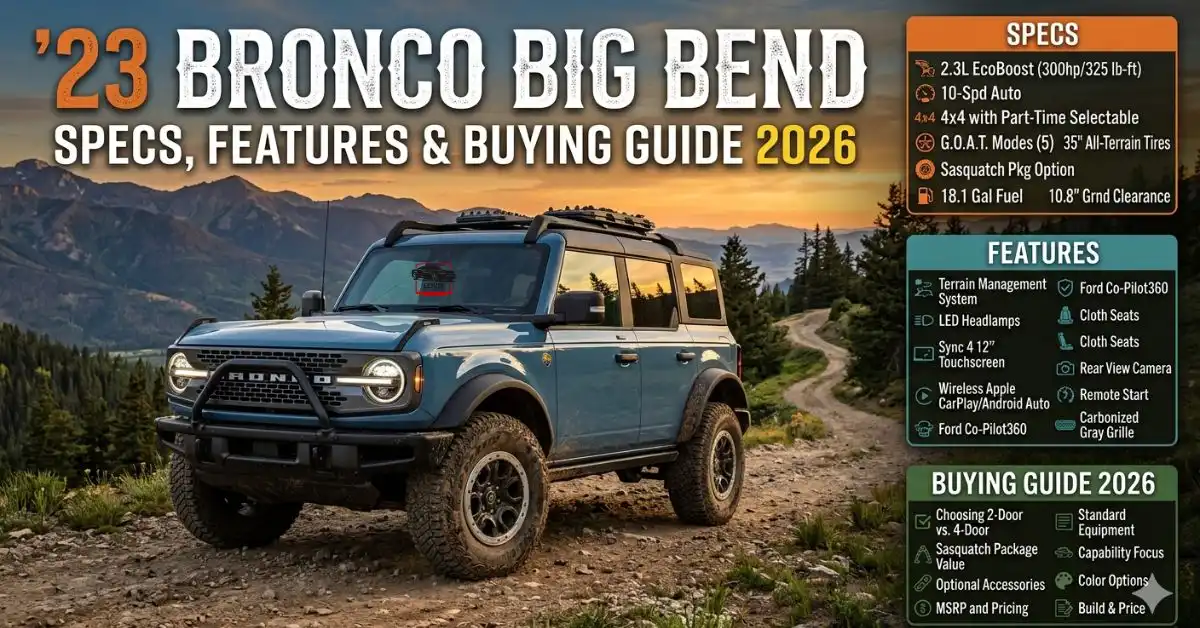
23 Bronco Big Bend: Specs, Features & Buying Guide 2026
Ford’s Bronco comeback has been one of the most talked-about automotive returns in recent memory. Since its relaunch in 2021, the 23 Bronco Big Bend has carved out a serious reputation as a capable, character-filled SUV that doesn’t apologize for what it is.
Among all the years in this generation, the 23 Bronco Big Bend — the 2023 model year in the Big Bend trim — holds a particularly sweet spot for buyers. It arrived with the kinks of the first two model years worked out, brought meaningful standard equipment improvements, and delivered the same trail-ready personality that made the Bronco famous in the first place.
If you’re shopping for a used or certified pre-owned Bronco in 2026, the 2023 model year is one of the smartest places to start your search. And within that lineup, the Big Bend trim consistently earns praise as the most balanced pick — enough capability to be genuinely useful off-road, enough comfort to be livable every day, and a price point that doesn’t require a second mortgage.
This guide covers everything you need to make a confident decision: full specs, standard and optional features, real-world driving impressions, trim comparisons, pricing expectations in 2026, and honest advice on what to watch for when buying one today.
Also Read: Bronco Big Bend Area 51: Best Review, Specs & Buying Guide
Why the 23 Bronco Big Bend Model Year Matters
Not all model years are created equal, and with the Bronco, the gap between 2021 and 2023 is noticeable.
The first year of production had well-documented growing pains — soft top quality issues, roof panel leaks, some supplier delays, and early assembly inconsistencies that frustrated buyers who had waited years for their orders. Ford addressed most of these through the 2022 model year, but 2023 was when the platform really hit its stride.
By the 23 Bronco Big Bend, Ford had refined the assembly process, resolved the persistent top-related complaints, improved interior fit and finish, and updated the SYNC 4 software to a more stable and responsive version. The result is a truck that feels more polished than its predecessors without losing any of the raw character that buyers fell in love with.
The 2023 model year also saw Ford adjust the standard equipment list on the Big Bend to better match what buyers were actually adding through options. Features that previously required an upgrade package were folded into the standard spec, making the base Big Bend a stronger value proposition than it had been in prior years.
For a 2026 buyer looking at the used market, these refinements translate directly into a more satisfying ownership experience and fewer headaches chasing down early production issues.
Also Read: Honda Pilot Elite 2023 Black: Specs, Features & Review
23 Bronco Big Bend: Full Specs Breakdown
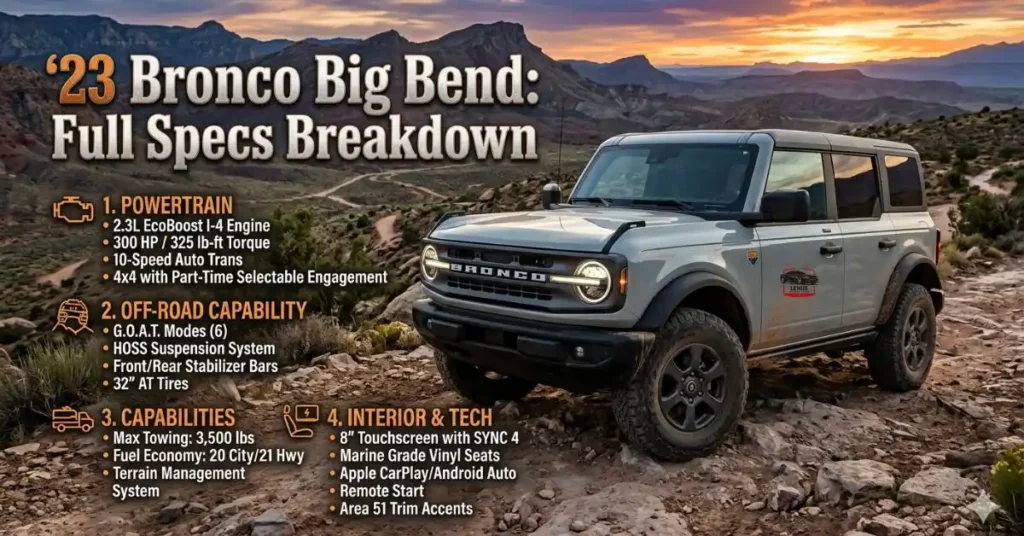
Let’s get into the numbers. Understanding what the 23 Bronco Big Bend offers on paper is the foundation of any smart buying decision.
Engine and Powertrain Options 23 Bronco Big Bend
The 2023 Big Bend gives you two engine choices, and both are genuinely good. The standard engine is the 2.3-liter EcoBoost four-cylinder, a turbocharged unit that produces 300 horsepower and 325 lb-ft of torque.
This engine is not a compromise — it pulls hard from low RPM, responds crisply to throttle inputs, and has a long track record of reliability across multiple Ford platforms including the Mustang, Explorer, and Ranger. For most buyers, the 2.3L is all the engine they’ll ever need.
The optional engine is the 2.7-liter EcoBoost V6, generating 330 horsepower and a substantial 415 lb-ft of torque. The V6 is the right pick if you plan to tow regularly, if you frequently carry four adults plus gear over long distances, or if you simply want the reassurance of extra grunt on steep climbs.
It costs more upfront and uses slightly more fuel, but it transforms the Bronco’s personality on challenging terrain.
Transmission choices include a 7-speed manual with a dedicated crawler gear — a proper low-speed ratio that operates independently of the main transmission — and a 10-speed SelectShift automatic.
The manual is a genuine enthusiast’s option and is increasingly rare in the SUV segment. The automatic is the more popular choice and shifts smoothly under everyday conditions while still managing off-road demands well.
Also Read: Best 2019 Honda Accord Sport 2.0T: Power, Specs & Guide
Four-Wheel Drive System 23 Bronco Big Bend
Every 23 Bronco Big Bend comes with Ford’s selectable four-wheel drive system as standard equipment. The system uses a dedicated rotary dial to switch between 2H, 4H, and 4L modes. The two-speed transfer case provides a proper low-range gear reduction — essential for technical trail work, steep descents, and rock crawling scenarios where you need maximum torque at minimum speed.
The Big Bend trim comes with an open front differential as standard. Buyers wanting locking differentials front and rear will need to add the Sasquatch Package or step up to the Badlands trim. That said, the standard four-wheel drive system with traction control intervention handles a wide range of off-road situations effectively before you start bumping into its limits.
Suspension and Dimensions 23 Bronco Big Bend
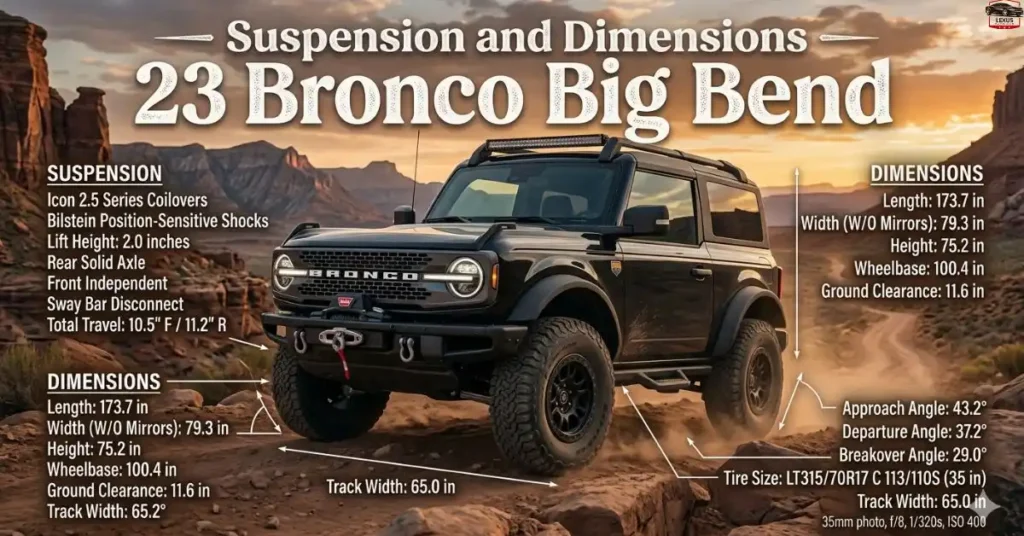
The Bronco uses an independent front suspension with a solid rear axle setup — a layout that balances on-road composure with the wheel articulation needed off-road. The ride height is set for trail work, with the four-door Big Bend offering 8.4 inches of ground clearance in standard configuration. Add the Sasquatch Package and clearance jumps to 11.6 inches — a dramatic improvement that opens up much more challenging terrain.
Two-door dimensions: 173.7 inches in length, 83.8 inches in width, and 71.9 inches in height. Four-door dimensions: 189.4 inches long, 83.8 inches wide, and 73.1 inches tall. The four-door is the more popular choice and offers a more practical rear seat for adult passengers.
Approach angle on the four-door Big Bend is 35.5 degrees. Departure angle is 30 degrees, and the breakover angle is 22.7 degrees. These numbers represent solid real-world trail capability even before any modifications.
Wheels, Tires, and Brakes 23 Bronco Big Bend
Standard fitment on the Big Bend is a 235/75R17 all-terrain tire on a 17-inch painted steel wheel. These tires are a genuine step above typical highway-biased rubber and provide meaningful grip in mud, gravel, and loose terrain. Step up to Sasquatch and you move to 315/70R17 tires — a significant width and height increase that dramatically changes the truck’s trail presence and traction.
Braking is handled by four-wheel disc brakes with electronic brake-force distribution and ABS as standard. The Trail Control system — which is standard on the Big Bend — uses the braking system to modulate individual wheel speed on rough terrain, effectively acting as off-road cruise control so the driver can focus entirely on steering line rather than throttle management.
Also Read: Best Lexus 4Runner 2023: GX 460 vs 4Runner Full Comparison
Towing and Payload 23 Bronco Big Bend
With the 2.3-liter engine, the 23 Bronco Big Bend is rated to tow 3,500 pounds. The 2.7-liter V6 raises that to 4,500 pounds. Payload capacity is approximately 1,030 pounds for the four-door configuration. These are not truck-beating figures, but they are entirely practical for towing a small boat, a motorcycle trailer, a lightweight pop-up camper, or equipment for a weekend adventure.
Standard Features on the 23 Bronco Big Bend
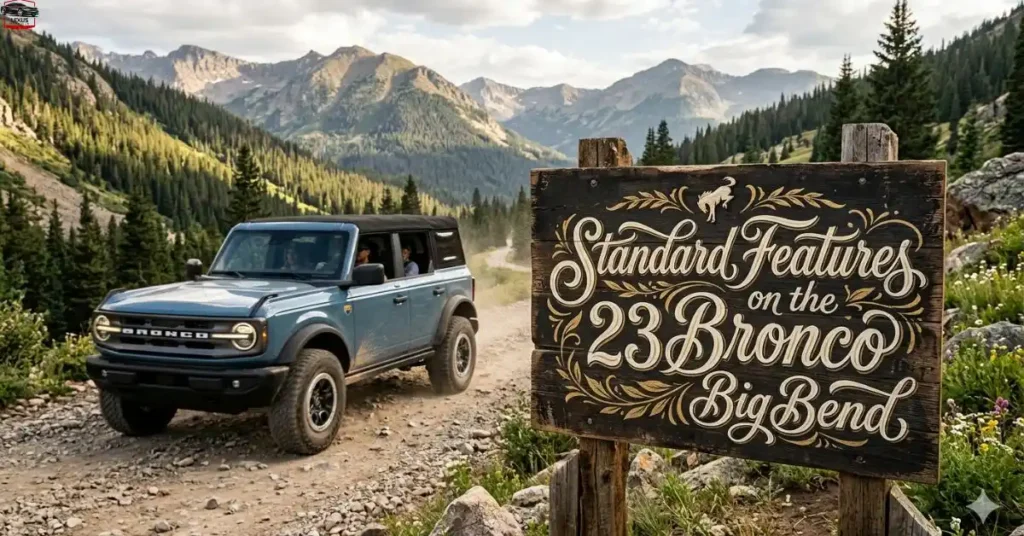
Part of what makes the Big Bend trim compelling is how much it includes without requiring you to build an options list just to get a usable vehicle. The 23 Bronco Big Bend comes well-equipped from the factory.
Inside, you get an 8-inch touchscreen running Ford’s SYNC 4 infotainment system. Wireless Apple CarPlay and Android Auto are standard — no cable required. The interface is clean, fast, and genuinely intuitive compared to many competitors.
Physical knobs handle climate control, which is exactly right for a vehicle that spends time off-road. Voice recognition is built in and works reasonably well for navigation and phone commands.
The standard audio is a six-speaker system that handles everyday listening without complaint. Buyers who prioritize sound quality can upgrade to the B&O Sound System option, which brings ten speakers and noticeably richer output — worth it if music matters to you on long drives.
Seating is cloth upholstery as standard with available Marine Grade Vinyl as an upgrade. The MGV seats are easy to clean after muddy trail days — a practical choice if you plan on using the Bronco the way it’s intended. Heated front seats are standard on the Big Bend, a small comfort feature that makes a big difference on cold mornings.
Also Read: Best 2024 Toyota Limited: Luxury Specs & Full Guide
The GOAT Modes selector is standard equipment and gives you seven terrain presets: Normal, Eco, Sport, Slippery, Sand, Mud/Ruts, and Rock Crawl. Each preset adjusts throttle mapping, traction control intervention thresholds, and transmission behavior to match the surface.
Rock Crawl in particular transforms the Bronco into a remarkably composed machine on technical terrain — throttle response becomes ultra-precise, and the system manages wheel slip with impressive sensitivity.
Trail Control, Ford’s off-road cruise control system, is also standard on the Big Bend. Set your desired crawl speed with the toggle, and the truck manages throttle and braking while you steer. It sounds like a luxury feature, but on long technical trails it genuinely reduces driver fatigue and improves line precision.
The signature removable doors and roof are standard Bronco features that carry over to the Big Bend. The two-door comes with a standard modular hardtop or an available soft top. The four-door can be configured with a full modular hardtop, a dual-top option combining hard and soft panels, or a full soft top.
Removing the doors is a process that takes around ten minutes per side once you’ve done it a few times, and driving doorless on a summer trail is an experience no competitor currently matches.
Also Read: Best 2023 Jeep Wrangler Sahara Price: Complete Buyer’s Guide
Available Option Packages Worth Knowing 23 Bronco Big Bend
The base Big Bend is a strong truck, but a few option packages genuinely change what the vehicle is capable of. Understanding these before you shop the used market helps you evaluate listings accurately.
The Sasquatch Package 23 Bronco Big Bend
This is the most important option available on the 23 Bronco Big Bend. The Sasquatch Package includes a 2-inch suspension lift, Bilstein position-sensitive dampers, locking front and rear Dana axles, a wider front track, and those 315/70R17 tires on beadlock-capable wheels.
The transformation is substantial — ground clearance jumps significantly, approach and departure angles improve, and the locking differentials open up terrain that would otherwise require a spotter and some careful tire selection.
A Big Bend with Sasquatch genuinely competes with the Badlands trim in terms of capability at a lower price point. On the used market, Sasquatch-equipped Big Bends command a premium and are worth paying it. If you’re buying used and trail use is on the agenda, prioritize finding a Sasquatch example over a standard-spec truck.
Also Read: Best 2022 Chevy Tahoe RST: Power, Style & Complete Guide
Tow Package 23 Bronco Big Bend
The Tow Package adds a Class III hitch receiver, a four-pin and seven-pin trailer wiring harness, and upgrades to the cooling system to handle sustained towing loads. If you plan to pull anything regularly, this is a practical addition and adds meaningful capability without impacting the driving experience.
Aux Switch Bank 23 Bronco Big Bend
The Auxiliary Switch Bank adds eight switches pre-wired to the dashboard, designed for aftermarket accessories like light bars, air compressors, and winches.
It’s a feature that serious overlanders and off-road enthusiasts genuinely use, and it simplifies accessory installation considerably compared to custom wiring. Not essential for casual buyers, but highly desirable if you plan to build the truck up over time.
On-Road and Off-Road Driving Experience

Reading spec sheets is necessary. Understanding how those specs translate into actual driving is what ultimately makes or breaks a purchase decision.
On paved roads, the 23 Bronco Big Bend drives with more composure than you might expect from a body-on-frame, solid-rear-axle SUV. The steering is weighted appropriately, feedback is honest, and the vehicle tracks straight without constant correction.
Wind noise is present above 60 mph — a natural consequence of the Bronco’s upright, boxy shape — and the ride is noticeably firmer than a crossover. These are trade-offs worth making, not flaws to apologize for. The Bronco is not trying to be a smooth highway cruiser, and buyers who approach it with realistic expectations find the on-road behavior more than acceptable for daily use.
City driving is actually where many buyers are pleasantly surprised. The tight turning radius, good outward visibility, and responsive throttle make the Bronco surprisingly easy to maneuver in parking lots and urban traffic. It doesn’t feel cumbersome the way some body-on-frame SUVs do in stop-and-go conditions.
Off-road, the Big Bend is where the truck’s personality comes fully alive. Engage 4L, dial in Rock Crawl mode, and the Bronco becomes a focused, deliberate machine. On graded dirt roads and gravel trails, the standard setup handles everything with ease.
On rockier terrain with embedded boulders and loose shale, the Sasquatch-equipped Big Bend starts to show its real capability. Wheel articulation is impressive, the suspension keeps tires planted through awkward angles, and the GOAT system’s real-time adjustments keep the truck moving forward without drama.
Water crossings are another Bronco strength. The standard wading depth is 33.5 inches — raised to 37.2 inches with the Sasquatch Package. That covers most creek crossings and seasonal water features without requiring snorkel modifications or nervous passengers.
Also Read: 2017 Jeep Grand Cherokee Overland: Ultimate Buyer’s Guide
23 Bronco Big Bend vs. Competing Trims
Shopping for the right Bronco means understanding where the Big Bend sits in the lineup and whether it’s actually the right trim for your use case.
The base Bronco is cheaper but gives up Trail Control, the heated seats, and some of the visual distinction that makes the Big Bend stand out. For buyers on a strict budget, the base works — but most people who drive both prefer the Big Bend’s additional standard equipment for the relatively modest price difference.
The Outer Banks trim is the comfort-focused step above the Big Bend. It adds a 12-inch touchscreen, more premium interior materials, and a more polished overall presentation. What it doesn’t add is meaningful off-road hardware. The Outer Banks is genuinely better if your driving is mostly pavement with the occasional forest road. If trail capability is part of your plan, the Big Bend with Sasquatch is the smarter spend.
The Badlands is the dedicated off-road trim with factory sway bar disconnect, locking differentials, and higher approach angles as standard equipment. It’s the right pick for buyers who consistently tackle demanding technical trails. For everyone else, a properly optioned Big Bend covers the same ground at lower cost.
The Wildtrak is the lifted, style-focused trim that blends off-road aesthetics with comfort priorities. It’s visually striking but sits in an odd position between the Outer Banks and Badlands without completely owning either role. The Big Bend is a cleaner proposition for buyers who know what they want.
What to Look For When Buying a Used 23 Bronco Big Bend in 2026
Buying a three-year-old Bronco in 2026 is a different exercise than buying new. The used market has matured, prices have settled from the early post-launch premiums, and certified pre-owned examples are available through Ford dealers. Here’s what to check carefully.
Inspect the roof and door seals thoroughly. Even though 2023 models largely resolved the early soft top issues, it’s worth checking for any signs of water intrusion, particularly around the A-pillars and front header. If the truck lived in a wet climate, look at the floorboards for any moisture staining.
Check the undercarriage. A Bronco that was genuinely used off-road may show scrapes on the skid plates, rock rash on the frame rails, or worn underbody components. Light trail use marks are normal and expected — they don’t indicate abuse. Bent or cracked skid plates, however, suggest harder use that warrants closer inspection of the suspension and drivetrain components.
Verify the four-wheel drive system engages and disengages cleanly in all modes. Test 4H and 4L engagement in a parking lot. Listen for any clunking or grinding when transitioning between modes, which can indicate transfer case wear from improper use — specifically, people engaging 4L at speed or using 4H on dry pavement habitually.
Check the differential fluid history if records are available. Locking differentials on Sasquatch-equipped trucks benefit from fluid changes after significant off-road use, and sellers don’t always maintain this.
Look at tire wear carefully. Uneven wear patterns can indicate alignment issues — not uncommon on trucks that have hit obstacles off-road — or suspension components that need attention.
Finally, run the full CARFAX or vehicle history report and cross-reference it with any visible evidence of hard use. Broncos that served purely as daily drivers will show very different wear patterns than those used aggressively on trails every weekend.
Pricing Expectations in 2026
The used market for the 23 Bronco Big Bend has found its natural level in 2026. The early dealer markups and allocation premiums are long gone. A clean, standard-spec four-door 2023 Big Bend with reasonable mileage generally trades in the $32,000 to $38,000 range depending on mileage, color, and regional demand.
Sasquatch-equipped examples command $3,000 to $5,000 above those figures. Certified Pre-Owned examples through Ford dealers sit at the higher end of the market but come with extended warranty coverage that adds genuine peace of mind.
Two-door examples are less common and tend to appeal to a specific buyer — the premium over four-door is modest and sometimes nonexistent given lower demand for the shorter configuration. If the two-door suits your lifestyle, it can represent good value in the current market.
Popular colors like Area 51, Eruption Green, and Antimatter Blue hold value better than more common colors like Oxford White or Cactus Gray, so expect to pay slightly more for a well-kept example in those finishes.
My Final Thoughts:
After everything covered in this guide, the answer for most buyers is yes — the 23 Bronco Big Bend is one of the most well-rounded used SUV purchases available in 2026 in its price range.
It delivers genuine off-road capability in a package that is livable every single day. The 2023 model year specifically benefits from Ford having worked through the early production issues, resulting in a more refined and reliable truck than 2021 or early 2022 examples. The Big Bend trim hits the intersection of value, capability, and practicality better than any other position in the Bronco lineup for the average buyer.
If you can find a Sasquatch-equipped example with low mileage and a clean history, buy it with confidence. If budget is the priority, a standard-spec Big Bend still offers more trail capability than most of its segment competitors and delivers a driving experience that genuinely stands apart from the crossover crowd.
The Bronco is not a perfect vehicle. It’s loud at highway speeds, the ride is firm, and fuel economy won’t impress anyone. But it is honest about what it is — and for buyers who want a real off-road machine that doubles as everyday transportation, that honesty is exactly the point.
Take your time with the purchase, inspect any used example carefully, and don’t skip the test drive on a surface that actually challenges the truck. The 23 Bronco Big Bend earns its reputation on the road and off it.
FAQs
What is the 23 Bronco Big Bend?
The 23 Bronco Big Bend is the 2023 Ford Bronco Big Bend trim, offering a balance of off-road capability, comfort, and everyday usability.
What engine comes in the 23 Bronco Big Bend?
The 2023 Bronco Big Bend typically features a 2.3L EcoBoost turbocharged engine, with additional powertrain options available on select models.
Is the 23 Bronco Big Bend good for off-roading?
Yes, it includes advanced 4×4 capability, G.O.A.T. Modes™ (Goes Over Any Terrain), and durable suspension components for off-road adventures.
What features are included in the 23 Bronco Big Bend?
Key features include all-terrain tires, a terrain management system, SYNC infotainment, removable doors and roof options, and driver-assistance technologies.
How many passengers can the 23 Bronco Big Bend seat?
Depending on the body style, the 2023 Bronco Big Bend can comfortably seat four to five passengers.

I’m M Ahmad Ansari, a Lexus enthusiast with 5+ years of hands-on experience across the entire lineup—from the RC F’s roaring V8 to the whisper-quiet RZ electric. I understand what separates Japanese luxury from the rest: obsessive engineering, unmatched reliability, and that refined driving feel you can’t find anywhere else. Whether it’s F Sport performance packages, hybrid technology, or choosing between new and certified models, I bring real-world knowledge and genuine passion for what makes Lexus exceptional.