2017 Audi Q7 Premium Plus: Specs, Review & Hidden Features
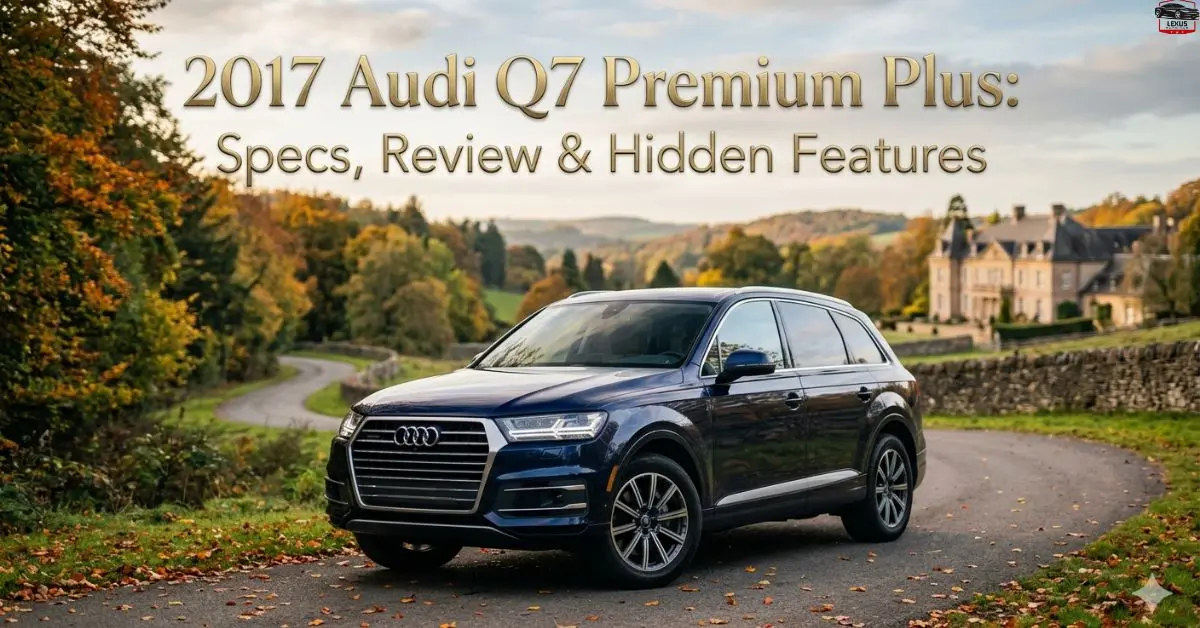
There is a certain kind of used luxury SUV that ages so well it almost feels unfair to buyers who paid full price at launch. The 2017 Audi Q7 Premium Plus falls squarely into that category. Seven years after its initial sale, it remains one of the most sophisticated, technology-rich, and genuinely comfortable three-row luxury SUVs available on the used market at any price point.
The second-generation Q7 — which the 2017 model belongs to — was a dramatic reinvention of the platform, shedding hundreds of pounds from its predecessor while gaining meaningful improvements in technology, interior quality, and driving refinement.
The Premium Plus sits in a critical position within the Q7 lineup. It is the middle trim between the entry-level Premium and the fully loaded Prestige, and it makes a compelling argument that it is the sweet spot of the range — equipped with most of the features buyers actually use and value while avoiding the Prestige’s price premium for content that matters less in daily life.
For a used buyer in 2026, the 2017 Audi Q7 Premium Plus represents an extraordinary amount of vehicle for the money.
This article covers everything — full specifications, drivetrain details, the technology features that were groundbreaking for the era, the hidden features many owners never discover, real-world driving impressions, ownership considerations, and an honest assessment of where this vehicle stands in the used market today. Whether you are actively shopping or simply doing your research, this is the guide that answers all the questions.
Also Read: 2021 Jeep Cherokee Altitude for Sale: Best Deals & Specs
The Second-Generation Q7: Why 2017 Matters
Context matters when evaluating any used vehicle, and the 2017 Q7’s context is important. The second generation launched in 2016, and by 2017 Audi had addressed the handful of early production quirks that showed up in the first year.
The 2017 model year represents a fully matured first run of this generation — the improvements were incorporated, the software was more stable, and the overall production quality reflected a platform that Audi’s engineering team had fully dialed in.
The weight reduction over the first-generation Q7 was remarkable — Audi shed approximately 325 pounds from the platform through extensive use of ultra-high-strength steel and aluminum in the body structure. The result is an SUV that handles with considerably more agility than its size suggests, responds more crisply to throttle inputs, and achieves better fuel economy than its predecessor despite delivering more power.
The interior was completely redesigned for the second generation, introducing Audi’s then-new MMI Touch interface, a virtual cockpit digital instrument cluster, and a level of build quality and material refinement that set a new benchmark in the luxury SUV segment for its era. Walking into a well-maintained 2017 Q7 interior in 2026 still feels like stepping into a vehicle that takes craftsmanship seriously.
Also Read: GMC Acadia Denali Black Diamond Edition: Specs & Review
2017 Audi Q7 Premium Plus: Full Specifications
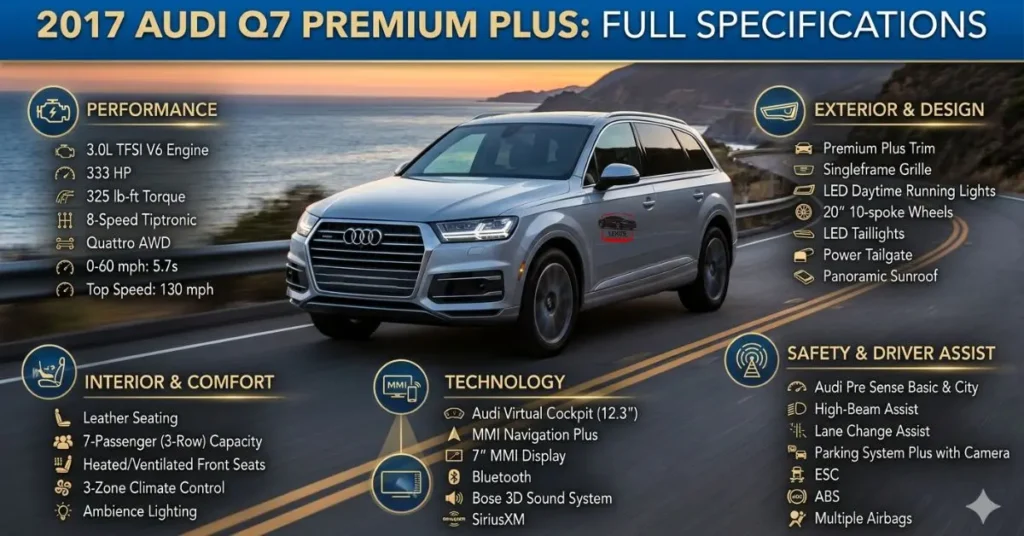
Understanding the complete technical specification of the 2017 Audi Q7 Premium Plus is essential before any purchase decision. Here is the thorough breakdown across every relevant category.
Engine and Powertrain 2017 Audi Q7 Premium Plus
The 2017 Q7 Premium Plus is powered by a 2.0-liter turbocharged four-cylinder TFSI engine producing 252 horsepower and 273 lb-ft of torque. This is the standard engine for the Premium Plus configuration in the United States market, and despite being a four-cylinder in a three-row luxury SUV, it performs substantially better than those numbers might initially suggest.
The torque delivery is broad and accessible from low RPM, which means the engine pulls confidently from a standstill and handles highway on-ramp acceleration without strain.
The optional — and highly desirable — engine for the 2017 Q7 is the 3.0-liter supercharged V6 TFSI unit, producing 333 horsepower and 325 lb-ft of torque. This engine transforms the Q7’s character entirely.
Where the 2.0-liter is adequate and efficient, the supercharged V6 is genuinely exciting — instantaneous torque delivery from the positive-displacement supercharger eliminates lag completely, and the engine pulls smoothly and powerfully throughout the entire rev range.
When shopping used examples, prioritizing a V6-equipped Premium Plus is worth the additional cost for buyers who value performance and long-distance confidence.
Both engines are paired with an eight-speed Tiptronic automatic transmission that is one of the better gearboxes in the luxury SUV segment. Shifts are smooth and well-timed in everyday driving, and the manual Tiptronic gate allows precise driver control when a more engaged experience is desired.
The transmission adapts its shift patterns based on driving style over time — a feature that becomes noticeable after extended ownership as the gearbox learns your preferences.
Also Read: 23 Bronco Big Bend: Specs, Features & Buying Guide 2026
Quattro All-Wheel Drive System 2017 Audi Q7 Premium Plus
All-wheel drive is standard on every Q7 sold in North America, and the Quattro system fitted to the 2017 model is one of the most sophisticated AWD setups in the luxury SUV segment. The system uses a center differential that distributes torque in a default 40/60 front-to-rear split, biased toward the rear for a more natural driving balance.
Under wheelspin conditions, the system can redirect up to 70 percent of torque to the front axle or up to 85 percent to the rear — a range that covers virtually every traction scenario a Q7 buyer will encounter.
The optional air suspension — standard on many Premium Plus configurations and worth confirming on any specific example — works in conjunction with the Quattro system to provide adjustable ride height.
The system raises the Q7’s ground clearance for off-road or rough-road use and lowers it at highway speeds for improved aerodynamics and handling stability. This feature is a meaningful contributor to the Q7’s unusually broad capability range.
2017 Audi Q7 Premium Plus Suspension, Ride, and Handling
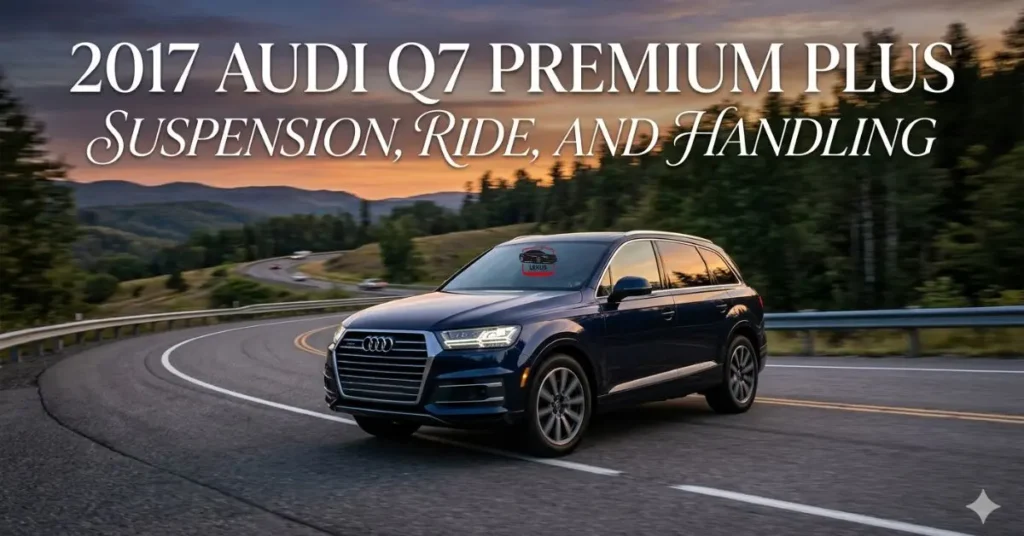
The standard suspension on the 2017 Q7 is a steel spring setup with adaptive dampers — a system that adjusts damping force in real time based on road surface input and selected drive mode. The air suspension is an option that many Premium Plus buyers selected, and its presence on a used example significantly improves the vehicle’s versatility and long-distance comfort.
Drive modes — selectable through the MMI system or the Drive Select button — include Comfort, Auto, Dynamic, and Efficiency, plus an Individual mode that allows custom combinations of settings. In Comfort mode, the Q7 is a genuinely relaxed long-distance cruiser.
In Dynamic mode, the steering weight increases, throttle response sharpens, the transmission holds gears longer, and the adaptive dampers firm up to transform the vehicle’s handling character into something that feels almost sporty for a vehicle of this size.
Steering is electric-assisted and well-calibrated for a luxury SUV — precise enough to place the vehicle accurately on winding roads, light enough for effortless city driving. Body roll is well-controlled without sacrificing ride quality, and the low center of gravity achieved through the weight reduction program gives the Q7 a planted, confidence-inspiring feel in corners that full-size SUVs rarely match.
Also Read: Bronco Big Bend Area 51: Best Review, Specs & Buying Guide
2017 Audi Q7 Premium Plus Dimensions and Interior Space
The 2017 Q7 is a genuine three-row SUV with dimensions that reflect its family-hauler capability. Overall length is 198.9 inches, width is 78.1 inches, and height is 68.0 inches. The wheelbase of 117.9 inches is the critical number for interior space — it’s a long wheelbase for the segment and directly enables the generous second-row legroom.
First-row legroom is 41.3 inches with the standard power adjustable seats. Second-row legroom is 40.5 inches — genuinely excellent for adult passengers and among the best figures in the luxury midsize SUV class.
The second row slides fore and aft on the Premium Plus, allowing occupants to optimize the balance between second and third-row space. Third-row legroom is 33.4 inches — the most useful third-row figure in the segment for this era and genuinely accommodating for adults on medium-length journeys.
Cargo space is 14.8 cubic feet behind the third row, 45.9 cubic feet with the third row folded, and 71.6 cubic feet with both rear rows folded. These figures are practical and competitive for the vehicle’s mission as a premium family hauler.
Also Read: Honda Pilot Elite 2023 Black: Specs, Features & Review
2017 Audi Q7 Premium Plus Performance and Efficiency
The 2.0-liter Q7 Premium Plus reaches 60 mph from standstill in approximately 7.1 seconds — respectable for a three-row luxury SUV. The V6 cuts that to 5.7 seconds, a figure that genuinely impresses in a vehicle of this size and weight.
Fuel economy on the 2.0-liter is rated at 19 mpg city and 25 mpg highway. The supercharged V6 achieves 17 mpg city and 25 mpg highway — the highway figures are essentially equal thanks to the V6’s ability to cruise at lower throttle loads.
Maximum towing capacity is 7,700 pounds when properly equipped — a class-leading figure that surpasses most competitors at this size and price point. This is a meaningful differentiator for buyers who need to tow boats, horse trailers, or utility loads that other luxury SUVs cannot handle confidently.
Interior Quality and Standard Features on the Premium Plus
The interior of the 2017 Audi Q7 Premium Plus is where the vehicle makes its strongest case as a compelling used purchase in 2026. Audi’s interior quality standards for this generation were exceptional, and the materials, fit, and finish hold up remarkably well with proper care.
Standard seating in the Premium Plus is leather with available Nappa leather as an upgrade — many used examples will have the more supple Nappa leather, which is worth verifying. Front seats are power adjustable with memory settings for two drivers — a feature that families with multiple drivers genuinely appreciate.
Heated front and second-row seats are standard on the Premium Plus, and ventilated front seats are available as an option frequently found on used examples. The dashboard is finished in a combination of genuine open-pore wood inlays, aluminum trim, and soft-touch materials on every surface that a hand or arm contacts.
There is no hard plastic in the Q7’s cabin in any area that matters — a level of material investment that luxury competitors at similar price points do not always match. The headliner is genuine Alcantara on most Premium Plus configurations, contributing to a sense of quality that extends upward as well as around the occupants.
The MMI Navigation Plus system with the 8.3-inch retractable screen is standard on the Premium Plus. The system uses a rotary controller with touch-sensitive surface on the center console for primary input — a layout that keeps the driver’s eyes forward while navigating menus.
Apple CarPlay was not available as a factory option on 2017 models due to a software licensing delay, but Audi offered a retrofit program in subsequent years and many used examples have had CarPlay added through dealership or third-party retrofit. Confirm whether the specific example you’re considering has this upgrade.
The Audi Virtual Cockpit — a 12.3-inch fully digital instrument cluster replacing conventional analog gauges — is standard on the Premium Plus. This system allows the driver to display full-screen navigation maps directly in the instrument cluster, eliminating the need to look away from the road to the center-stack screen for turn-by-turn guidance. In 2017, this was genuinely cutting-edge technology, and it remains impressive and functional in 2026.
Also Read: Best 2019 Honda Accord Sport 2.0T: Power, Specs & Guide
Hidden Features Many 2017 Q7 Owners Never Discover

One of the genuine pleasures of owning a well-equipped Audi is discovering the depth of features buried beneath the obvious surface-level technology. The 2017 Audi Q7 Premium Plus has a number of these hidden or underappreciated capabilities that many owners never fully explore.
The Convenience Key System of 2017 Audi Q7 Premium Plus
The Q7’s advanced key system goes beyond standard proximity unlocking. The vehicle can be unlocked and started without ever removing the key from a pocket or bag — standard behavior for keyless entry — but the system also incorporates door handle sensors that lock the vehicle when you walk away and touch the handle from outside.
Many owners use the remote key for years without realizing the touch-to-lock capability is built into the door handle itself, eliminating the need to press any button to secure the vehicle.
Drive Select Hidden Profiles 2017 Audi Q7 Premium Plus
The Drive Select system’s Individual mode stores custom settings for every adjustable parameter — steering weight, throttle response, suspension calibration, and transmission behavior. What many owners miss is that the Individual profile saves separately from all other modes and remembers settings across ignition cycles.
You can configure your exact preferred combination once and return to it every time without readjusting. The system also allows different Individual profiles to be stored against different driver memory seat positions — driver one and driver two can each have their own custom drive character recalled automatically when they adjust the seat to their saved position.
Also Read: Best Lexus 4Runner 2023: GX 460 vs 4Runner Full Comparison
Predictive Adaptive Cruise Control 2017 Audi Q7 Premium Plus
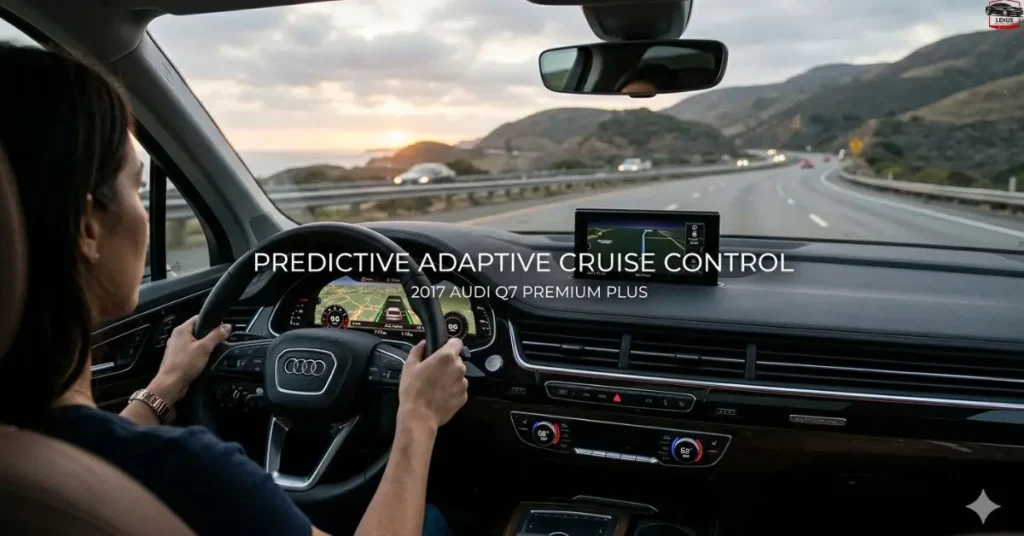
The adaptive cruise control system on properly equipped Premium Plus examples uses navigation map data to anticipate speed changes before they happen.
Approaching a mapped corner, the system reads the required speed for that radius from the navigation database and begins reducing speed in advance — a capability that makes the cruise control feel more natural and less reactive than systems that rely purely on radar.
Most owners who use adaptive cruise control never realize the system is using map data actively rather than just responding to the vehicle ahead.
Parking System Plus with Surround View
The Park Assist system on the Q7 includes a semi-automatic parking feature that steers the vehicle into parallel and perpendicular spaces while the driver manages only the throttle and brake. The system measures spaces as you drive past them, identifies gaps large enough for the vehicle, and guides you through the maneuver with audio and visual prompts.
Most owners who have good spatial awareness and confidence parking manually never activate this feature, but it is genuinely impressive in tight urban environments and worth knowing how to use.
2017 Audi Q7 Premium Plus Rear Side Window Sun Shades
Built into the rear door panels of every 2017 Q7 are deployable roller sun shades for the rear side windows. These are operated by a small pull handle at the base of the window frame and extend upward to block direct sunlight on rear passengers.
In warmer climates, they are extremely useful for families with children, but they are tucked away so discreetly that many owners discover them only years into ownership — if at all.
Also Read: Best 2024 Toyota Limited: Luxury Specs & Full Guide
Ambient Lighting Customization
The ambient lighting system — standard on the Premium Plus — provides selectable color options for the interior illumination strips that line the doors, footwells, and dashboard. Through the MMI menu, owners can select from a range of colors to set the cabin mood.
Most owners select a color at delivery and never revisit the setting, unaware that the full spectrum of options remains available and easily accessible through the lighting submenu.
Highway Lane Assist at Speed 2017 Audi Q7 Premium Plus
The lane keeping assist on properly equipped Q7 examples operates differently at higher speeds than at lower ones. Below approximately 40 mph, it provides gentle steering corrections to maintain lane position.
Above 65 mph on the highway, the system becomes more active and will hold the vehicle centered in its lane with enough steering authority to maintain position without constant driver input on well-marked highways.
Combined with adaptive cruise control, this creates a proto-highway-assist system that anticipates what later full-stack driver assistance features would formalize — and many owners never push the system’s capability to find its upper operating envelope.
Also Read: Best 2023 Jeep Wrangler Sahara Price: Complete Buyer’s Guide
Real-World Driving Experience 2017 Audi Q7 Premium Plus
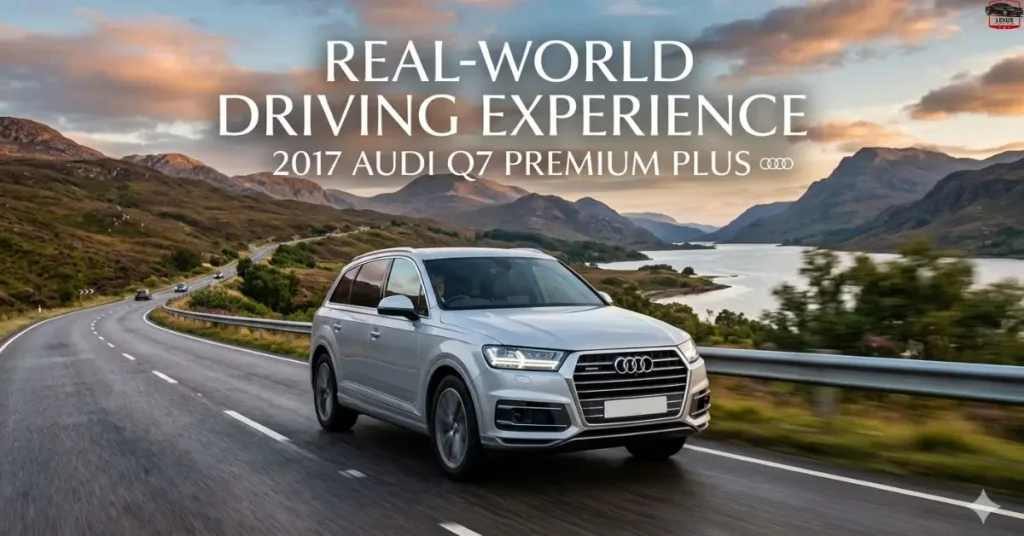
Reading about a vehicle’s specifications and features tells part of the story. What the 2017 Audi Q7 Premium Plus feels like on the road tells the rest.
From the driver’s seat, the Q7’s most immediately striking quality is how small it feels for its actual size. The driving position is commanding without being elevated to the point of SUV cliché, the outward visibility is excellent, and the controls — MMI rotary, drive select, air suspension height if equipped — all fall naturally to hand.
The interior noise level is among the best in its class, with road, wind, and powertrain sounds suppressed to a level that allows comfortable conversation at highway speeds without raising voices.
The supercharged V6, for buyers fortunate enough to find that configuration, delivers one of the most satisfying powertrain experiences in the used luxury SUV market. The absence of turbo lag — a fundamental characteristic of positive-displacement supercharging — means power is always available immediately regardless of engine speed.
Pressing the throttle in city traffic, on a highway on-ramp, or mid-corner on a winding road produces instant, linear response that builds consistently to the top of the power band. It sounds mechanical in the best possible way — a subtle, purposeful intake note under hard acceleration that communicates effort without dramatics.
On poor road surfaces, the air-suspended Q7 manages broken pavement and expansion joints with an ease that steel-sprung competitors cannot match. The air springs absorb sharp impacts and distribute them gradually through the cabin — a fundamentally different ride character than even well-calibrated steel suspension provides.
Long highway journeys in a well-maintained air-suspended 2017 Q7 are genuinely relaxing in a way that remains remarkable given the vehicle’s age.
Ownership Considerations and Common Issues
An honest review of any used vehicle must address the ownership realities alongside the engineering strengths. The 2017 Audi Q7 Premium Plus is a well-built machine, but it is a complex German luxury vehicle with age and mileage — and that combination deserves realistic expectation-setting.
The air suspension, if equipped, is the component most worth scrutinizing on any used example. Air spring failures — either the air bags themselves or the compressor that maintains pressure — are a known wear item on air-suspended vehicles.
A failing air suspension announces itself through uneven ride height, longer-than-normal leveling times after startup, or a compressor that runs audibly for extended periods. Repair costs vary but can reach $1,500 to $3,000 per corner for genuine Audi parts.
Verifying the air suspension’s condition through a full leveling test and a pre-purchase inspection is non-negotiable. The MMI system’s hard drive — the vehicle uses an internal hard drive for navigation map storage and media — can fail in older examples with high accumulated runtime.
Symptoms include slow system startup, navigation errors, or MMI lockups. A failing MMI hard drive is generally a $500 to $1,200 repair depending on whether the unit is rebuilt or replaced. Ask the seller about any MMI issues in the ownership history.
Oil consumption is a characteristic of the 2.0-liter TFSI engine that some owners report — particularly at higher mileage. Checking the oil level at the inspection and asking about consumption history is worth doing.
The supercharged V6 has no notable oil consumption issues and is generally considered the more mechanically straightforward long-term ownership proposition. Regular maintenance on any Audi requires quality parts and competent service.
Independent shops specializing in German vehicles are a cost-effective alternative to dealer servicing for routine maintenance while ensuring the work is performed to appropriate standards. Budget for maintenance costs that exceed domestic brand equivalents — this is a real and consistent characteristic of German luxury vehicle ownership that should be factored into the total cost calculation.
Pricing on the Used Market in 2026
The used market pricing for the 2017 Audi Q7 Premium Plus in 2026 reflects a vehicle that has depreciated substantially from its original MSRP while retaining strong demand from buyers who recognize its enduring quality.
A 2.0-liter FWD — though AWD is universal in the US, FWD was occasionally specified for fleet use — with 60,000 to 80,000 miles in clean condition sits in the $22,000 to $28,000 range. The more desirable supercharged V6 Premium Plus with similar mileage runs from $26,000 to $33,000 in comparable condition.
Air-suspended examples command a $1,500 to $3,000 premium over steel-spring configurations — justified by the significant improvement in ride quality and versatility. 2017 Audi Q7 Premium Plus examples with the Bose premium audio upgrade, panoramic sunroof, and ventilated front seats naturally sit at the upper end of the range.
Clean, well-documented single-owner examples with full service history will attract premium pricing and warrant it.
My Final Thoughts:
For the buyer who approaches the purchase with eyes open, the 2017 Audi Q7 Premium Plus is one of the most compelling used luxury SUV purchases available in 2026. It delivers a level of interior quality, technology sophistication, and driving refinement that competitors at the same price point struggle to match.
The Virtual Cockpit, adaptive air suspension, Quattro AWD, class-leading towing capacity, and genuinely usable third row combine into a package that remains relevant and impressive nearly a decade after its manufacture.
The hidden features scattered throughout the vehicle reward thorough exploration and contribute to an ownership experience that deepens over time rather than becoming familiar and routine. From the predictive adaptive cruise control to the touch-to-lock door handles, the Q7 consistently reveals new capabilities to attentive owners.
Approach the purchase with a thorough pre-purchase inspection, prioritize the V6 engine and air suspension if your budget allows, verify MMI and air suspension health specifically, and maintain the vehicle to the standards it deserves. Do all of that, and the 2017 Audi Q7 Premium Plus will provide years of luxurious, capable, and genuinely satisfying ownership.
Always obtain a full vehicle history report, have the air suspension independently inspected, and confirm service history completeness before committing to any used luxury vehicle purchase. The due diligence investment protects you comprehensively against surprises that even well-presented vehicles occasionally hide.
FAQs
What engine comes with the 2017 Audi Q7 Premium Plus?
The 2017 Audi Q7 Premium Plus is commonly equipped with a 3.0L supercharged V6 engine that delivers strong performance and smooth acceleration.
Does the 2017 Audi Q7 Premium Plus have all-wheel drive?
Yes, the Q7 Premium Plus comes with Audi’s renowned quattro all-wheel-drive system for enhanced traction and stability.
How many passengers can the 2017 Audi Q7 Premium Plus seat?
The SUV features three rows of seating and can accommodate up to seven passengers, depending on configuration.
What luxury features are included in the 2017 Audi Q7 Premium Plus?
Key features include leather seating, a panoramic sunroof, advanced infotainment, premium audio options, and driver-assistance technologies.
Is the 2017 Audi Q7 Premium Plus a good family SUV?
Yes, it offers a spacious cabin, strong safety ratings, comfortable seating, and versatile cargo space, making it an excellent family vehicle.

I’m M Ahmad Ansari, a Lexus enthusiast with 5+ years of hands-on experience across the entire lineup—from the RC F’s roaring V8 to the whisper-quiet RZ electric. I understand what separates Japanese luxury from the rest: obsessive engineering, unmatched reliability, and that refined driving feel you can’t find anywhere else. Whether it’s F Sport performance packages, hybrid technology, or choosing between new and certified models, I bring real-world knowledge and genuine passion for what makes Lexus exceptional.