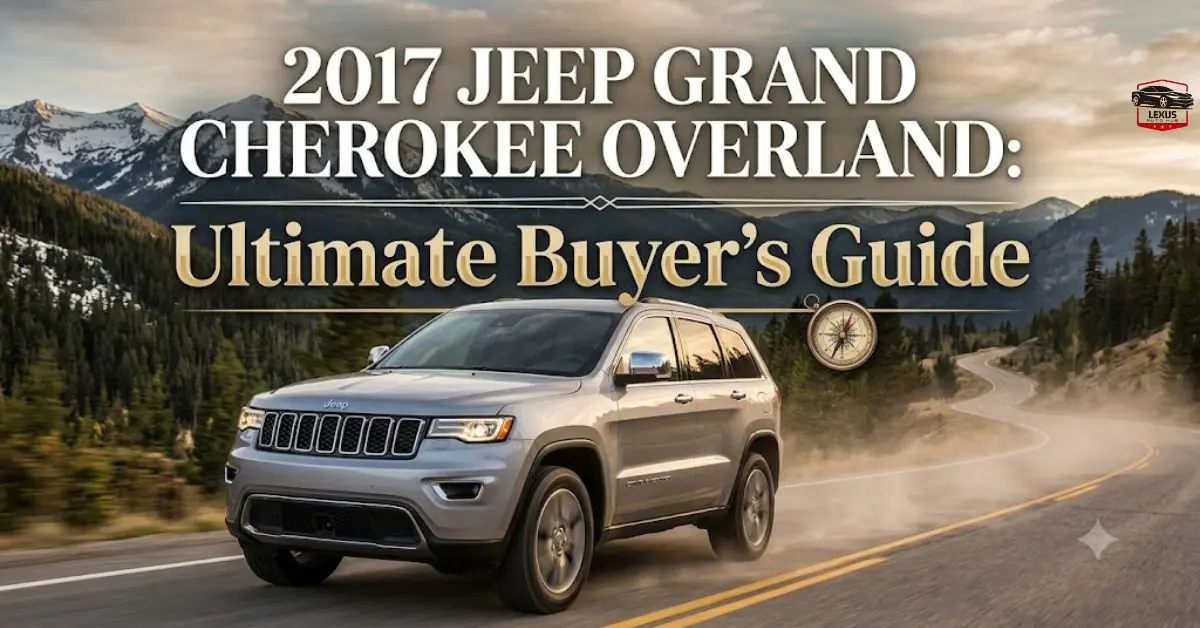
2017 Jeep Grand Cherokee Overland: Ultimate Buyer's Guide
There are few nameplates in the American automotive world that carry as much weight as the Jeep Grand Cherokee. It has been a benchmark in the midsize SUV segment for decades, and the 2017 model year represents one of the most polished versions of this vehicle that Jeep has ever produced.
Within that lineup, one trim stands out above the rest for buyers who want a genuine balance of luxury, capability, and everyday practicality the 2017 Jeep Grand Cherokee Overland. This guide covers every aspect of this SUV in depth, so whether you are shopping used or simply want to understand what you are dealing with, you will have all the information you need before making a decision.
Also Read: Best Infiniti Q50 3.0T: Specs, Performance & Full Review
Short Answer About 2017 Jeep Grand Cherokee Overland
The 2017 Jeep Grand Cherokee Overland is a premium midsize SUV that blends luxury with legendary Jeep capability. It offers a refined interior, available V6 and V8 engine options, advanced technology, and impressive off-road performance.
With comfortable seating, high-quality materials, and practical cargo space, it serves as an excellent choice for both everyday driving and weekend adventures. Its combination of comfort, versatility, and rugged capability continues to make it a popular option in the used SUV market.
The Grand Cherokee Overland: What It Stands For
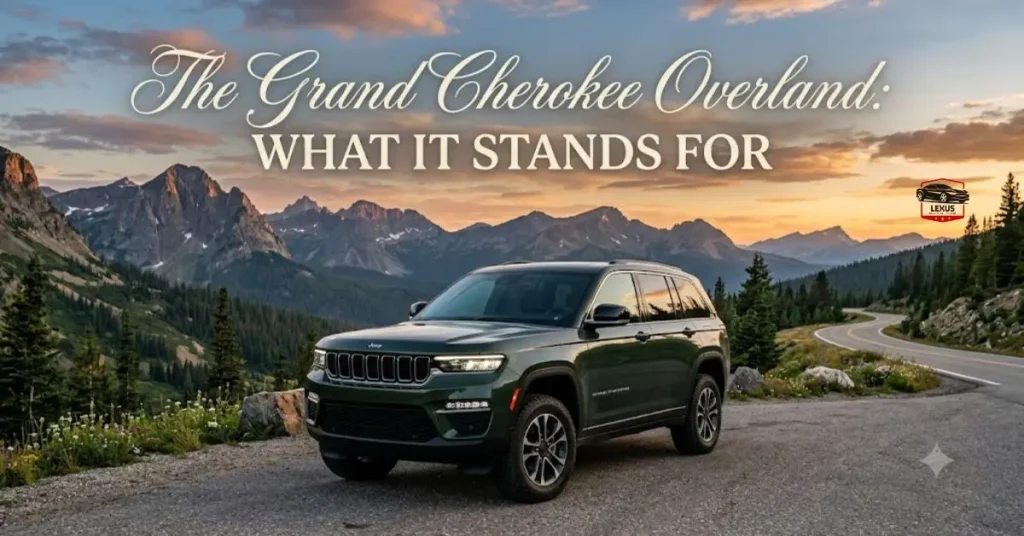
The Overland name has a long history in the Jeep world. It was originally used on the Willys-Overland vehicles that predated the modern Jeep brand, so attaching that badge to the top-tier Grand Cherokee trim is a deliberate nod to heritage.
In practical terms, the Overland sits one level above the Limited and one level below the Summit in the 2017 Grand Cherokee trim structure. It occupies that sweet spot where premium materials and serious off-road capability exist together without compromise.
What separates the 2017 Jeep Grand Cherokee Overland from lesser trims is not just a list of added features.
The Overland represents a philosophy — the idea that an SUV should not force you to choose between arriving at a trailhead in comfort or arriving there at all. The leather is stitched better, the suspension is tuned more carefully, and the technology package is more comprehensive than anything you get in the trims below it.
For the used car buyer in particular, this trim level is significant. Because the Overland was priced at a premium when new, it tends to hold more features per dollar than base or mid-level trims when shopping the used market. You get genuinely upscale hardware at prices that have softened considerably with depreciation.
Also Read: 2023 Honda Pilot EX-L 8 Passenger: Specs & Features Guide
Engine Options Available on the 2017 Grand Cherokee Overland
One of the strengths of the 2017 Jeep Grand Cherokee Overland is the range of engine choices Jeep offered. Unlike many SUVs that give you one or two powertrain options, the Grand Cherokee Overland came with three distinct choices, each targeting a different kind of buyer.
The standard engine is the 3.6-liter Pentastar V6, producing 295 horsepower and 260 lb-ft of torque. This is a proven, reliable unit that has powered millions of Chrysler and Jeep vehicles over the years. It delivers adequate performance for daily driving and light towing, returns reasonable fuel economy, and costs less to maintain than the larger options. For buyers who primarily use their SUV for family duties and occasional light trails, this engine is 2017 Jeep Grand Cherokee Overland more than sufficient.
The second option is the 5.7-liter HEMI V8, which bumps output to 360 horsepower and 390 lb-ft of torque. This engine transforms the character of the vehicle considerably. Acceleration becomes effortless, the towing capacity jumps to 7,200 pounds, and the exhaust note takes o2017 Jeep Grand Cherokee Overland n that distinctive rumble that HEMI fans know well.
Fuel economy drops relative to the V6, but the trade-off in capability is significant for buyers who regularly tow trailers, boats, or campers.
The third and most interesting option is the 3.0-liter EcoDiesel V6. This turbocharged diesel engine produces 240 horsepower and an impressive 420 lb-ft of torque.
That torque figure rivals the V8 for real-world pulling power, but the diesel returns substantially better fuel economy — often reaching 27 to 28 mpg on the highway. It is the engine of choice for long-distance drivers, frequent highway travelers, and anyone who needs towing capacity without constant fuel stops.
All three engines are paired with an 8-speed automatic transmission that shifts smoothly and intelligently across driving conditions. The gearbox adapts well to both leisurely cruising and more demanding driving scenarios.
Also Read: Best Stormy Sea Santa Fe 2023: Photos, Specs & Features
Four-Wheel Drive Systems and Off-Road Capability
The 2017 Jeep Grand Cherokee Overland comes standard with Quadra-Trac II, a full-time four-wheel drive system that requires no driver input to activate. It reads traction conditions continuously and shifts torque between axles automatically. For the vast majority of buyers who encounter wet roads, snow, and light dirt trails, this system is entirely adequate and genuinely transparent in use.
Buyers who want more serious off-road hardware can opt for the Quadra-Drive II system, which adds an electronic rear limited-slip differential. This rear locker can send up to 100 percent of torque to a single rear wheel when traction conditions demand it, which makes a meaningful difference on loose surfaces, steep grades, and technical terrain where standard open differentials would leave you spinning.
The Overland trim also comes with Selec-Terrain, Jeep’s terrain management system that allows the driver to select between Auto, Snow, Sport, Sand/Mud, and 2017 Jeep Grand Cherokee Overland Rock modes.
Each mode adjusts throttle response, transmission behavior, stability control thresholds, and four-wheel drive torque distribution to suit the specific conditions. Rock mode, in particular, is impressively capable — activating the rear locker, maximizing crawl control, and allowing the truck to claw through obstacles that would stop most unibody SUVs cold.
Ground clearance on the standard suspension sits at 8.6 inches. For buyers who want more, the optional Quadra-Lift air suspension raises that clearance to 10.8 inches in its maximum Off-Road 2 setting — placing the Grand Cherokee in genuine off-road territory that most crossover competitors cannot match.
Suspension, Ride Quality, and On-Road Behavior
Where many truck-based SUVs ask you to tolerate a choppy, truck-like ride as the price of off-road capability, the 2017 Jeep Grand Cherokee Overland largely avoids that compromise. The standard steel spring suspension is well-tuned and offers a comfortable, composed ride on pavement. Body motions are controlled without feeling harsh, and the SUV tracks straight and confidently on the highway.
The optional Quadra-Lift air suspension, which is available on Overland models, elevates the experience further. It raises and lowers the vehicle automatically based on speed and driver input, dropping to a lower position at highway speeds to improve aerodynamics and fuel economy, then rising for departure clearance when leaving a parked position. The air suspension also significantly smooths out rough roads compared to the steel spring alternative.
Steering is accurate without being sporty. The Grand Cherokee is a large, heavy vehicle, and Jeep wisely tuned the steering to prioritize stability and ease over razor-sharp response. Highway lane changes are confident, and the turning radius is manageable in parking situations despite the vehicle’s size.
Handling in corners is decent for an SUV of this size and mass. Roll is present but well controlled, and the chassis feels balanced enough to give the driver confidence during spirited driving. This is not a vehicle that was designed to attack mountain switchbacks, but it is equally not a vehicle that feels clumsy or nervous when driven with some enthusiasm.
Also Read: 2023 Nissan Sentra SV Blue: Stunning Look & Features
Interior Features and Cabin Quality on the Overland Trim
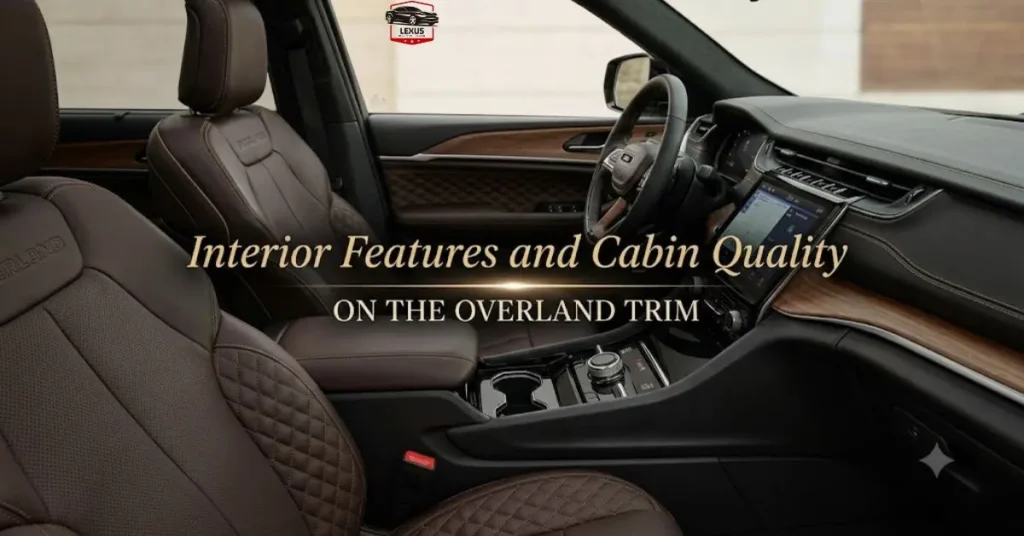
The interior of the 2017 Jeep Grand Cherokee Overland is where this SUV makes its strongest statement. Jeep equipped the Overland with Nappa leather seating surfaces — a semi-aniline leather that is noticeably softer and more supple than the standard leather found in the Limited trim below. The front seats are heated and ventilated, and the driver’s seat offers a wide range of electrical adjustments to dial in the perfect driving position.
Rear passengers are well looked after too. Second-row seats are heated in the Overland, which is a feature many competitors reserve for premium trims. Legroom in the rear is generous, and the recline angle is comfortable enough for longer journeys.
The panoramic sunroof, available as an option, opens the 2017 Jeep Grand Cherokee Overland cabin considerably and makes the rear seats feel airy and welcoming.
Wood trim accents run across the dashboard and door panels, and they are genuine pieces rather than printed plastic film. The dashboard itself is well organized, with physical controls for critical climate functions sitting below the central touchscreen where they are easy to reach without menu navigation. Soft-touch materials cover the primary touchpoints, and panel fit and finish are consistent throughout.
Cargo space is competitive at 36.3 cubic feet behind the rear seats, expanding to 68.3 cubic feet with the rear seats folded flat. The load floor is relatively low and accessible, and the power liftgate opens hands-free by waving a foot under the rear bumper — a genuinely useful feature when your arms are full.
Also Read: 2020 Jeep Wrangler Unlimited Sport Altitude: Specs & Review
Uconnect Infotainment System and Technology
The 2017 Jeep Grand Cherokee Overland comes equipped with 2017 Jeep Grand Cherokee Overland the 8.4-inch Uconnect infotainment system as standard.
At the time of its release, Uconnect was widely considered one of the best touchscreen systems in the automotive industry, and it holds up reasonably well even today. The interface is logical, the screen responds quickly to inputs, and the menu structure is shallow enough that most functions are reachable in two taps or fewer.
Apple CarPlay and Android Auto were available as part of the available technology packages, allowing smartphone integration for navigation, music, and messaging. Bluetooth audio and hands-free calling come standard.
The navigation system built into the unit uses HD Radio data for traffic information and provides reliable route guidance, though many users 2017 Jeep Grand Cherokee Overland prefer the live traffic updates available through connected smartphone apps.
The available Alpine premium audio system features 19 speakers with a dedicated subwoofer and delivers exceptional sound quality throughout the cabin. It is one of the better factory audio options in this segment and genuinely enhances the ownership experience for music-focused buyers.
Driver assistance technology on the Overland includes forward collision warning with active braking, blind spot monitoring with rear cross-path detection, adaptive cruise control, lane departure warning, and a 360-degree surround view camera system. The surround view camera is particularly useful given the Grand Cherokee’s size, making parking maneuvers and tight trail navigation considerably easier.
Towing and Payload Capacity
One of the practical strengths of the 2017 Jeep Grand Cherokee Overland is its towing capability, which sets it apart from the car-based crossovers that dominate the SUV sales charts. With the V6 engine, the Grand Cherokee Overland is rated to tow up to 6,200 pounds — enough for a mid-size boat, a loaded camping trailer, or a couple of jet skis without breaking a sweat.
Opt for the 5.7-liter HEMI V8 and that number climbs to 7,200 pounds, which pushes into the territory of light-duty trucks and full-size SUVs.
This is the engine to choose if regular towing of heavy trailers is part of your ownership plan. The EcoDiesel also delivers a 7,400-pound towing rating while maintaining its strong highway fuel economy — making it arguably the most practical all-around choice for buyers who tow frequently and cover long 2017 Jeep Grand Cherokee Overland distances.
Payload capacity sits at around 1,200 pounds, which covers most real-world loading scenarios comfortably. The trailer hitch receiver is a Class IV unit, and Jeep includes a trailer sway control system that actively helps stabilize the rig during trailer towing — a safety feature that is genuinely valuable when conditions get difficult.
Also Read: Best 2023 Toyota Tacoma SR5 Double Cab: Specs & Review
Fuel Economy Across the Three Engines
Fuel economy figures for the 2017 Jeep Grand Cherokee Overland vary considerably depending on which engine sits under the hood. The V6 returns an EPA-estimated 19 mpg in the city and 26 mpg on the highway in rear-wheel drive form, dropping slightly with four-wheel drive active. These numbers are competitive for a midsize SUV with this level of capability.
The HEMI V8 drops to 14 city and 22 highway. That highway figure is helped by cylinder deactivation technology that shuts down four of the eight cylinders during light-load cruising, reducing fuel consumption during highway driving. In real-world conditions, V8 owners often report seeing 19 to 21 mpg on open highway trips — better than the EPA rating suggests is possible.
The EcoDiesel is the standout here, delivering 21 city and 28 highway according to EPA estimates. Real-world owners often beat these figures on long highway runs, with many reporting consistent 30 mpg or better on fuel-efficient driving routes. For high-mileage drivers, the diesel’s lower operating cost over time can offset its higher purchase price.
Common Issues and Things to Check Before Buying

No vehicle is without its potential problems, and the 2017 Jeep Grand Cherokee Overland is no exception. Being informed about the known issues 2017 Jeep Grand Cherokee Overland helps you inspect used examples more carefully and avoid expensive surprises after purchase.
The EcoDiesel engine has had a complicated history. The 2014 to 2016 EcoDiesel models were affected by emissions software issues that led to a recall and buyback program. The 2017 model year EcoDiesel was updated and cleared, but buyers should verify that any emission-related software updates have been properly applied to the specific vehicle they are considering.
The Quadra-Lift air suspension, while excellent when functioning properly, can develop leaks over time. Air spring failures are not uncommon on higher-mileage examples, and replacement costs can be significant. When test driving a used Overland equipped with air suspension, listen for compressor cycling sounds at startup and check that all height settings function correctly.
Electrical gremlins have been reported by some owners, including issues with the Uconnect system freezing or rebooting. These are typically addressed by software updates and are not structural problems, but they can be frustrating. The power liftgate and proximity key system have also generated occasional complaints.
The HEMI V8 has a reputation for high oil consumption in some examples. Check the oil level and condition carefully during inspection, and ask about oil change frequency and intervals. A well-maintained V8 Grand Cherokee should not be consuming excessive oil, but it is worth verifying.
Safety Ratings and Crash Test Results
The 2017 Jeep Grand Cherokee Overland earned a five-star overall safety rating from the National Highway Traffic Safety Administration. The NHTSA rated the vehicle five stars in frontal crash protection and four stars in side crash and rollover categories.
The Insurance Institute for Highway Safety gave the 2017 Grand Cherokee good ratings in most categories, with acceptable results in the small overlap 2017 Jeep Grand Cherokee Overland frontal test — a challenging evaluation that many trucks and SUVs struggle with.
Standard safety equipment on the Overland is comprehensive. Electronic stability control, hill start assist, hill descent control, trailer sway control, and multiple airbags are all included.
The available forward collision warning with automatic emergency braking provides an active safety net for situations where the driver does not react in time, and the blind spot monitoring system has proven genuinely useful for reducing lane-change incidents.
Also Read: Best 2023 Toyota Tacoma SR5 Double Cab: Specs & Review
Pricing on the Used Market: What to Expect

Depreciation has been kind to buyers looking at used examples of the 2017 Jeep Grand Cherokee Overland. When new, a fully loaded Overland with HEMI V8, Quadra-Lift air suspension, and premium packages could push past $55,000. Today, depending on mileage, condition, and local market conditions, comparable examples can be found in the $22,000 to $32,000 range.
V6 examples with moderate mileage tend to sit at the lower end of that range, offering strong value for buyers who do not need maximum towing or off-road capability. HEMI V8 examples command a modest premium.
EcoDiesel models vary more widely in price because of the complicated reputation the engine developed in earlier years — well-maintained 2017 examples with updated software represent genuine bargains for buyers willing to do their homework.
Certified pre-owned examples from Jeep dealerships carry additional warranty coverage and have undergone multi-point inspections, which reduces risk for buyers who are less experienced with evaluating used vehicles. The premium over private sale is often worth it for the peace of mind, particularly on vehicles equipped with the air suspension or diesel engine.
Who Is the 2017 Jeep Grand Cherokee Overland Best Suited For?

The 2017 Jeep Grand Cherokee Overland is not a vehicle for everyone, and that is precisely what makes it excellent for the right buyer. It is built for people who genuinely need a capable SUV — one that can handle winter roads, dirt trails, and towing duties — but who also refuse to sacrifice the comfort and technology that a modern luxury vehicle should offer.
Families who split time between urban commuting and weekend adventure will find it an ideal partner. The comfortable interior makes school runs and grocery trips easy, while the four-wheel drive systems and ground clearance open up camping spots and back roads that compact crossovers cannot reach. The towing capacity means the boat, horse trailer, or camper can come along without requiring a separate truck in the driveway.
Solo drivers and couples who cover significant highway mileage should look closely at the EcoDiesel. The combination of real-world fuel efficiency, substantial torque, and towing capability makes it one of the most cost-effective long-distance vehicles in this segment over a five to seven year ownership period.
My Final Thoughts:
After covering the full picture, the answer is straightforward. The 2017 Jeep Grand Cherokee Overland is one of the best-value midsize SUVs available on the used market today. It was built to a high standard, equipped generously, and designed to tackle a wider range of real-world conditions than most of its competitors were ever intended to handle.
The combination of genuine off-road hardware, a polished interior, strong technology, and multiple powertrain options gives it a versatility that few SUVs can 2017 Jeep Grand Cherokee Overland match at its current price point.
The known issues — air suspension wear, EcoDiesel software history, HEMI oil consumption — are all manageable with proper inspection and maintenance history review. None of them should be dealbreakers for an informed buyer.
If you want an SUV that takes you seriously, whether you are pointing it at a snowy mountain pass, a highway stretch at cruise control, or a grocery store parking lot — the 2017 Jeep Grand Cherokee Overland is a vehicle that delivers on every one of those demands.
It is tough where toughness matters, refined where refinement is expected, and capable in ways that the base trims and competitor models simply cannot replicate. Right buyer, it remains one of the smartest purchases in its segment, years after it rolled off the showroom 2017 Jeep Grand Cherokee Overland floor.
FAQs
What is the 2017 Jeep Grand Cherokee Overland?
The 2017 Jeep Grand Cherokee Overland is a premium trim of the Jeep Grand Cherokee lineup that combines luxury, comfort, and off-road capability. It features an upscale interior, advanced technology, and a refined design while maintaining the rugged performance Jeep is known for.
What engine options are available in the 2017 Jeep Grand Cherokee Overland?
The 2017 Grand Cherokee Overland is commonly equipped with a 3.6-liter Pentastar V6 engine, while some models are available with a more powerful 5.7-liter HEMI V8 engine. Both options provide dependable performance for daily driving, highway travel, and towing.
Is the 2017 Jeep Grand Cherokee Overland good for families?
Yes, it is an excellent family SUV thanks to its spacious interior, comfortable seating, generous cargo capacity, and advanced safety features. It is also suitable for road trips and outdoor adventures with its smooth ride and practical design.
What luxury features does the 2017 Jeep Grand Cherokee Overland trim include?
The Overland trim offers premium leather upholstery, heated and ventilated front seats, a heated steering wheel, dual-pane panoramic sunroof, navigation system, premium audio options, and advanced infotainment features, depending on the vehicle configuration.
Is the 2017 Jeep Grand Cherokee Overland capable off-road?
Yes. While it offers luxury-focused features, the Overland trim still delivers impressive off-road capability. Available four-wheel-drive systems, selectable terrain modes, and strong ground clearance make it capable of handling a variety of road and trail conditions.

I’m M Ahmad Ansari, a Lexus enthusiast with 5+ years of hands-on experience across the entire lineup—from the RC F’s roaring V8 to the whisper-quiet RZ electric. I understand what separates Japanese luxury from the rest: obsessive engineering, unmatched reliability, and that refined driving feel you can’t find anywhere else. Whether it’s F Sport performance packages, hybrid technology, or choosing between new and certified models, I bring real-world knowledge and genuine passion for what makes Lexus exceptional.