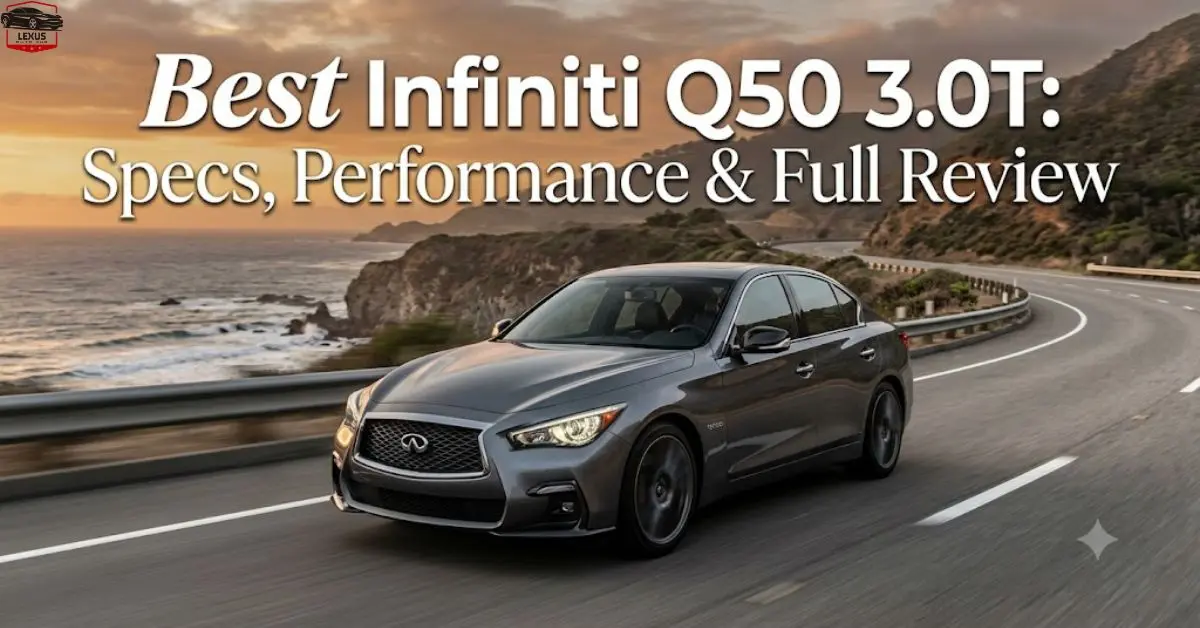
Best Infiniti Q50 3.0T: Specs, Performance & Full Review
The luxury sports sedan market has always been a tough space to crack. German automakers have dominated this segment for decades, and breaking into that circle requires something genuinely special. Infiniti managed to do exactly that when they released the Infiniti Q50 3.0T.
This car brought twin-turbocharged power, rear-wheel drive dynamics, and a polished interior to a segment where buyers expect nothing less than perfection. Whether you are shopping for a used example or just want to understand what makes this sedan tick, this full review covers everything you need to know.
Also Read: 2023 Honda Pilot EX-L 8 Passenger: Specs & Features Guide
Short Answer About Infiniti Q50 3.0T
The Infiniti Q50 3.0T is a luxury sports sedan powered by a twin-turbocharged 3.0-liter V6 engine that delivers strong performance and refined driving dynamics. It offers a premium interior, advanced technology, comfortable seating, and available all-wheel drive for enhanced confidence on the road.
Combining sporty performance with everyday practicality, the Q50 3.0T remains a popular choice for drivers seeking a balance of luxury, power, and modern features.
Background: Where the Infiniti Q50 3.0T Comes From
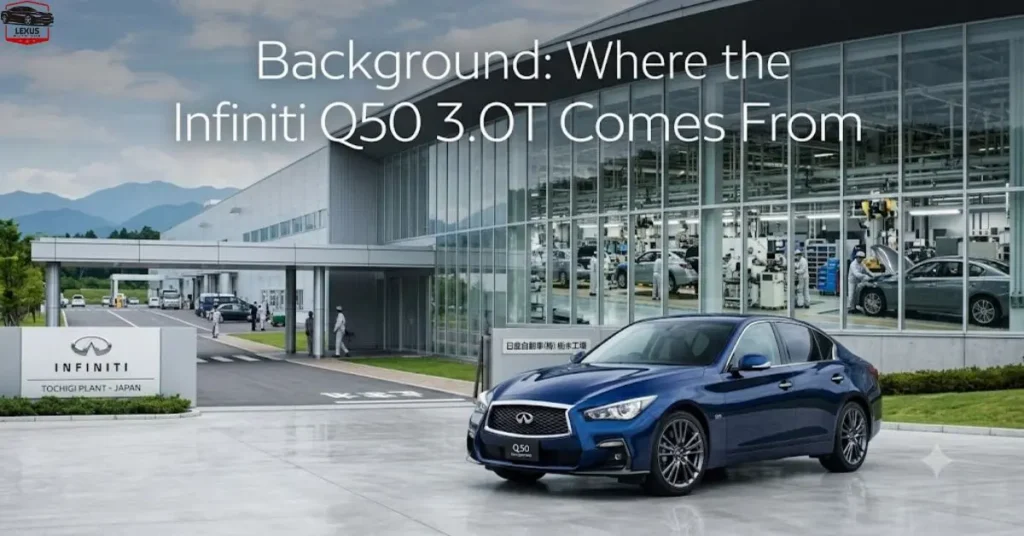
The Q50 originally launched in 2013 as a replacement for the long-running G37 sedan. For its first few years, it used a naturally aspirated 3.7-liter V6, which was a decent engine but not exactly exciting by modern standards. Infiniti knew they needed more bite in the engine bay, so in 2016 they introduced the twin-turbocharged 3.0-liter V6 — giving birth to the Infiniti Q50 3.0T that we know and talk about today.
This engine swap was a significant move. Turbocharging allowed Infiniti to extract more power from a smaller displacement, improve throttle response at lower RPMs, and give drivers a broader powerband to work with during everyday driving. The result was a car that felt genuinely quick when you pushed it, yet remained composed and refined in city traffic.
Over the years, Infiniti offered this engine in multiple output tiers: 300 horsepower and 400 horsepower versions. The 300hp model targets daily driver types who want performance without the fuel penalty, while the 400hp Red Sport trim targets enthusiasts who want to eat up highway miles with authority.
Also Read: Best Stormy Sea Santa Fe 2023: Photos, Specs & Features
Infiniti Q50 3.0T Engine Specs and Technical Details
At the heart of the Infiniti Q50 3.0T sits a 3.0-liter twin-turbocharged V6 engine. This is the same basic architecture that Infiniti shared with Mercedes-Benz during their period of technical partnership, though Infiniti tuned it specifically for their own character and driving philosophy.
The standard 300hp variant produces 295 lb-ft of torque, which is available from a relatively low 1,600 RPM. This means the car does not feel sluggish off the line — torque arrives early and carries you smoothly into the mid-range.
The 400hp Red Sport version takes things further with 350 lb-ft of torque, making it one of the most powerful sedans in its price bracket during its production run.
Power is sent through a 7-speed automatic transmission. The gearbox is responsive enough for spirited driving and pairs nicely with the paddle shifters mounted behind the steering wheel. It does not have the dual-clutch snappiness of some competitors, but it shifts cleanly and intelligently in everyday use.
Rear-wheel drive comes standard, which is the proper setup for a sports sedan. All-wheel drive is available as an option for buyers in colder climates or those who want added traction security during wet weather driving.
Performance Numbers That Matter

Numbers on a spec sheet only tell part of the story, but they still matter. The Infiniti Q50 3.0T in 300hp form completes the 0 to 60 mph sprint in around 5.1 seconds. That is genuinely quick for a full-size luxury sedan. Step up to the 400hp Red Sport, and that time drops to approximately 4.5 seconds — placing it firmly in sports car territory.
Top speed is electronically limited to around 155 mph, which is the same ceiling you find on most performance-oriented sedans. In real-world driving, the engine feels strongest between 2,000 and 5,500 RPM, and the twin turbos do a respectable job of minimizing lag at the bottom of the rev range.
Braking performance is solid on standard models and improves further on Red Sport trims, which get Brembo brakes at the front. The stopping distances are competitive, and the pedal feel is consistent under hard use — something that cannot be said for every sport sedan in this price range.
Fuel economy sits around 20 mpg in city conditions and 29 mpg on the highway for the 300hp version. Those numbers are acceptable for a twin-turbocharged V6 but not class-leading. The 400hp variant is expectedly thirstier, returning around 19 city and 26 highway. If fuel efficiency is your priority, the Infiniti Q50 3.0T is not the ideal choice, but it is not a gas guzzler either.
Also Read: 2023 Nissan Sentra SV Blue: Stunning Look & Features
Exterior Design: Understated but Purposeful
Infiniti has always had a design philosophy rooted in flowing curves and organic shapes rather than sharp, angular lines. The Q50 reflects this clearly. The front fascia is dominated by a wide, crescent-cut grille that looks assertive without being aggressive. LED headlights on higher trims give it a premium presence, especially at night.
The body lines along the sides are subtle but well-executed. The car has a fastback-like roofline that gives it a sporty profile without compromising rear headroom too badly. Overall length sits at 184.6 inches, which puts it on the compact end of the luxury sedan spectrum — smaller than a BMW 5 Series but similar in scale to a BMW 3 Series or Audi A4.
The Red Sport 400 adds a more aggressive body kit, larger wheels, and quad exhaust tips that signal the extra performance underneath. Standard models look clean and professional. Neither version looks dated even now, which speaks well of Infiniti’s designers.
Interior Quality and Technology Inside the Q50 3.0T
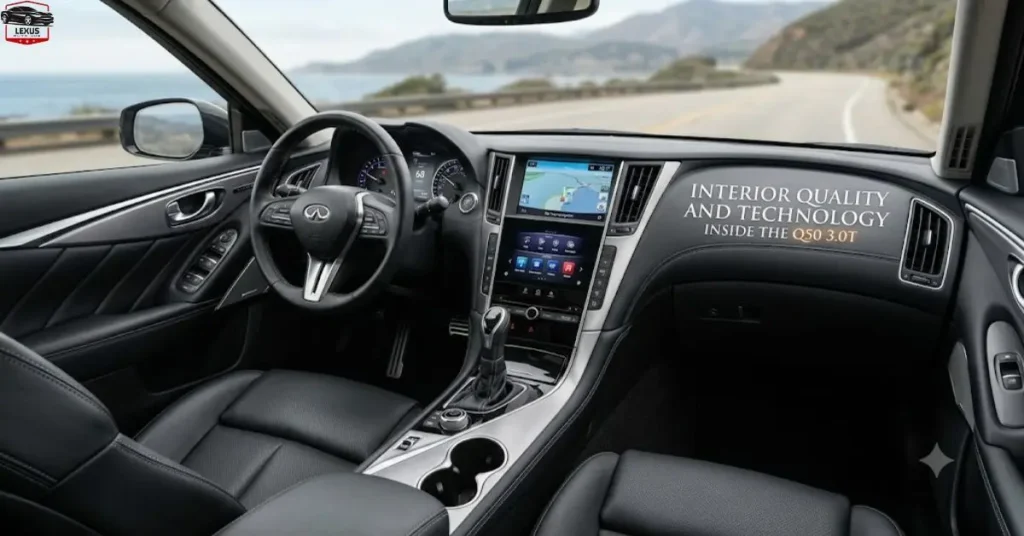
Step inside an Infiniti Q50 3.0T and you are greeted by a cabin that tries hard to justify the luxury badge. The dual-screen infotainment setup in the center console is one of the first things you notice.
The upper screen handles navigation and media, while the lower screen manages climate and other secondary functions. It was an interesting layout when it launched, though some critics felt the system could be difficult to use without taking your eyes off the road.
Leather seating is standard across most trims, and the front seats offer good lateral support for spirited driving. The driver’s seat has a range of electrical adjustments, and the steering wheel can be positioned comfortably for most body types. Rear seat space is adequate for two adults but can feel tight for three across, especially on longer journeys.
Materials quality is generally very good. Soft-touch surfaces cover most touchpoints, wood trim accents add warmth to the cabin, and the overall build quality feels solid. Where some rivals like the Audi A4 edge slightly ahead is in the precision of panel gaps and consistency of materials throughout. The Q50 is not far behind, but the difference is noticeable if you spend time in both cars.
The Bose premium audio system available on higher trims sounds excellent, with clear separation and strong bass reproduction. Technology features include a 360-degree camera system, blind spot monitoring, forward emergency braking, lane departure warning, and adaptive cruise control — all features that were genuinely premium when this car was at its height.
Also Read: 2020 Jeep Wrangler Unlimited Sport Altitude: Specs & Review
Driving Dynamics and Handling Character

This is where the Infiniti Q50 3.0T earns its place in the conversation. Infiniti made a controversial decision when they introduced their Direct Adaptive Steering system — an electronically controlled steering setup that decouples the steering wheel from the front wheels at low speeds. The intention was to filter out road imperfections and reduce driver fatigue on long trips.
The reality was mixed. Many drivers found the system to feel artificial and disconnected, particularly around the center position where steering feel is most critical. Infiniti addressed this with updates over time, and later models with the improved system feel more natural.
If you are shopping used examples, it is worth seeking out a 2018 or newer model where the steering refinements are most noticeable.
Handling itself is properly good. The rear-wheel drive chassis is balanced and responsive. Body roll is well controlled without making the ride feel overly harsh, and the car transitions between corners with confidence. Sport and Sport+ modes firm up the dampers and sharpen throttle response, making the car noticeably more engaging when you want it to be.
In Comfort mode, the Infiniti Q50 3.0T settles into a smooth, long-distance cruising character that makes it easy to live with daily. This dual personality — relaxed commuter by day, quick and engaging by weekend — is one of its most appealing traits.
Available Trim Levels and What They Offer
Infiniti offered the Infiniti Q50 3.0T across several trim levels to cater to different buyers. Here is a breakdown of the main tiers:
Pure: The entry point for the 3.0T lineup. It comes with 300 horsepower, cloth and leather seating, dual-screen infotainment, and a solid list of safety features. This trim gives you the twin-turbo engine without a lot of extras, keeping the price accessible.
Luxe: Adds genuine leather throughout, wood trim upgrades, power-folding mirrors, and upgraded audio. This is the trim most buyers tend to choose as it strikes a strong balance between features and value.
Sport: Focuses on the driving experience with sport-tuned suspension, larger 19-inch wheels, sport seats with extra bolstering, and a sportier steering rack tune. Still uses the 300hp engine.
Red Sport 400: The flagship performance model. This is where you get the 400 horsepower version of the engine, Brembo front brakes, Sport+ driving mode, unique exterior styling, and the most aggressive suspension tune in the lineup. For enthusiasts, this is the one to have.
Also Read: Best 2023 Toyota Tacoma SR5 Double Cab: Specs & Review
Reliability and Ownership Experience
The Infiniti Q50 3.0T has a reasonable reliability record, though it is not without its quirks. The twin-turbo engine itself has proven durable when maintained properly. Regular oil changes with the correct specification oil are important, as turbocharged engines are more sensitive to oil quality than naturally aspirated units.
The Direct Adaptive Steering system has been a source of concern for some owners, particularly in early production years. Electrical issues with the steering system have been reported, and replacement costs can be significant.
This is worth investigating if you are buying a used example — check whether any steering-related recalls or updates have been completed.
The infotainment system, while functional, is showing its age compared to newer rivals. Software updates from Infiniti have been limited compared to what some competitors offer. If cutting-edge connected technology is important to you, this is a factor to weigh carefully.
Overall cost of ownership is moderate for the luxury segment. Parts and servicing are generally more affordable than comparable German alternatives, which is a meaningful advantage for buyers who plan to hold onto the car for several years. Independent shops with Infiniti or Nissan experience can service these cars competently and at lower rates than the dealer.
How the Infiniti Q50 3.0T Compares to Its Rivals

In a segment populated by the BMW 3 Series, Mercedes C-Class, Audi A4, and Cadillac CT5, the Infiniti Q50 3.0T holds its ground in meaningful ways. It offers more standard power than most base-spec rivals, a more distinct design identity than the sometimes conservative European offerings, and a lower purchase price — both new and used.
Where it loses ground is in interior technology freshness and the brand perception gap. BMW and Mercedes carry stronger resale values and broader dealer networks globally. Infiniti’s appeal is strongest in North America where the brand has established a solid service infrastructure.
Against the Cadillac CT5, the Q50 is competitive on performance but trades a more driver-focused dynamics package against the Cadillac’s more polished interior presentation. Neither choice is wrong — it comes down to priorities.
Also Read: Best 2023 Toyota Tacoma SR5 Double Cab: Specs & Review
Who Should Buy the Infiniti Q50 3.0T?

The Infiniti Q50 3.0T makes the most sense for a specific type of buyer. If you want genuine twin-turbo performance in a rear-wheel drive luxury sedan, want to stand out slightly from the sea of German alternatives, and want to keep ownership costs manageable — this car deserves serious consideration.
It works particularly well as a used purchase. Depreciation on Infiniti products tends to be steeper than German rivals, which means you can find well-equipped examples at strong value. A 2018 to 2022 Q50 Red Sport 400 with reasonable mileage represents one of the best performance bargains in the used luxury car market today.
Buyers who prioritize the absolute latest infotainment technology, maximum brand prestige, or the sharpest possible steering feel might be better served elsewhere. But for the driver who wants to cover ground quickly, in comfort, with a car that does not quite blend in — the Q50 3.0T is a very satisfying choice.
My Final Thoughts:
The Infiniti Q50 3.0T is a car that rewards those willing to look past the badge and evaluate it on its actual merits. The twin-turbo V6 is a strong, characterful engine that delivers real-world performance across a wide variety of driving situations.
The chassis is genuinely balanced and enjoyable to push, the interior quality is high, and the overall package is one that holds up well even years after its introduction.
It is not a perfect car.
The steering controversy is real, though largely resolved in later models. The infotainment has not aged gracefully. And Infiniti’s brand presence in some markets is still not quite at the level of its German competitors. But none of these drawbacks are deal-breakers for the right buyer.
If your priority is driving enjoyment, a compelling engine, and a luxury car that delivers more than its asking price suggests — the Infiniti Q50 3.0T earns a strong recommendation.
It is the kind of car that makes you look forward to your daily commute, and that is not something every luxury sedan can honestly claim.
FAQs
What is the Infiniti Q50 3.0T?
The Infiniti Q50 3.0T is a luxury sports sedan that combines premium comfort with strong turbocharged performance. It is designed for drivers who want an upscale interior, advanced technology, and an engaging driving experience while maintaining everyday practicality.
What engine does the Infiniti Q50 3.0T have?
The Infiniti Q50 3.0T is powered by a 3.0-liter twin-turbocharged V6 engine that delivers impressive acceleration and responsive performance. Depending on the model year and trim, power output may vary, but it is known for offering a strong balance of speed and refinement.
Is the Infiniti Q50 3.0T good for daily driving?
Yes, the Infiniti Q50 3.0T is well-suited for daily use. It offers a comfortable cabin, smooth highway performance, modern technology features, and a quiet ride while still providing sporty handling and powerful acceleration.
What features are available in the Infiniti Q50 3.0T?
The Q50 3.0T includes features such as leather-appointed seating, touchscreen infotainment, smartphone connectivity, premium audio options, navigation on select trims, dual-zone climate control, and a range of advanced driver-assistance technologies.
Does the Infiniti Q50 3.0T offer all-wheel drive?
Yes, many Infiniti Q50 3.0T models are available with Intelligent All-Wheel Drive (AWD), providing improved traction and stability in various road and weather conditions while maintaining confident performance.

I’m M Ahmad Ansari, a Lexus enthusiast with 5+ years of hands-on experience across the entire lineup—from the RC F’s roaring V8 to the whisper-quiet RZ electric. I understand what separates Japanese luxury from the rest: obsessive engineering, unmatched reliability, and that refined driving feel you can’t find anywhere else. Whether it’s F Sport performance packages, hybrid technology, or choosing between new and certified models, I bring real-world knowledge and genuine passion for what makes Lexus exceptional.