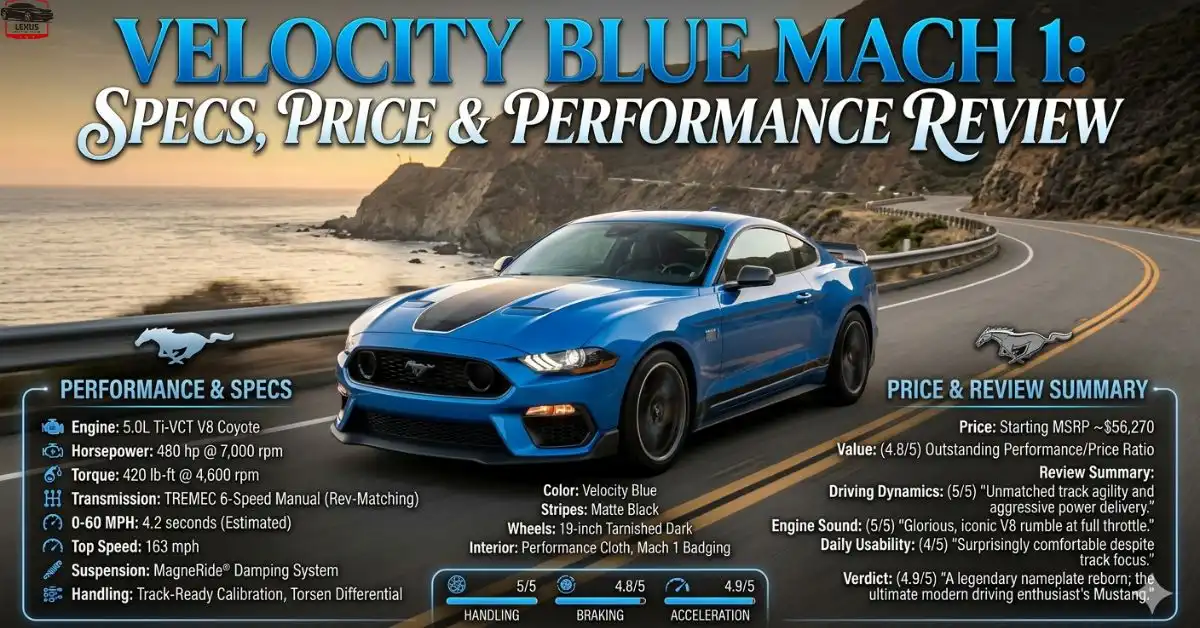
Velocity Blue Mach 1: Specs, Price & Performance Review
Of all the colors available for the 2021 Ford Mustang Mach 1, none captured the car’s character more completely than Velocity Blue. It is not a subtle color. It does not blend into traffic or park quietly beside office buildings without drawing attention.
The Velocity Blue Mach 1 is bold in exactly the way the car itself is bold — purposeful, distinctly American, and impossible to look at without feeling something. With the wide flat black stripe running up the hood, the four massive exhaust tips at the rear, and that deep, metallic blue sitting over aggressive Mach 1-specific bodywork, the Velocity Blue color transforms an already striking automobile into something genuinely memorable.
But color is decoration. What makes the Velocity Blue Mach 1 worth writing about — and worth owning — is everything underneath that paint. The 480-horsepower naturally aspirated 5.0-liter Coyote V8. The Tremec 3160 six-speed manual transmission borrowed directly from the Shelby GT350. The MagneRide adaptive dampers. The Brembo brakes.
The borrowed aerodynamics, cooling hardware, and suspension pieces from two of the most capable Mustangs ever built. Ford called it the most track-capable 5.0-liter Mustang ever made, and after spending time with one, that description is not marketing hyperbole — it is an accurate assessment.
This review covers everything: the full spec sheet, the engine and powertrain details, the transmission options and their real-world differences, the handling package and what it actually changes, the interior, the pricing structure, and an honest verdict on who the Velocity Blue Mach 1 is for and why it deserves serious consideration from anyone shopping in this segment.
Also Read: 2020 Hyundai Elantra Red: Specs, Price & Best Deals Guide
Velocity Blue Mach 1: The Mach 1 Nameplate and What It Means
The Mach 1 nameplate has a specific meaning in Mustang culture that the 2021 revival had to honor or risk the kind of backlash that automotive enthusiasts deliver without mercy. The original Mach 1 debuted in 1969 as a performance-oriented Mustang that sat between the base pony car and the more aggressive Shelby variants.
It combined visual aggression with genuine mechanical upgrades — not a mere appearance package, but a car with a real performance identity. The nameplate ran through the early 1970s, disappeared, briefly returned in 2003 and 2004, and then went dormant again until Ford chose to revive it for 2021.
The 2021 revival had specific context. Ford discontinued the Bullitt Mustang and the GT350 after 2020, leaving a meaningful gap between the standard Mustang GT and the supercharged GT500. The Velocity Blue Mach 1 fills that gap precisely — more capable and more purposeful than the GT, significantly more accessible than the GT500, and honest enough in its engineering to carry the Mach 1 legacy without embarrassing it.
Ford’s Director of Icons Dave Pericak described the Mach 1 as a “parts bin” car only in the sense that it borrowed from the best parts available in the Mustang ecosystem. The engine and clutch from the GT. The Tremec transmission from the GT350.
The suspension tuning, rear axle cooling, and aerodynamic work from the GT350 and GT500. What matters is not where the parts came from — it is how they were integrated. And in the Velocity Blue Mach 1, they were integrated with clear intent and genuine coherence.
Also Read: 2023 GMC Yukon XL AT4 Review: Specs, Features & Best Deals
Velocity Blue Mach 1: Engine, Powertrain, and Performance Numbers
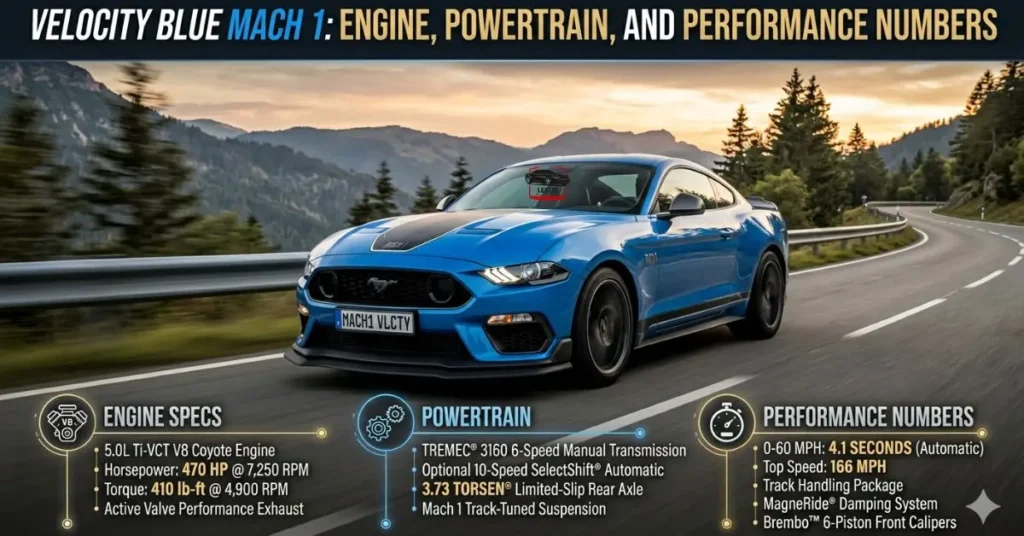
The heart of the Velocity Blue Mach 1 is the 5.0-liter naturally aspirated Coyote V8 engine, producing 480 horsepower at 7,000 rpm and 420 lb-ft of torque. The extra 20 horsepower over the standard Mustang GT comes from two specific changes: the addition of the GT350’s intake manifold and calibration changes to the engine management system.
These are not trivial modifications — the GT350’s intake manifold is a higher-flowing unit that allows the engine to breathe more freely at the top of the rev range, where the additional 20 horsepower is most noticeable.
What makes the Mach 1’s power delivery unique is its naturally aspirated character. There is no turbocharger lag, no supercharger whine, no artificial sharpness to the power curve. The Coyote V8 in this configuration pulls smoothly from idle, builds momentum through the midrange, and then accelerates with genuine urgency as the revs climb toward the 7,500-rpm redline.
Also Read: 2016 Jeep Grand Cherokee Limited 75th Anniversary Specs
The sound that accompanies that climb is one of the best naturally aspirated V8 sounds available in a production car at this price — deep at low revs, howling and purposeful as the engine approaches its limit.
The standard transmission in the Velocity Blue Mach 1 is the Tremec TR-3160 six-speed manual, borrowed directly from the Shelby GT350. This is a meaningfully better transmission than the Getrag MT-82 unit that comes in the standard Mustang GT.
The Tremec has a shorter throw, a more precise gate, and a clutch feel that communicates well with the driver. It comes with rev-matching standard — a feature that blips the throttle on downshifts to match revs and provide smoother transitions — which is the correct way to implement the feature on a performance car.
You can turn it off if you want to heel-and-toe yourself, but the Mach 1’s rev-matching calibration is good enough that most drivers will leave it on most of the time. The optional 10-speed Select Shift automatic transmission adds an upgraded torque converter, an additional oil cooler, and unique transmission calibration compared to the GT’s automatic.
It is a capable unit, particularly with paddle shifters in manual mode, but most buyers who choose the Velocity Blue Mach 1 for its performance character will find the Tremec manual the more rewarding choice.
The automatic does make the Mach 1 more accessible as a daily driver and is the faster transmission in measured acceleration testing — but the manual makes the car feel more connected and more alive in everyday driving.
On performance numbers, the Mach 1 delivers what the spec sheet suggests. Zero to 60 mph in approximately 4.2 to 4.4 seconds depending on conditions and transmission choice. The quarter mile in approximately 12.5 to 12.7 seconds at around 115 mph.
The manual transmission Bullitt — which shared identical engine output — ran 0-60 in 4.3 seconds and the quarter mile in 12.6 seconds at 115 mph in Car and Driver testing, and the Mach 1’s better aerodynamics and suspension setup place it at or slightly ahead of those figures.
Also Read: Dark Sky Metallic GMC Yukon: Best Color, Review & Details
Velocity Blue Mach 1: Full Specs at a Glance
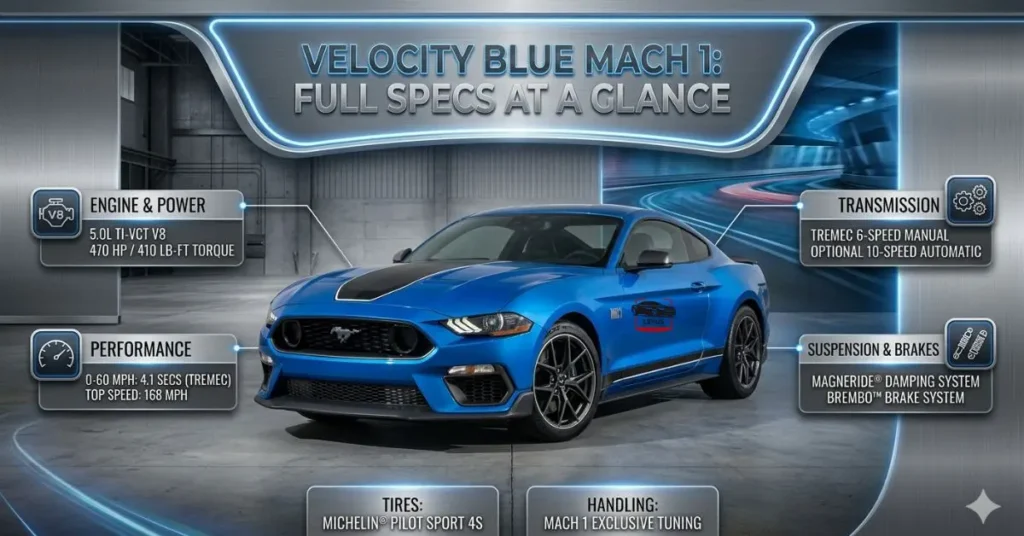
- Base MSRP (6-speed manual): $54,595
- Base MSRP (10-speed automatic): $55,190
- As-tested price (tested example): $58,490
- Engine: 5.0-liter Coyote V8 naturally aspirated
- Horsepower: 480 hp at 7,000 rpm
- Torque: 420 lb-ft at 4,600 rpm
- Standard transmission: Tremec TR-3160 6-speed manual with rev-matching
- Optional transmission: 10-speed SelectShift automatic with paddle shifters
- Drivetrain: Rear-wheel drive
- 0-60 mph: approximately 4.2–4.4 seconds
- Quarter mile: approximately 12.5–12.7 seconds at 115 mph
- Top speed: 163 mph (electronically limited)
- Fuel economy: 15 city / 23 highway / 18 combined MPG
- Fuel tank capacity: 16 gallons
- Suspension: MagneRide adaptive dampers (standard)
- Front brakes: Brembo 4-piston calipers
- Rear brakes: Brembo single-piston calipers
- Standard wheels: 19×9.5 front / 19×10 rear (Tarnished Dark aluminum)
- Standard tires: 255/40R19 front / 275/40R19 rear (Michelin Pilot Sport 4S)
- Differential: Torsen limited-slip rear differential (standard)
- Seating: 4 passengers
- Length: 188 inches
- Width: 75 inches
- Height: 54 inches
- Curb weight: approximately 3,873 lbs
- Available colors: Iconic Silver, Shadow Black, Oxford White, Velocity Blue, Twister Orange, Race Red, Grabber Yellow
- Powertrain Warranty: 5 years / 60,000 miles
Also Read: 2021 Jeep Cherokee Latitude Plus: Specs, Features & Review
Velocity Blue Mach 1: Suspension, Handling, and the Handling Package
The chassis setup on the Velocity Blue Mach 1 is where the borrowed parts from the GT350 and GT500 make the biggest tangible difference to how the car behaves.
Standard on every Mach 1 are MagneRide adaptive dampers — the same Multimatic DSSV units used in the GT350 — which use magnetorheological fluid to change their damping characteristics in milliseconds based on road conditions and driver inputs. In everyday driving, they provide a balance between compliance and body control that the standard Mustang GT’s suspension cannot match.
Also Read: BMW Southwest Houston: Best Deals & Inventory 2026
On a track or an aggressive back road, they maintain composure during transitions and carry speed through corners with a stability that makes the driver feel more capable than they might otherwise be.
The suspension geometry is also specifically tuned for the Mach 1 — not simply borrowed wholesale from the GT350 but recalibrated for the Mach 1’s specific weight and intended use. The power steering calibration is unique to the Mach 1, providing a heavier, more communicative steering feel than the standard GT.
The antilock brake and stability control calibrations are also specific to the Mach 1, reflecting its more track-oriented character. The optional Handling Package, priced at $3,750 and available only with the manual transmission, transforms the Velocity Blue Mach 1 into a genuinely serious track tool.
The package adds a larger front splitter that provides 150 percent more front downforce than the Mustang GT Performance Pack — a meaningful aerodynamic improvement that changes how the front end behaves at speed. A larger rear wing, rear tire spats from the GT500, adjustable strut top mounts, and wider tires round out the package.
Tire sizes jump to 305/30R19 front and 315/30R19 rear with the Handling Package — significantly more rubber on the road than the standard configuration. The Handling Package also allows deletion of the rear seat, saving weight for track-day use.
The result of the Handling Package is a Mach 1 that approaches GT350 performance levels at a lower price point. Motor Authority described a full day of testing at Willow Springs Raceway as revealing not a parts-bin assembly but a “cohesive and track-ready Mustang that hits the sweet spot at the performance end of the Mustang lineup.”
That is precisely the correct characterization. The Velocity Blue Mach 1 with the Handling Package is the version of this car that will be remembered and collected — the one that makes the strongest case for its existence as a distinct performance model rather than a visual package.
Even without the Handling Package, the standard suspension of the Velocity Blue Mach 1 is among the most capable configurations available in a production Mustang at its price. The Torsen limited-slip rear differential — standard equipment — manages power distribution efficiently out of corners and provides the kind of traction confidence that allows drivers to use the car’s performance without constantly managing wheelspin.
Also Read: Best Scat Pack Black: R/T & Performance Specs Guide 2026
Velocity Blue Mach 1: Exterior Design and Why the Color Works
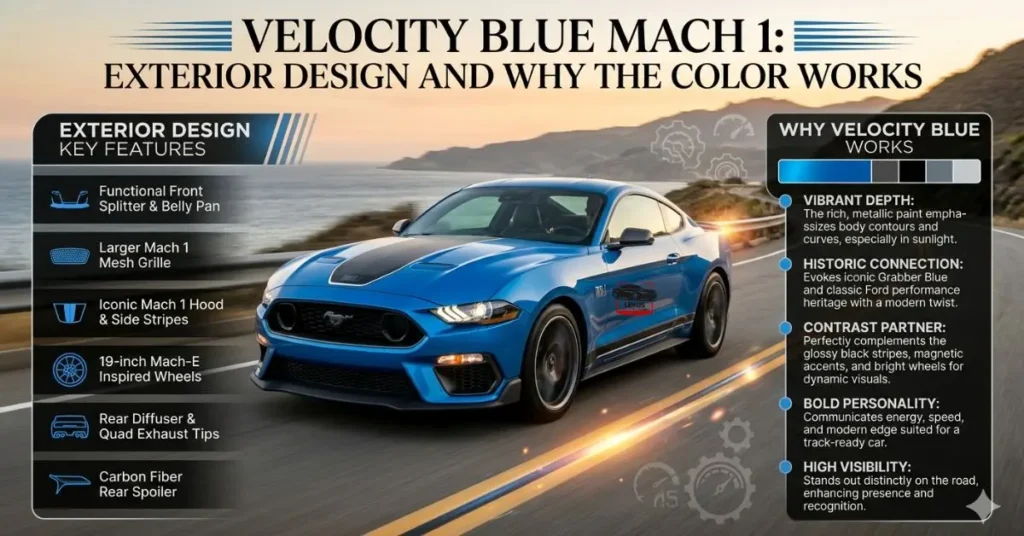
Choosing between the seven available colors for the Velocity Blue Mach 1 is a genuinely consequential decision because this car’s exterior has enough visual presence that the wrong color can mute its character. Velocity Blue, which was listed as the official color of the tested vehicle in multiple professional reviews, is widely considered the best color choice for the Mach 1 — and there is good reason for that consensus.
The color is a deep, metallic blue that shifts perceptibly between cooler blue-gray tones in shade and a richer, more saturated blue in direct sunlight. It sits on the Mach 1’s bodywork — which includes a unique front fascia with functional corner air vents, a reshaped hood with functional heat extractors, and a lower rear diffuser with four massive exhaust tips — with exactly the kind of weight and presence that the car’s performance pedigree deserves.
Also Read: Dodge Scat Pack 2020: Review, Best Specs & Price Guide
The wide flat black hood stripe, which runs from the leading edge of the hood to the roof, creates a strong graphic element against the blue that reads as aggressive without being cartoonish. The functional nature of the hood stripe — it follows the same path as the heat exchanger vents rather than existing purely for appearance — gives the exterior a purposeful honesty that buyers notice even if they cannot immediately articulate why.
The 19-inch Tarnished Dark painted aluminum wheels are a design callback to the Magnum 500-style wheels of the original 1969 Mach 1, and on Velocity Blue they provide exactly the right amount of visual contrast. The Brembo brake calipers behind those wheels are painted red — another detail that works particularly well against blue paint, creating a color story that references the classic American performance palette without feeling retro or forced.
Mach 1 badging sits on each front fender, and the heritage-inspired graphics package is executed with enough subtlety to avoid the over-badged feeling that afflicts some limited-edition vehicles. The Velocity Blue Mach 1 looks fast standing still and looks exactly as fast as it is once you have driven it — which is the correct relationship between appearance and performance.
Velocity Blue Mach 1: Interior, Technology, and Daily Usability
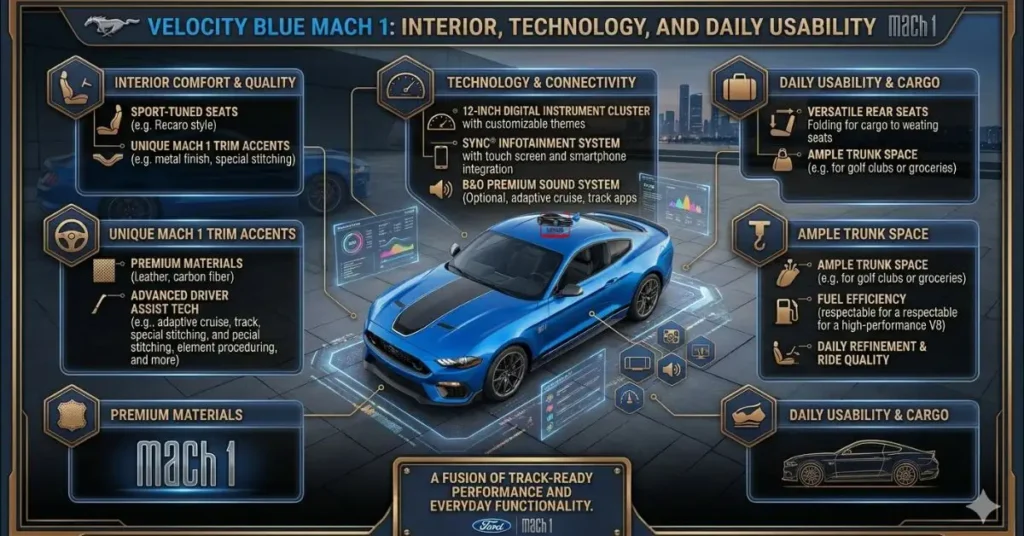
The interior of the Velocity Blue Mach 1 reflects the car’s performance orientation without completely sacrificing daily comfort. The front seats are supportive and well-bolstered — a meaningful distinction from standard Mustang GT seats — providing the lateral support necessary during spirited driving while remaining comfortable for highway commuting.
The standard interior color on most Mach 1 configurations is Ebony, though the appearance package brings an Ebony and orange combination with orange Mach 1 identification stitching.
The instrument cluster is one of the more driver-focused in the industry — a 12-inch digital LCD display that is configurable through several display modes, with a performance cluster mode that shows large analog-style gauges for speed, RPM, and oil temperature, supplemented by additional data channels for performance monitoring.
The center stack is anchored by Ford’s SYNC 3 infotainment system on an 8-inch touchscreen that supports both Apple CarPlay and Android Auto wirelessly. The system is responsive and logical — one of the better interfaces in Ford’s lineup from the era — though it has since been succeeded by the larger screens of the current Mustang generation.
The active exhaust system — standard on the Mach 1 — is worth discussing as a technology feature because it meaningfully changes the car’s daily character. The exhaust includes four selectable modes through the touchscreen or steering wheel controls: Normal, Sport, Track, and Quiet.
Quiet mode is genuinely functional — it reduces exhaust noise to a level that allows early-morning departures from residential neighborhoods without waking everyone on the street. Track mode removes any electronic muffling and lets the 5.0-liter V8 sing at full volume.
Sport provides the in-between setting that most owners use for normal driving. The calibration across modes is well-executed and does not sound artificial in any position.
Daily usability in the Velocity Blue Mach 1 is reasonable for a focused performance coupe. Rear seat access and space are limited by the long, low body, but front occupants have adequate room for extended drives.
The trunk is 13.5 cubic feet — generous for a sports car — and the folding rear seats extend cargo flexibility when you remove the occasional passenger burden. Fuel economy of 15 city and 23 highway is not exceptional but is acceptable for 480 naturally aspirated horsepower, and real-world highway driving typically returns 21 to 23 mpg under relaxed conditions.
Velocity Blue Mach 1: Cooling, Braking, and Track-Specific Hardware
One of the most technically interesting aspects of the Velocity Blue Mach 1 is the thermal management hardware borrowed from the GT500. Ford included a rear axle cooling system — a feature carried over from the supercharged GT500 — that prevents rear differential temperatures from building up during sustained track use.
This is not cosmetic heritage. It is real engineering that allows the car to run multiple aggressive laps without the thermal limitations that would otherwise degrade performance.
The Mach 1 also introduced brake-cooling ramps as a first for any production Mustang. These ramps direct airflow to the front brake rotors and calipers during track driving, managing the temperature of the Brembo brakes under repeated hard braking events.
Brake fade is one of the most common limiting factors for street cars during track days, and the brake-cooling ramps directly address that limitation in a way that previous Mustangs — including the GT350 — did not.
Two side heat exchangers are also included in the Velocity Blue Mach 1’s thermal management system, managing engine oil temperature during sustained high-speed driving.
Combined with the rear axle cooling and brake cooling systems, the Mach 1’s thermal architecture allows it to run harder for longer than almost any other 5.0-liter Mustang before it — which is why Ford’s own engineers called it the most track-capable 5.0-liter Mustang ever made. That is a specific and defensible claim backed by specific and real engineering choices.
The Brembo brakes — four-piston front calipers and single-piston rear — provide excellent stopping power and a firm, communicative pedal feel that inspires confidence during both everyday driving and track sessions.
The pedal travel is consistent and progressive, allowing precise modulation in threshold braking situations. Combined with the MagneRide suspension’s stability under hard braking and the Torsen differential’s traction management, the Velocity Blue Mach 1 provides a complete system of go, stop, and turn capability that significantly exceeds what any individual component spec suggests.
Velocity Blue Mach 1: Pricing, Value, and Used Market
The Velocity Blue Mach 1 entered the market at a base price of $54,595 for the manual transmission version and $55,190 for the automatic, before destination charges. A fully optioned example with the Handling Package, premium audio, and other additions reached approximately $58,000 to $62,000 as tested.
Those numbers positioned the Mach 1 directly in the performance sweet spot of the Mustang lineup — meaningfully above the Mustang GT at $36,000 to $40,000, and meaningfully below the supercharged GT500 starting near $74,000.
The value equation of the Velocity Blue Mach 1 is strong for buyers who understand what they are getting. The Tremec transmission alone — which would cost thousands as an aftermarket replacement — is standard equipment. The MagneRide dampers add thousands in value.
The GT350 intake manifold, the thermal management hardware, the Brembo brakes, and the Handling Package’s aerodynamic upgrades all represent real performance value that cannot be replicated on a standard GT for anywhere near the price difference.
Multiple automotive publications noted that the Mach 1 represented better performance value than both the car it replaced (the Bullitt) and the car it approached (the GT350).
In the used market as of 2026, the Mach 1 has depreciated modestly relative to its original MSRP. Examples with the Handling Package and low mileage command prices in the $42,000 to $52,000 range depending on condition and specification.
Velocity Blue examples carry a slight premium in some markets due to color popularity. For used buyers, the Velocity Blue Mach 1 with the Handling Package and the Tremec manual represents perhaps the strongest performance-per-dollar Mustang available in the used market at any price below the GT500.
Velocity Blue Mach 1: Pros and Cons
Pros:
- 480 naturally aspirated horsepower — no turbo lag, pure V8 character
- Tremec TR-3160 transmission from the GT350 is genuinely excellent
- MagneRide adaptive dampers standard — among the best in class
- Velocity Blue color is visually exceptional with the Mach 1’s body graphics
- Thermal management hardware (rear axle cooling, brake cooling ramps) enables real track use
- Brembo four-piston front brakes provide confident, fade-resistant stopping power
- Handling Package transforms the car into a legitimate track tool
- Active exhaust system with Quiet mode makes daily driving considerate
- Torsen limited-slip differential standard
- 150% more front downforce than GT Performance Pack with Handling Package
- Future collectible status — the last naturally aspirated Mach 1 before electrification
Cons:
- Handling Package only available with manual transmission — automatic buyers miss out
- Rear seat access and space are limited
- Fuel economy of 15 city / 23 highway requires premium fuel
- Heavier than the GT350 it was meant to replace
- SYNC 3 infotainment has been succeeded by newer systems
- Available in only two model years (2021-2023) — production is now complete
My Final Thoughts:
The Velocity Blue Mach 1 is the right car for a specific and well-defined buyer. If you want a naturally aspirated V8 performance Mustang with a genuine manual transmission, real track capability from the factory, an appearance that turns heads without requiring explanation, and a future collectible status that is already beginning to establish itself in the enthusiast community — this is your car.
The Mach 1 nameplate’s history, the limited production window of 2021-2023, and the likelihood that the next generation Mustang will not offer this exact combination of naturally aspirated V8 power and analog driving experience make the Mach 1 one of those rare modern cars that appreciates in significance as time passes.
The Velocity Blue color specifically is worth the choice. It photographs exceptionally, ages without looking dated, and carries the car’s performance character in a way that the more subdued Shadow Black or Oxford White configurations do not. When someone parks a Velocity Blue Mach 1 with the hood stripe and the Brembo brakes visible, the question is not “what is that?” — it is “how do I get one?” That quality of a car is worth more than any spec number.
Buyers who should look elsewhere include those who need four doors, those who want AWD capability, and those who prioritize maximum horsepower above all else. The GT500’s 760 supercharged horsepower makes everything else feel modest by comparison, and at used-market prices, the gap between the two has narrowed enough to deserve consideration.
But for the enthusiast who values the complete driving experience — the sound of a naturally aspirated V8, the feel of a precision manual transmission, the confidence of suspension hardware that came from two of Ford’s most capable Mustangs — the Velocity Blue Mach 1 represents one of the last, best expressions of that experience in a production Mustang. It deserves to be remembered, driven, and celebrated for exactly that reason.
FAQs
What is the Velocity Blue Mach 1?
The Velocity Blue Mach 1 is the 2021-2023 Ford Mustang Mach 1 finished in Velocity Blue — a deep metallic blue that was one of seven available colors and widely regarded as the most visually distinctive choice for the Mach 1’s specific bodywork and graphics package.
How much horsepower does the Velocity Blue Mach 1 have?
The Velocity Blue Mach 1 produces 480 horsepower and 420 lb-ft of torque from its naturally aspirated 5.0-liter Coyote V8, which is 20 horsepower more than the standard Mustang GT thanks to the GT350’s intake manifold and engine management calibration.
What transmission does the Velocity Blue Mach 1 use?
The standard transmission is the Tremec TR-3160 six-speed manual borrowed from the Shelby GT350, with rev-matching standard. A 10-speed SelectShift automatic is available as an option, though the Handling Package is only available with the manual.
What is the Mach 1 Handling Package?
The Handling Package ($3,750, manual only) adds a larger front splitter providing 150% more front downforce, wider 305/30R19 front and 315/30R19 rear tires, adjustable strut top mounts, a larger rear wing, and GT500 rear tire spats. It is the configuration most recommended for track use.
What was the original price of the Velocity Blue Mach 1?
The Mach 1 started at $54,595 for the manual transmission and $55,190 for the automatic, before destination charges. As tested examples with the Handling Package and additional options typically ranged from $58,000 to $62,000.

I’m M Ahmad Ansari, a Lexus enthusiast with 5+ years of hands-on experience across the entire lineup—from the RC F’s roaring V8 to the whisper-quiet RZ electric. I understand what separates Japanese luxury from the rest: obsessive engineering, unmatched reliability, and that refined driving feel you can’t find anywhere else. Whether it’s F Sport performance packages, hybrid technology, or choosing between new and certified models, I bring real-world knowledge and genuine passion for what makes Lexus exceptional.